The first day drove the house at a constant speed of 400 meters per minute to...
The first day drove the house at a constant speed of 400 meters per minute to the train station. After the train was 4 minutes away, the second day drove the house at a constant speed of 500 meters per minute to the train station before the train left for 5 minutes. Find the distance from home to the train station.
Homework Answers

Let me know if you need any further clarification on this.
Please upvote the answer if you have understood it.
Add Answer to:
The first day drove the house at a constant speed of
400 meters per minute to...
1)Imagine a train that is 400 meters long in its own inertial reference frame, and a...
1)Imagine a train that is 400 meters long in its own inertial reference frame, and a railway platform is 320 meters long in its own inertial reference frame. The train speeds by the railway platform so fast that, in the platform's reference frame, both the train and platform are exactly the same length. Imagine that the platform station manager is standing exactly in the center of the platform as the train passes by. He notes two events: the engine (front)...
Suppose that busses arrive at a station with constant rate per minute. Conferences 1. Assume that...
 Suppose that busses arrive at a station with constant rate per minute. Conferences 1. Assume that one waits at the station for 5 minutes. (a) Find the probability that there are at least 2 busses within 5 minutes. (b) Find the expectation and variance of the number of busses within 5 minutes
Can someone explain all these questions? B5. In order to go to university a student needs to catch a train at 8:41a.m. every morning. Cycling to the station from home takes the student on average 14 m...
 Can someone explain all these
questions?
B5. In order to go to university a student needs to catch a train at 8:41a.m. every morning. Cycling to the station from home takes the student on average 14 minutes, with a standard deviation of 3 minutes. You can assume that the distribution of trip times is normally distributed and independent between days i) What is the probability that the student's cycle ride to the station will take more than 21 4 marks...
Can someone explain all these
questions?
B5. In order to go to university a student needs to catch a train at 8:41a.m. every morning. Cycling to the station from home takes the student on average 14 minutes, with a standard deviation of 3 minutes. You can assume that the distribution of trip times is normally distributed and independent between days i) What is the probability that the student's cycle ride to the station will take more than 21 4 marks...
S) 20 pts. A freight train that is 700-meters from engine to caboose enters a crossing...
 S) 20 pts. A freight train that is 700-meters from engine to caboose enters a crossing at a speed of 5 km/hr. The local requirements demand that freight trains do not block traffic for more than 4 minutes If the train accelerated at a constant rate: a) What should be the acceleration so that the caboose passes the crossing just 4 minutes after the engine? b) What will be the speed of the train when the caboose passes the crossing?...
A train begins at the origin and moves at constant speed v1=16.1 m/s toward another train...
A train begins at the origin and moves at constant speed v1=16.1 m/s toward another train which is initially at rest at a distance d=108 m from the first train. If the second train has an acceleration of magnitude a2=1.29 m/s2 toward the first train, how far does the first train move before the trains collide? (Hint : use quadratic equation and choose positive time)
A train begins at the origin and moves at constant speed v1=15.2 m/s toward another train...
A train begins at the origin and moves at constant speed v1=15.2 m/s toward another train which is initially at rest at a distance d=164 m from the first train. If the second train has an acceleration of magnitude a2=1.02 m/s2 toward the first train, how far does the first train move before the trains collide? (Hint : use quadratic equation and choose positive time)
A train begins at the origin and moves at constant speed v1=13.1 m/s toward another train...
A train begins at the origin and moves at constant speed v1=13.1 m/s toward another train which is initially at rest at a distance d=264 m from the first train. If the second train has an acceleration of magnitude a2=1.22 m/s2 toward the first train, how far does the first train move before the trains collide? (Hint : use quadratic equation and choose positive time)
A train begins at the origin and moves at constant speed v1=11.7 m/s toward another train...
A train begins at the origin and moves at constant speed v1=11.7 m/s toward another train which is initially at rest at a distance d=152 m from the first train. If the second train has an acceleration of magnitude a2=0.95 m/s2 toward the first train, how far does the first train move before the trains collide? (Hint : use quadratic equation and choose positive time)
Choose the green light first. λ = 5.461 x 10⁻⁷ meters for green Choose lens to...
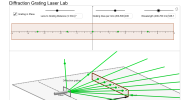 Choose the green light first. λ = 5.461 x 10⁻⁷ meters
for green
Choose lens to “Grating distance” as 7 and
“Grading lines per nm” as 400 nm
Check the button “Grading in place”
Record I1 and I1’ to the table and
calculate an angle as average if you know both I1 and
I1’
(hint from your trig how to get your angle: tan-1
(Opposite / Adjacent) = θ(angle)
Find distance between I’1 and I1 and
divide in half to...
Choose the green light first. λ = 5.461 x 10⁻⁷ meters
for green
Choose lens to “Grating distance” as 7 and
“Grading lines per nm” as 400 nm
Check the button “Grading in place”
Record I1 and I1’ to the table and
calculate an angle as average if you know both I1 and
I1’
(hint from your trig how to get your angle: tan-1
(Opposite / Adjacent) = θ(angle)
Find distance between I’1 and I1 and
divide in half to...
A train begins at the origin and moves at constant speed V1 =18.2 m/s toward another...
 A train begins at the origin and moves at constant speed V1 =18.2 m/s toward another train which is initially at rest at a distance d=242 m from the first train. If the second train has an acceleration of magnitude az=0.99 m/s2 toward the first train, how far does the first train move before the trains collide? (Hint: use quadratic equation and choose positive time) Select one: 245.38 m 302.01 m 75.50 m 188.76 m 132.13 m
 Suppose that busses arrive at a station with constant rate per minute. Conferences 1. Assume that one waits at the station for 5 minutes. (a) Find the probability that there are at least 2 busses within 5 minutes. (b) Find the expectation and variance of the number of busses within 5 minutes
 Can someone explain all these
questions?
B5. In order to go to university a student needs to catch a train at 8:41a.m. every morning. Cycling to the station from home takes the student on average 14 minutes, with a standard deviation of 3 minutes. You can assume that the distribution of trip times is normally distributed and independent between days i) What is the probability that the student's cycle ride to the station will take more than 21 4 marks...
Can someone explain all these
questions?
B5. In order to go to university a student needs to catch a train at 8:41a.m. every morning. Cycling to the station from home takes the student on average 14 minutes, with a standard deviation of 3 minutes. You can assume that the distribution of trip times is normally distributed and independent between days i) What is the probability that the student's cycle ride to the station will take more than 21 4 marks...
 S) 20 pts. A freight train that is 700-meters from engine to caboose enters a crossing at a speed of 5 km/hr. The local requirements demand that freight trains do not block traffic for more than 4 minutes If the train accelerated at a constant rate: a) What should be the acceleration so that the caboose passes the crossing just 4 minutes after the engine? b) What will be the speed of the train when the caboose passes the crossing?...
 Choose the green light first. λ = 5.461 x 10⁻⁷ meters
for green
Choose lens to “Grating distance” as 7 and
“Grading lines per nm” as 400 nm
Check the button “Grading in place”
Record I1 and I1’ to the table and
calculate an angle as average if you know both I1 and
I1’
(hint from your trig how to get your angle: tan-1
(Opposite / Adjacent) = θ(angle)
Find distance between I’1 and I1 and
divide in half to...
Choose the green light first. λ = 5.461 x 10⁻⁷ meters
for green
Choose lens to “Grating distance” as 7 and
“Grading lines per nm” as 400 nm
Check the button “Grading in place”
Record I1 and I1’ to the table and
calculate an angle as average if you know both I1 and
I1’
(hint from your trig how to get your angle: tan-1
(Opposite / Adjacent) = θ(angle)
Find distance between I’1 and I1 and
divide in half to...
 A train begins at the origin and moves at constant speed V1 =18.2 m/s toward another train which is initially at rest at a distance d=242 m from the first train. If the second train has an acceleration of magnitude az=0.99 m/s2 toward the first train, how far does the first train move before the trains collide? (Hint: use quadratic equation and choose positive time) Select one: 245.38 m 302.01 m 75.50 m 188.76 m 132.13 m
Most questions answered within 3 hours.
-
Where is the error in this code sequence?
String s1 = "Hello";
String s2 = "ello";...
asked 10 months ago -
Financial data for Joel de Paris, Inc., for last year
follow:
Joel de Paris, Inc.
Balance...
asked 10 months ago -
Consider this reaction:
Al2(SO4)3 (aq)+ BaCl3
(aq) Al2Cl6 (aq)- +
3BaSO4(s) . What is the...
asked 10 months ago -
Suppose that Savneet is considering increasing her
recent random sample from 20 car rentals to 40...
asked 10 months ago -
Trucks arrive at an unloading terminal at an average rate of 120
per hour.
Trucks arrive...
asked 10 months ago -
Why are methanol and ethanol completely soluble in water while
octanol is not very little soluble....
asked 10 months ago -
A facilities manager at a university reads in a research report
that the mean amount of...
asked 10 months ago -
When the CuSO4 is rehydrated by adding water to the anhydrous
compound, is this an endothermic...
asked 10 months ago -
A ray of sunlight is passing from diamond into crown glass; the
angle of incidence is...
asked 10 months ago -
A block of mass 0.249 kg is placed on top of a light, vertical
spring of...
asked 10 months ago -
how do the kidneys compensate in the presences of acidosis
a) trigger hyperventilate
b) reserve acid...
asked 10 months ago -
Question 501 pts
The rental rate of capital to the firm increases. Which of the
following...
asked 10 months ago