1. The process of convection occurs in -Solids, liquids, gases, fluids, all of the above 2....
1. The process of convection occurs in
-Solids, liquids, gases, fluids, all of the above
2. Which phases of matter have a definite shape?
-solid, liquid, gas
3. Which phase(s) of matter can be considered fluids?
-solid, liquid, gas
4. All objects above 0K are
-liquid, gas, solid, moving
Homework Answers
1. fluids is the right answer.
Convection is heat transfer by mass motion of a fluid such as air or water.Convection does not occur in solids because the particles within are too tightly packed to facilitate the process. Convection requires actual movement between the particles within a substance.
2.solids have the definite shape because the particles are too tightly packed.
3.liquid and gases are considered as fluids.because they have tendency to flow.
4.all objects above 0 Kelvin are moving. because kinetic energy of particles is directly proportional to the increase in temperature.
Add Answer to:
1. The process of convection occurs in
-Solids, liquids, gases, fluids, all of the above
2....
which statement is incorrect concerning differences of gases, liquids and solids? a) gases are easily compressed...
which statement is incorrect concerning differences of gases, liquids and solids? a) gases are easily compressed when stored under pressure. b) liquids have a definite volume and take the shape of their container. c) for a gas, molecules are held in specific spatials relationships. d) the change of state of gas to a solid is called deposition.
What are the main properties of liquids (in contrast to gases and solids)? Check all that...
What are the main properties of liquids (in contrast to gases and solids)? Check all that apply. Liquids have an indefinite shape and assume the shape of their container. Liquids have much higher densities in comparison to gases. Liquids are not easily compressed. Liquids have an indefinite shape and do not assume the shape of their container. Liquids are easily compressed. Liquids have not a definite volume. Liquids have a definite volume. Liquids have lower densities in comparison to gases.
As we learned, matter exists in different states--solid, liquid and gas. Which one of these could...
 As we learned, matter exists in different states--solid, liquid and gas. Which one of these could be described as having high density and a shape that is NOT definite? O A. none of the above B. gases O C. solids OD. liquids O E. both solids and liquids
Which state(s) has/have closely spaced atoms or molecules? none of the above gases liquids both solids...
 Which state(s) has/have closely spaced atoms or molecules? none of the above gases liquids both solids and liquids solids
identifying phase transitions on a heating curve - O GASES, LIQUIDS, AND SOLIDS Identifying phase transitions...
 identifying phase transitions on a heating curve
- O GASES, LIQUIDS, AND SOLIDS Identifying phase transitions on a heating curve A pure solid sample of Substance X is put into an evacuated flask. The flask is heated at a steady rate and the temperature recorded as time passes. Here is a graph of the results: temperature (°C) heat added (kJ/mol Use this graph to answer the following questions: What is the melting point of X? What phase (physical state) of...
identifying phase transitions on a heating curve
- O GASES, LIQUIDS, AND SOLIDS Identifying phase transitions on a heating curve A pure solid sample of Substance X is put into an evacuated flask. The flask is heated at a steady rate and the temperature recorded as time passes. Here is a graph of the results: temperature (°C) heat added (kJ/mol Use this graph to answer the following questions: What is the melting point of X? What phase (physical state) of...
Question 1 (1 point) Under which one of the following circumstances will heat transfer occur via...
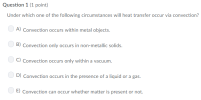 Question 1 (1 point) Under which one of the following circumstances will heat transfer occur via convection? A) Convection occurs within metal objects. B) Convection only occurs in non-metallic solids. C)Convection occurs only within a vacuum. D) Convection occurs in the presence of a liquid or a gas. E) Convection can occur whether matter is present or not.
5. Conduction best takes place in Group of answer choices solids fluids liquids gases vacuum 6....
5. Conduction best takes place in Group of answer choices solids fluids liquids gases vacuum 6. A 300 g block of an unknown metal is heated from 20o C to 170o C. This takes 2430 calories of heat. What is the specific heat of this metal? Group of answer choices 0.11 cal/g oC 0.093 cal/g oC 0.031cal/g oC 0.054 cal/g oC 0.22 cal/g oC 7. What is the Fahrenheit temperature scale reading of 15o C? Group of answer choices 68o...
Question 2 Which is the least common state of matter among elements solids, liquids or gases?...
 Question 2 Which is the least common state of matter among elements solids, liquids or gases? Explain your answer. BIVA AIE xx, E E F 2 e 12pt Paragraph SC 7 141. & 7 2 4 6 Q W R T U Y D F J K A S H 5
Question 1 (1 point) Solids, liquids and gaseous phases of matter may interact by van der Waals forces, which are...
 Question 1 (1 point) Solids, liquids and gaseous phases of matter may interact by van der Waals forces, which are weak electrostatic intermolecular bonds that form between neutral molecules. True False Question 2 (1 point) Hydrogen bonding is the only type of van der Waals force exhibited in the water molecule. True False Question 3 (1 point) Solids may be classified as crystalline or amorphous. True False Question 4 (1 point) Solid to liquid phase is known as sublimation. aaPM...
Homework Assignment #5 States of Matter Gases, Liquids and Solids (Due date: October 29, 2019) (1)...
 Homework Assignment #5 States of Matter Gases, Liquids and Solids (Due date: October 29, 2019) (1) Consider the following sample of gases: = He = N2 (i) (ii) (iii) If the three samples are all at the same temperature, rank them with respect to (a) total pressure; (b) partial pressure of helium; (c) density; (d) average kinetic energy of particles. (II) The temperature of a gas is raised from 10 °C to 20 °C. Will the volume double if mass...
 As we learned, matter exists in different states--solid, liquid and gas. Which one of these could be described as having high density and a shape that is NOT definite? O A. none of the above B. gases O C. solids OD. liquids O E. both solids and liquids
 Which state(s) has/have closely spaced atoms or molecules? none of the above gases liquids both solids and liquids solids
 identifying phase transitions on a heating curve
- O GASES, LIQUIDS, AND SOLIDS Identifying phase transitions on a heating curve A pure solid sample of Substance X is put into an evacuated flask. The flask is heated at a steady rate and the temperature recorded as time passes. Here is a graph of the results: temperature (°C) heat added (kJ/mol Use this graph to answer the following questions: What is the melting point of X? What phase (physical state) of...
identifying phase transitions on a heating curve
- O GASES, LIQUIDS, AND SOLIDS Identifying phase transitions on a heating curve A pure solid sample of Substance X is put into an evacuated flask. The flask is heated at a steady rate and the temperature recorded as time passes. Here is a graph of the results: temperature (°C) heat added (kJ/mol Use this graph to answer the following questions: What is the melting point of X? What phase (physical state) of...
 Question 1 (1 point) Under which one of the following circumstances will heat transfer occur via convection? A) Convection occurs within metal objects. B) Convection only occurs in non-metallic solids. C)Convection occurs only within a vacuum. D) Convection occurs in the presence of a liquid or a gas. E) Convection can occur whether matter is present or not.
 Question 2 Which is the least common state of matter among elements solids, liquids or gases? Explain your answer. BIVA AIE xx, E E F 2 e 12pt Paragraph SC 7 141. & 7 2 4 6 Q W R T U Y D F J K A S H 5
 Question 1 (1 point) Solids, liquids and gaseous phases of matter may interact by van der Waals forces, which are weak electrostatic intermolecular bonds that form between neutral molecules. True False Question 2 (1 point) Hydrogen bonding is the only type of van der Waals force exhibited in the water molecule. True False Question 3 (1 point) Solids may be classified as crystalline or amorphous. True False Question 4 (1 point) Solid to liquid phase is known as sublimation. aaPM...
 Homework Assignment #5 States of Matter Gases, Liquids and Solids (Due date: October 29, 2019) (1) Consider the following sample of gases: = He = N2 (i) (ii) (iii) If the three samples are all at the same temperature, rank them with respect to (a) total pressure; (b) partial pressure of helium; (c) density; (d) average kinetic energy of particles. (II) The temperature of a gas is raised from 10 °C to 20 °C. Will the volume double if mass...
Most questions answered within 3 hours.
-
Where is the error in this code sequence?
String s1 = "Hello";
String s2 = "ello";...
asked 11 months ago -
Financial data for Joel de Paris, Inc., for last year
follow:
Joel de Paris, Inc.
Balance...
asked 11 months ago -
Consider this reaction:
Al2(SO4)3 (aq)+ BaCl3
(aq) Al2Cl6 (aq)- +
3BaSO4(s) . What is the...
asked 11 months ago -
Suppose that Savneet is considering increasing her
recent random sample from 20 car rentals to 40...
asked 11 months ago -
Trucks arrive at an unloading terminal at an average rate of 120
per hour.
Trucks arrive...
asked 11 months ago -
Why are methanol and ethanol completely soluble in water while
octanol is not very little soluble....
asked 11 months ago -
A facilities manager at a university reads in a research report
that the mean amount of...
asked 11 months ago -
When the CuSO4 is rehydrated by adding water to the anhydrous
compound, is this an endothermic...
asked 11 months ago -
A ray of sunlight is passing from diamond into crown glass; the
angle of incidence is...
asked 11 months ago -
A block of mass 0.249 kg is placed on top of a light, vertical
spring of...
asked 11 months ago -
how do the kidneys compensate in the presences of acidosis
a) trigger hyperventilate
b) reserve acid...
asked 11 months ago -
Question 501 pts
The rental rate of capital to the firm increases. Which of the
following...
asked 11 months ago