The coefficient of friction between a block and a horizontal surface is 0.200 Determine the mass...
The coefficient of friction between a block and a horizontal surface is 0.200 Determine the mass of the block if a force of 250 N is required to keep it sliding along the surface.
Homework Answers

Add Answer to:
The coefficient of friction between a block and a horizontal
surface is 0.200 Determine the mass...
Please help A. A block is pulled along a horizontal surface by a force of 12.0...
 Please help
A. A block is pulled along a horizontal surface by a force of 12.0 N. The block has a mass of 4.00 kg and it accelerates at 2.00 m/s. Find the coefficient of kinetic friction for the interface between the block and the surface. B. A stone falls vertically through the air and experiences a drag force. If the stone's mass is 6.00 kg. and the drag force (upwards force) is 14.0 N, what is the acceleration of...
Please help
A. A block is pulled along a horizontal surface by a force of 12.0 N. The block has a mass of 4.00 kg and it accelerates at 2.00 m/s. Find the coefficient of kinetic friction for the interface between the block and the surface. B. A stone falls vertically through the air and experiences a drag force. If the stone's mass is 6.00 kg. and the drag force (upwards force) is 14.0 N, what is the acceleration of...
A 28.0-kg block is initially at rest on a horizontal surface. A horizontal force of 73.0...
A 28.0-kg block is initially at rest on a horizontal surface. A horizontal force of 73.0 N is required to set the block in motion, after which a horizontal force of 55.0 N is required to keep the block moving with constant speed. (a) Find the coefficient of static friction between the block and the surface. (b) Find the coefficient of kinetic friction between the block and the surface.
If the coefficient of kinetic friction between the block and the surface is 0.30 and the...
If the coefficient of kinetic friction between the block and the surface is 0.30 and the magnitude of the frictional force is 80.0 N, what is the mass of the block?
A block, of weight 100 N, rests on a horizontal surface. The coefficient of kinetic friction...
A block, of weight 100 N, rests on a horizontal surface. The coefficient of kinetic friction between the surface and the block is 0.5. A force, with horizontal component of 40 N and a vertical component of 60 N is applied to the block (i.e., F= 40i +60j Newtons). Calculate the acceleration of the block.
A block of mass M is sitting on a friction-less horizontal surface. A second block of...
A block of mass M is sitting on a friction-less horizontal surface. A second block of mass m is sitting on top of the first block. The (horizontal) interface between the two blocks is characterized by a static friction coefficient µ. The acceleration of gravity is g. Find the max horizontal force F that can be applied to the lower block such that the upper block does not slide off it.
A block of mass is placed on a horizontal surface and attached to the free end...
A block of mass is placed on a horizontal surface and attached to the free end of a spring. When the spring is neither stretched nor compressed, it exerts no force on the block. When the block is displaced from this position the force on it due to the spring is equal to 250 N/m times the distance the block is displaced. If the coefficient of static friction between the block and the surface is 0.24, how far from this...
A block of mass M is pulled over a rough horizontal surface. The block has a coefficient of kinetic friction with the s...
 A block of mass M is pulled over a rough horizontal surface. The block has a coefficient of kinetic friction with the surface of p. The block is subject to the normal force, the friction force, the force of gravity, and a force from a rope of magnitude T which pulls up and to the right at an angle of 0 with the horizontal. The box was initially travelling to the right at speed v = 1.3" If M =9.7kg,...
An 85 kg box rests on a horizontal surface. The coefficient of static friction between the...
An 85 kg box rests on a horizontal surface. The coefficient of static friction between the box and the surface is 0.50. A horizontal force 250 N force is applied to the box. What is the magnitude of the static friction force on the box? A.42N B.250N C.16.5N D.130N E.0.00N
Question 7 A 0.73 kg block is placed on a horizontal surface with a coefficient of...
 Question 7 A 0.73 kg block is placed on a horizontal surface with a coefficient of kinetic friction of 0.122. The block is pressed against a spring that has a spring constant of 683 N/m until it has compressed the spring by 13.7 cm. When the block is allowed to move freely, the spring pushes the block 10 cm along the horizontal surface at which point it encounters an upward slope with an angle of 29.0°. This slope has the...
What coefficient of friction is needed to keep the 5-kg block A from sliding on the...
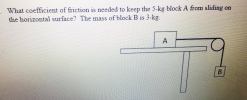 What coefficient of friction is needed to keep the 5-kg block A from sliding on the horizontal surface? The mass of block B is 3 -kg.
 Please help
A. A block is pulled along a horizontal surface by a force of 12.0 N. The block has a mass of 4.00 kg and it accelerates at 2.00 m/s. Find the coefficient of kinetic friction for the interface between the block and the surface. B. A stone falls vertically through the air and experiences a drag force. If the stone's mass is 6.00 kg. and the drag force (upwards force) is 14.0 N, what is the acceleration of...
Please help
A. A block is pulled along a horizontal surface by a force of 12.0 N. The block has a mass of 4.00 kg and it accelerates at 2.00 m/s. Find the coefficient of kinetic friction for the interface between the block and the surface. B. A stone falls vertically through the air and experiences a drag force. If the stone's mass is 6.00 kg. and the drag force (upwards force) is 14.0 N, what is the acceleration of...
 A block of mass M is pulled over a rough horizontal surface. The block has a coefficient of kinetic friction with the surface of p. The block is subject to the normal force, the friction force, the force of gravity, and a force from a rope of magnitude T which pulls up and to the right at an angle of 0 with the horizontal. The box was initially travelling to the right at speed v = 1.3" If M =9.7kg,...
 Question 7 A 0.73 kg block is placed on a horizontal surface with a coefficient of kinetic friction of 0.122. The block is pressed against a spring that has a spring constant of 683 N/m until it has compressed the spring by 13.7 cm. When the block is allowed to move freely, the spring pushes the block 10 cm along the horizontal surface at which point it encounters an upward slope with an angle of 29.0°. This slope has the...
 What coefficient of friction is needed to keep the 5-kg block A from sliding on the horizontal surface? The mass of block B is 3 -kg.
Most questions answered within 3 hours.
-
Where is the error in this code sequence?
String s1 = "Hello";
String s2 = "ello";...
asked 10 months ago -
Financial data for Joel de Paris, Inc., for last year
follow:
Joel de Paris, Inc.
Balance...
asked 10 months ago -
Consider this reaction:
Al2(SO4)3 (aq)+ BaCl3
(aq) Al2Cl6 (aq)- +
3BaSO4(s) . What is the...
asked 10 months ago -
Suppose that Savneet is considering increasing her
recent random sample from 20 car rentals to 40...
asked 10 months ago -
Trucks arrive at an unloading terminal at an average rate of 120
per hour.
Trucks arrive...
asked 10 months ago -
Why are methanol and ethanol completely soluble in water while
octanol is not very little soluble....
asked 10 months ago -
A facilities manager at a university reads in a research report
that the mean amount of...
asked 10 months ago -
When the CuSO4 is rehydrated by adding water to the anhydrous
compound, is this an endothermic...
asked 10 months ago -
A ray of sunlight is passing from diamond into crown glass; the
angle of incidence is...
asked 10 months ago -
A block of mass 0.249 kg is placed on top of a light, vertical
spring of...
asked 10 months ago -
how do the kidneys compensate in the presences of acidosis
a) trigger hyperventilate
b) reserve acid...
asked 10 months ago -
Question 501 pts
The rental rate of capital to the firm increases. Which of the
following...
asked 10 months ago