What are the names and structures of the products produced in these aldol condensation reactions? a)...
What are the names and structures of the products produced in these aldol condensation reactions?
a) 4-methylbenzaldehyde + acetone
b)4-methylbenzaldehyde + cyclohexanone
c) 4-methylbenzaldehyde + 4-methylcyclohexanone
d) trans-cinnamaldehyde + acetone
e) trans-cinnamaldehyde + cyclohexanone
f) trans-cinnamaldehyde + 4-methylcyclohexanone
note: two moles of each aldehyde are used for every one mole of ketone.
Homework Answers


Add Answer to:
What are the names and structures of the products produced in
these aldol condensation reactions?
a)...
What are the possible aldol condensation products and structures of the products from this list of...
 What are the possible aldol condensation products and structures of
the products from this list of ketones and aldehydes?
Possible ketones: acetone, cyclopentanone, cyclohexanone, and 4-methylcyclohexanone, Possible aldehydes: benzaldehyde, 4-methylbenzaldehyde, 4-anisaldehyde, and trans cinnamaldehyde.
What are the possible aldol condensation products and structures of
the products from this list of ketones and aldehydes?
Possible ketones: acetone, cyclopentanone, cyclohexanone, and 4-methylcyclohexanone, Possible aldehydes: benzaldehyde, 4-methylbenzaldehyde, 4-anisaldehyde, and trans cinnamaldehyde.
Aldol-dehydration reaction Please draw all 25 products formed from the reaction of the below ketones and...
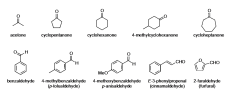 Aldol-dehydration reaction Please draw all 25
products formed from the reaction of the below ketones and
aldehydes. Mechanism is not necessary.
acetone cyclopentanone cyclohexanone 4-methylcyclohexanone cycloheptanone H H CHO H CHO Meo benzaldehyde 4-methylbenzaldehyde (p-tolualdehyde) 4-methoxybenzaldehyde p-anisaldehyde E-3-phenylpropenal (cinnamaldehyde) 2-furaldehyde (furfural) Ketone Aldehyde acetone cyclopentanone cyclohexanone 4-Me-cyclohexanone cyloheptanone benzaldehyde 113 °C 189-190 °C 118-119 °C 98-99 °C 106-107°C tolualdehyde 175 °C 233-235 °C 170 °C 134-136 °C 131-133°C anisaldehyde 129-130 °C 212-214°C 160-162 °C 136 °C 128-129°C cinnamaldehyde 144-145 °C...
Aldol-dehydration reaction Please draw all 25
products formed from the reaction of the below ketones and
aldehydes. Mechanism is not necessary.
acetone cyclopentanone cyclohexanone 4-methylcyclohexanone cycloheptanone H H CHO H CHO Meo benzaldehyde 4-methylbenzaldehyde (p-tolualdehyde) 4-methoxybenzaldehyde p-anisaldehyde E-3-phenylpropenal (cinnamaldehyde) 2-furaldehyde (furfural) Ketone Aldehyde acetone cyclopentanone cyclohexanone 4-Me-cyclohexanone cyloheptanone benzaldehyde 113 °C 189-190 °C 118-119 °C 98-99 °C 106-107°C tolualdehyde 175 °C 233-235 °C 170 °C 134-136 °C 131-133°C anisaldehyde 129-130 °C 212-214°C 160-162 °C 136 °C 128-129°C cinnamaldehyde 144-145 °C...
Postlab Assignment for Minilab 34 “Preparation of Aldol Condensation Produ...
Postlab Assignment for Minilab 34 “Preparation of Aldol Condensation Products” 1. Explain why benzaldehyde is expected to be the most reactive aldehyde among the three aldehydes used in this experiment. (used benzaldehyde, 4-methylbenzaldehyde, and 4-methoxybenzaldehyde) 2. What is the role of aqueous NaOH used in the experiment you carried out? 3. How would you change the procedures in this experiment if you wished to synthesize benzalacetophenone (C6H5CH=CHCOC6H5). Just indicate the two main organic starting materials. 4. Write a mechanism for...
This experiment was based on Aldol-dehydration reaction using unknown aldehydes and ketones. We carried out an...
 This experiment was based on Aldol-dehydration reaction using
unknown aldehydes and ketones. We carried out an aldol condensation
between an unknown aldehyde and an unknown ketone. Here are the
list of possible unknown aldehydes and ketones that were used.
Here is the NMR of the final product. Please predict the
structure given the melting point is 163 degrees Celsius.
The analysis of the 1H NMR spectrum should include a detailed
assignment of each of the NMR resonances to the protons...
This experiment was based on Aldol-dehydration reaction using
unknown aldehydes and ketones. We carried out an aldol condensation
between an unknown aldehyde and an unknown ketone. Here are the
list of possible unknown aldehydes and ketones that were used.
Here is the NMR of the final product. Please predict the
structure given the melting point is 163 degrees Celsius.
The analysis of the 1H NMR spectrum should include a detailed
assignment of each of the NMR resonances to the protons...
what is the product of the aldol condensation between cyclohexanone and 4-methylbenzaldehyde? show the mechanism for...
what is the product of the aldol condensation between cyclohexanone and 4-methylbenzaldehyde? show the mechanism for this condensation. is it possible for this reaction to form alternative products? how do you know whether it can or not?
Experimental Outline In its simplest form, the aldol condensation is a self-addition involving tw...
 Organic Chemistry 2
Experimental Outline In its simplest form, the aldol condensation is a self-addition involving two molecules of the same aldehyde or ketone, in the presence of a base, and results in the formation of a new carbon-carbon bond joining the carbonyl carbon of one molecule to the a-position of the second. In many cases - if the reaction conditions aren't sufficiently mild - the initially formed aldol product reacts further in an elimination reaction to give what is...
Organic Chemistry 2
Experimental Outline In its simplest form, the aldol condensation is a self-addition involving two molecules of the same aldehyde or ketone, in the presence of a base, and results in the formation of a new carbon-carbon bond joining the carbonyl carbon of one molecule to the a-position of the second. In many cases - if the reaction conditions aren't sufficiently mild - the initially formed aldol product reacts further in an elimination reaction to give what is...
Draw the structures of the aldol addition and condensation products of pentanal. Draw only one final...
 Draw the structures of the aldol addition and condensation products of pentanal. Draw only one final condensation product.
Aldol Condensation Post-Lab Questions: 4. Provide skeletal structures of the aldol products that form when the...
 Aldol Condensation Post-Lab Questions: 4. Provide skeletal structures of the aldol products that form when the following compoun mixtures of compounds are reacted under basic (NaOH) conditions: NaOH, H2O BARBA==== NaOH, H2O Page 139
QUESTION 33 2 points ($18.7) What is the product of the following crossed aldol condensation? (Complete...
 QUESTION 33 2 points ($18.7) What is the product of the following crossed aldol condensation? (Complete aldol reactions using two different aldehydes or ketones.) Reagents: acetyl aldehyde + p-chlorobenzaldehyde (no alpha hydrogen) + NaOH a strong base + H20 and heat.) HOA o oo QUESTION 34 2 points (518.7) Which compound, in a reaction with the ketone below, would produce the fewest side products? (Identify which aldol reactions will proceed in high yield). Reagents: starting material acetone + (1) NaOH...
Codes: Aldehyde: ZPA Ketone: BCK Amount of material started with: 2 mL of aldehyde and 0.5...
 Codes:
Aldehyde: ZPA
Ketone: BCK
Amount of material started with: 2 mL of aldehyde and 0.5 mL
of Ketone
Recrystallized Mass: 1.53 g
Melting Range: 196-200 C
Recrystallization Solvent: 9:1 Ethanol/Acetone
6.1724 7.6069 7.5891 Z-8, CDC13 Z-B, CDC13 7.2839 2724 7.6069 7.5891 4.061 7.0012 6.9836 7.2839 7.2 6.08.18 8862 7.0 4.0666 7.0012 6.9836 3.9987 -3.1154 Ippm] Ippm] Aldehydes ketones Cyclopentanone Cyclohexanone Acetone Benzaldehyde p-tolualdehyde p-anisaldehyde Cinnamaldehyde 113 °C 175 °C 129-130 °C 144 °C 189 °C 235-236 °C 212 °C...
Codes:
Aldehyde: ZPA
Ketone: BCK
Amount of material started with: 2 mL of aldehyde and 0.5 mL
of Ketone
Recrystallized Mass: 1.53 g
Melting Range: 196-200 C
Recrystallization Solvent: 9:1 Ethanol/Acetone
6.1724 7.6069 7.5891 Z-8, CDC13 Z-B, CDC13 7.2839 2724 7.6069 7.5891 4.061 7.0012 6.9836 7.2839 7.2 6.08.18 8862 7.0 4.0666 7.0012 6.9836 3.9987 -3.1154 Ippm] Ippm] Aldehydes ketones Cyclopentanone Cyclohexanone Acetone Benzaldehyde p-tolualdehyde p-anisaldehyde Cinnamaldehyde 113 °C 175 °C 129-130 °C 144 °C 189 °C 235-236 °C 212 °C...
 What are the possible aldol condensation products and structures of
the products from this list of ketones and aldehydes?
Possible ketones: acetone, cyclopentanone, cyclohexanone, and 4-methylcyclohexanone, Possible aldehydes: benzaldehyde, 4-methylbenzaldehyde, 4-anisaldehyde, and trans cinnamaldehyde.
What are the possible aldol condensation products and structures of
the products from this list of ketones and aldehydes?
Possible ketones: acetone, cyclopentanone, cyclohexanone, and 4-methylcyclohexanone, Possible aldehydes: benzaldehyde, 4-methylbenzaldehyde, 4-anisaldehyde, and trans cinnamaldehyde.
 Aldol-dehydration reaction Please draw all 25
products formed from the reaction of the below ketones and
aldehydes. Mechanism is not necessary.
acetone cyclopentanone cyclohexanone 4-methylcyclohexanone cycloheptanone H H CHO H CHO Meo benzaldehyde 4-methylbenzaldehyde (p-tolualdehyde) 4-methoxybenzaldehyde p-anisaldehyde E-3-phenylpropenal (cinnamaldehyde) 2-furaldehyde (furfural) Ketone Aldehyde acetone cyclopentanone cyclohexanone 4-Me-cyclohexanone cyloheptanone benzaldehyde 113 °C 189-190 °C 118-119 °C 98-99 °C 106-107°C tolualdehyde 175 °C 233-235 °C 170 °C 134-136 °C 131-133°C anisaldehyde 129-130 °C 212-214°C 160-162 °C 136 °C 128-129°C cinnamaldehyde 144-145 °C...
Aldol-dehydration reaction Please draw all 25
products formed from the reaction of the below ketones and
aldehydes. Mechanism is not necessary.
acetone cyclopentanone cyclohexanone 4-methylcyclohexanone cycloheptanone H H CHO H CHO Meo benzaldehyde 4-methylbenzaldehyde (p-tolualdehyde) 4-methoxybenzaldehyde p-anisaldehyde E-3-phenylpropenal (cinnamaldehyde) 2-furaldehyde (furfural) Ketone Aldehyde acetone cyclopentanone cyclohexanone 4-Me-cyclohexanone cyloheptanone benzaldehyde 113 °C 189-190 °C 118-119 °C 98-99 °C 106-107°C tolualdehyde 175 °C 233-235 °C 170 °C 134-136 °C 131-133°C anisaldehyde 129-130 °C 212-214°C 160-162 °C 136 °C 128-129°C cinnamaldehyde 144-145 °C...
 This experiment was based on Aldol-dehydration reaction using
unknown aldehydes and ketones. We carried out an aldol condensation
between an unknown aldehyde and an unknown ketone. Here are the
list of possible unknown aldehydes and ketones that were used.
Here is the NMR of the final product. Please predict the
structure given the melting point is 163 degrees Celsius.
The analysis of the 1H NMR spectrum should include a detailed
assignment of each of the NMR resonances to the protons...
This experiment was based on Aldol-dehydration reaction using
unknown aldehydes and ketones. We carried out an aldol condensation
between an unknown aldehyde and an unknown ketone. Here are the
list of possible unknown aldehydes and ketones that were used.
Here is the NMR of the final product. Please predict the
structure given the melting point is 163 degrees Celsius.
The analysis of the 1H NMR spectrum should include a detailed
assignment of each of the NMR resonances to the protons...
 Organic Chemistry 2
Experimental Outline In its simplest form, the aldol condensation is a self-addition involving two molecules of the same aldehyde or ketone, in the presence of a base, and results in the formation of a new carbon-carbon bond joining the carbonyl carbon of one molecule to the a-position of the second. In many cases - if the reaction conditions aren't sufficiently mild - the initially formed aldol product reacts further in an elimination reaction to give what is...
Organic Chemistry 2
Experimental Outline In its simplest form, the aldol condensation is a self-addition involving two molecules of the same aldehyde or ketone, in the presence of a base, and results in the formation of a new carbon-carbon bond joining the carbonyl carbon of one molecule to the a-position of the second. In many cases - if the reaction conditions aren't sufficiently mild - the initially formed aldol product reacts further in an elimination reaction to give what is...
 Draw the structures of the aldol addition and condensation products of pentanal. Draw only one final condensation product.
 Aldol Condensation Post-Lab Questions: 4. Provide skeletal structures of the aldol products that form when the following compoun mixtures of compounds are reacted under basic (NaOH) conditions: NaOH, H2O BARBA==== NaOH, H2O Page 139
 QUESTION 33 2 points ($18.7) What is the product of the following crossed aldol condensation? (Complete aldol reactions using two different aldehydes or ketones.) Reagents: acetyl aldehyde + p-chlorobenzaldehyde (no alpha hydrogen) + NaOH a strong base + H20 and heat.) HOA o oo QUESTION 34 2 points (518.7) Which compound, in a reaction with the ketone below, would produce the fewest side products? (Identify which aldol reactions will proceed in high yield). Reagents: starting material acetone + (1) NaOH...
 Codes:
Aldehyde: ZPA
Ketone: BCK
Amount of material started with: 2 mL of aldehyde and 0.5 mL
of Ketone
Recrystallized Mass: 1.53 g
Melting Range: 196-200 C
Recrystallization Solvent: 9:1 Ethanol/Acetone
6.1724 7.6069 7.5891 Z-8, CDC13 Z-B, CDC13 7.2839 2724 7.6069 7.5891 4.061 7.0012 6.9836 7.2839 7.2 6.08.18 8862 7.0 4.0666 7.0012 6.9836 3.9987 -3.1154 Ippm] Ippm] Aldehydes ketones Cyclopentanone Cyclohexanone Acetone Benzaldehyde p-tolualdehyde p-anisaldehyde Cinnamaldehyde 113 °C 175 °C 129-130 °C 144 °C 189 °C 235-236 °C 212 °C...
Codes:
Aldehyde: ZPA
Ketone: BCK
Amount of material started with: 2 mL of aldehyde and 0.5 mL
of Ketone
Recrystallized Mass: 1.53 g
Melting Range: 196-200 C
Recrystallization Solvent: 9:1 Ethanol/Acetone
6.1724 7.6069 7.5891 Z-8, CDC13 Z-B, CDC13 7.2839 2724 7.6069 7.5891 4.061 7.0012 6.9836 7.2839 7.2 6.08.18 8862 7.0 4.0666 7.0012 6.9836 3.9987 -3.1154 Ippm] Ippm] Aldehydes ketones Cyclopentanone Cyclohexanone Acetone Benzaldehyde p-tolualdehyde p-anisaldehyde Cinnamaldehyde 113 °C 175 °C 129-130 °C 144 °C 189 °C 235-236 °C 212 °C...
Most questions answered within 3 hours.
-
Where is the error in this code sequence?
String s1 = "Hello";
String s2 = "ello";...
asked 11 months ago -
Financial data for Joel de Paris, Inc., for last year
follow:
Joel de Paris, Inc.
Balance...
asked 11 months ago -
Consider this reaction:
Al2(SO4)3 (aq)+ BaCl3
(aq) Al2Cl6 (aq)- +
3BaSO4(s) . What is the...
asked 11 months ago -
Suppose that Savneet is considering increasing her
recent random sample from 20 car rentals to 40...
asked 11 months ago -
Trucks arrive at an unloading terminal at an average rate of 120
per hour.
Trucks arrive...
asked 11 months ago -
Why are methanol and ethanol completely soluble in water while
octanol is not very little soluble....
asked 11 months ago -
A facilities manager at a university reads in a research report
that the mean amount of...
asked 11 months ago -
When the CuSO4 is rehydrated by adding water to the anhydrous
compound, is this an endothermic...
asked 11 months ago -
A ray of sunlight is passing from diamond into crown glass; the
angle of incidence is...
asked 11 months ago -
A block of mass 0.249 kg is placed on top of a light, vertical
spring of...
asked 11 months ago -
how do the kidneys compensate in the presences of acidosis
a) trigger hyperventilate
b) reserve acid...
asked 11 months ago -
Question 501 pts
The rental rate of capital to the firm increases. Which of the
following...
asked 11 months ago