Decomposition of Solid mercury (I) oxide produced 37.40 cm³ elemental mercury and unknown quantity of elemental...
Decomposition of Solid mercury (I) oxide produced 37.40 cm³ elemental mercury and unknown quantity of elemental oxygen. Calculate the mass of mercury oxide if density of elemental mercury is 13.69 g/cm³.
Homework Answers

Add Answer to:
Decomposition of Solid mercury (I) oxide produced 37.40 cm³
elemental mercury and unknown quantity of elemental...
solid mercury (II) oxide decomposes on heating according to the equation: 2HgO(s) <--> 2Hg(g) + O2(g)...
solid mercury (II) oxide decomposes on heating according to the equation: 2HgO(s) <--> 2Hg(g) + O2(g) The total pressure of gases at equilibrium is 5.16x10^4 Pa at 420℃, and 10.8x10^4 Pa at 450℃. Calculate the equilibrium constants at these temperatures and the molar enthalpy of decomposition of mercury (II) oxide.
In a chemical reaction, a student react 1.315 grams of elemental Mg solid in the lab...
In a chemical reaction, a student react 1.315 grams of elemental Mg solid in the lab (with unlimited amount of oxygen) and produced MgO. 2Mg(s) + O2(g) 2MgO(s) (A) Determine the number of moles of Mg solid used in this reaction? (B) If all the magnesium reacted to form the magnesium oxide, how many moles of magnesium oxide was produced? (C) What mass of magnesium oxide was produced? (D)Name the general type of reaction shown above?
Experiment 3 Prelaboratory Assignment Empirical Formulas Date Lobo Sec. Name Desk No. 1. Elemental mercury was...
 Experiment 3 Prelaboratory Assignment Empirical Formulas Date Lobo Sec. Name Desk No. 1. Elemental mercury was first discovered when a mercury oxide was decomposed with heat, forming mercury metal and oxygen gas. When a 0.204-g sample of the mercury oxide heated. 0.189 g of mercury metal remains. Note: not attempt this experiment in the laboratory because of the release of toxic mercury vapor. a. What is the mole ratio of mercury to oxygen in the sample? b. What is the...
1. A 4.385 g sample of mercury (II)oxide was decomposed to produce 4.003 g of liquid...
 1. A 4.385 g sample of mercury (II)oxide was decomposed to produce 4.003 g of liquid mercury according to the equation below. Calculate the percent yield of mercury. 2 HgO(s)-> 2Hg() + O2(g) 4.385 (21656 =4.0039 2. Strontium carbonate decomposes into strontium oxide and carbon dioxide gas when heated, as shown below. What mass of strontium carbonate would be required to produce 49 g of strontium oxide, assuming the reaction went at 100% yield? SrCO3(s) > SEO (s) + CO2(g)...
When the reddish-brown mercury(II) oxide (HgO) is heated, it decomposes to its elements, liquid mercury metal...
When the reddish-brown mercury(II) oxide (HgO) is heated, it decomposes to its elements, liquid mercury metal and oxygen gas. If 2.63 g HgO is decomposed to Hg, calculate the mass of the pure Hg metal produced.
What volume of oxygen gas is produced when 24.2 g of mercury(II)oxide reacts completely according to...
 What volume of oxygen gas is produced when 24.2 g of mercury(II)oxide reacts completely according to the following reaction at 25 °C and 1 atm? mercury(II)oxide (8) — mercury )+ oxygen() liters oxygen gas
What volume of oxygen gas is produced when 53.4 g of mercury(II) oxide reacts completely according...
 What volume of oxygen gas is produced when 53.4 g of mercury(II) oxide reacts completely according to the following reaction at 25 °C and 1 atm? mercury(II) oxide (s)>mercury (1) + oxygen(g) liters oxygen gas
The great French chemist Antoine Lavoisier discovered the Law of Conservation of Mass in part by...
 The great French chemist Antoine Lavoisier discovered the Law of Conservation of Mass in part by doing a famous experiment in 1775. In this experiment Lavoisier found that mercury(II) oxide, when heated, decomposed into liquid mercury and an invisible and previously unknown substance: oxygen gas. 1. Write a balanced chemical equation, including physical state symbols, for the decomposition of solid mercury(11) oxide (Hgo) into liquid mercury and gaseous dioxygen. 2 HgOG) - 2Hg() + O2(g) x 5 ? 2. Suppose...
Oxygen can be produced by the thermal decomposition of mercuric oxide: heat 2 HgO(s) 2 Hg()...
 Oxygen can be produced by the thermal decomposition of mercuric oxide: heat 2 HgO(s) 2 Hg() + O2(g) What volume of O, is produced at 32.0°C and 0.941 atm by the decomposition of 26.3 g of HgO? LO2
plesse answer part two. oregaseous reactant The great French chemist Antoine Lavoisier discovered the Law of...
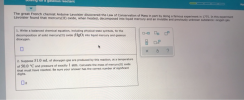 plesse answer part two.
oregaseous reactant The great French chemist Antoine Lavoisier discovered the Law of Conservation of Mass in part by doing a famous experiment in 1775. In this experiment Lavoisier found that mercury(II)oxide, when heated, decomposed into liquid mercury and an invisible and previously unknown substance: oxygen gas. 1. Write a balanced chemical equation, including physical state symbols, for the decomposition of solid mercury(II)oxide (HgO) into liquid mercury and gaseous dioxygen x 5 ? 2. Suppose 51.0 mL...
plesse answer part two.
oregaseous reactant The great French chemist Antoine Lavoisier discovered the Law of Conservation of Mass in part by doing a famous experiment in 1775. In this experiment Lavoisier found that mercury(II)oxide, when heated, decomposed into liquid mercury and an invisible and previously unknown substance: oxygen gas. 1. Write a balanced chemical equation, including physical state symbols, for the decomposition of solid mercury(II)oxide (HgO) into liquid mercury and gaseous dioxygen x 5 ? 2. Suppose 51.0 mL...
 Experiment 3 Prelaboratory Assignment Empirical Formulas Date Lobo Sec. Name Desk No. 1. Elemental mercury was first discovered when a mercury oxide was decomposed with heat, forming mercury metal and oxygen gas. When a 0.204-g sample of the mercury oxide heated. 0.189 g of mercury metal remains. Note: not attempt this experiment in the laboratory because of the release of toxic mercury vapor. a. What is the mole ratio of mercury to oxygen in the sample? b. What is the...
 1. A 4.385 g sample of mercury (II)oxide was decomposed to produce 4.003 g of liquid mercury according to the equation below. Calculate the percent yield of mercury. 2 HgO(s)-> 2Hg() + O2(g) 4.385 (21656 =4.0039 2. Strontium carbonate decomposes into strontium oxide and carbon dioxide gas when heated, as shown below. What mass of strontium carbonate would be required to produce 49 g of strontium oxide, assuming the reaction went at 100% yield? SrCO3(s) > SEO (s) + CO2(g)...
 What volume of oxygen gas is produced when 24.2 g of mercury(II)oxide reacts completely according to the following reaction at 25 °C and 1 atm? mercury(II)oxide (8) — mercury )+ oxygen() liters oxygen gas
 What volume of oxygen gas is produced when 53.4 g of mercury(II) oxide reacts completely according to the following reaction at 25 °C and 1 atm? mercury(II) oxide (s)>mercury (1) + oxygen(g) liters oxygen gas
 The great French chemist Antoine Lavoisier discovered the Law of Conservation of Mass in part by doing a famous experiment in 1775. In this experiment Lavoisier found that mercury(II) oxide, when heated, decomposed into liquid mercury and an invisible and previously unknown substance: oxygen gas. 1. Write a balanced chemical equation, including physical state symbols, for the decomposition of solid mercury(11) oxide (Hgo) into liquid mercury and gaseous dioxygen. 2 HgOG) - 2Hg() + O2(g) x 5 ? 2. Suppose...
 Oxygen can be produced by the thermal decomposition of mercuric oxide: heat 2 HgO(s) 2 Hg() + O2(g) What volume of O, is produced at 32.0°C and 0.941 atm by the decomposition of 26.3 g of HgO? LO2
 plesse answer part two.
oregaseous reactant The great French chemist Antoine Lavoisier discovered the Law of Conservation of Mass in part by doing a famous experiment in 1775. In this experiment Lavoisier found that mercury(II)oxide, when heated, decomposed into liquid mercury and an invisible and previously unknown substance: oxygen gas. 1. Write a balanced chemical equation, including physical state symbols, for the decomposition of solid mercury(II)oxide (HgO) into liquid mercury and gaseous dioxygen x 5 ? 2. Suppose 51.0 mL...
plesse answer part two.
oregaseous reactant The great French chemist Antoine Lavoisier discovered the Law of Conservation of Mass in part by doing a famous experiment in 1775. In this experiment Lavoisier found that mercury(II)oxide, when heated, decomposed into liquid mercury and an invisible and previously unknown substance: oxygen gas. 1. Write a balanced chemical equation, including physical state symbols, for the decomposition of solid mercury(II)oxide (HgO) into liquid mercury and gaseous dioxygen x 5 ? 2. Suppose 51.0 mL...
Most questions answered within 3 hours.
-
Where is the error in this code sequence?
String s1 = "Hello";
String s2 = "ello";...
asked 10 months ago -
Financial data for Joel de Paris, Inc., for last year
follow:
Joel de Paris, Inc.
Balance...
asked 10 months ago -
Consider this reaction:
Al2(SO4)3 (aq)+ BaCl3
(aq) Al2Cl6 (aq)- +
3BaSO4(s) . What is the...
asked 10 months ago -
Suppose that Savneet is considering increasing her
recent random sample from 20 car rentals to 40...
asked 10 months ago -
Trucks arrive at an unloading terminal at an average rate of 120
per hour.
Trucks arrive...
asked 10 months ago -
Why are methanol and ethanol completely soluble in water while
octanol is not very little soluble....
asked 10 months ago -
A facilities manager at a university reads in a research report
that the mean amount of...
asked 10 months ago -
When the CuSO4 is rehydrated by adding water to the anhydrous
compound, is this an endothermic...
asked 10 months ago -
A ray of sunlight is passing from diamond into crown glass; the
angle of incidence is...
asked 10 months ago -
A block of mass 0.249 kg is placed on top of a light, vertical
spring of...
asked 10 months ago -
how do the kidneys compensate in the presences of acidosis
a) trigger hyperventilate
b) reserve acid...
asked 10 months ago -
Question 501 pts
The rental rate of capital to the firm increases. Which of the
following...
asked 10 months ago