A rigid rotor has two particles of mass m attached to the ends of a massless...
-
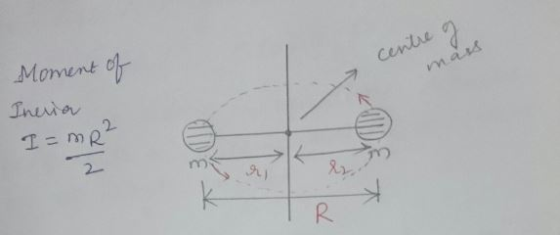
A rigid rotor has two particles of mass m attached to the ends of a massless rigid rod of length a. The rotor is free to rotate in three dimensions about the center of mass. This is a model for the rotational motion of a homonuclear diatomic molecule, a molecule with two identical nuclei. (An example is 16O2.)
-
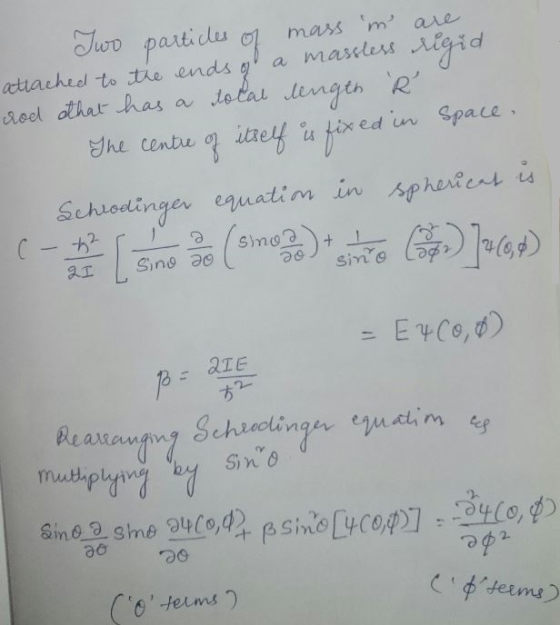
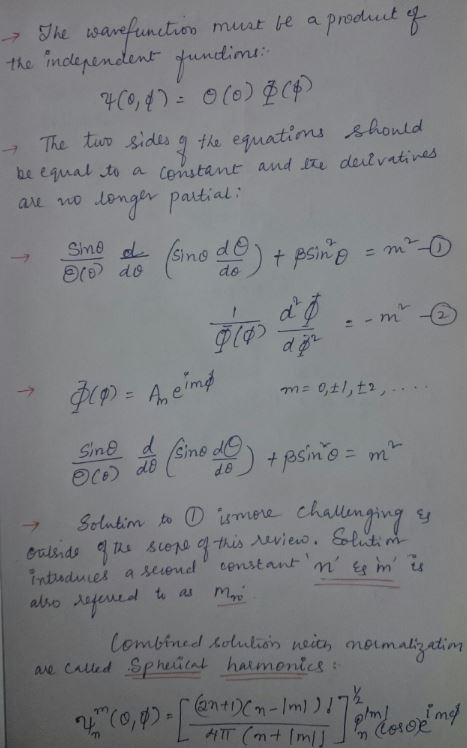
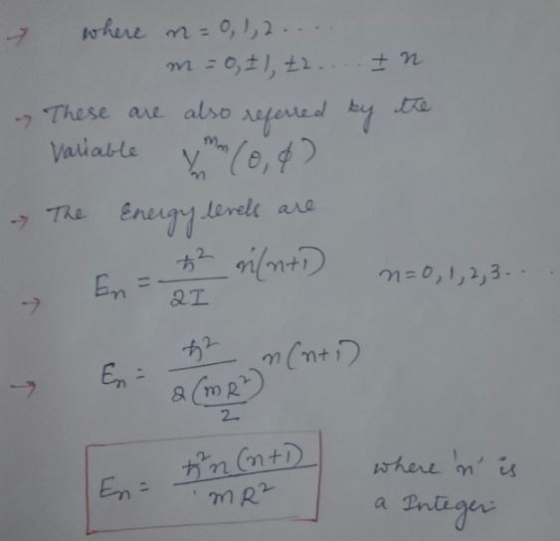
(a) By expressing the Hamiltonian in terms of the orbital angular momentum, show that the allowed energies of this rigid rotor are of the form
El =h^2*l(l + 1)/ma^2
-
(b) What are the normalized eigenfunctions? What is the degeneracy of the lth level?
(c) Consider now the effects of exchange symmetry on the system. Suppose the nuclei are identical fermions. What is the rotational ground state energy and wave function? Consider also the case of two identical bosons.
Homework Answers
Answer:
Note: In the following answer please Replace 'R' and 'L' with "a" and "n" respectively. You will arrive at answer for part-a)
ask part-b and c separately. Thank you.
Add Answer to:
A rigid rotor has two particles of mass m attached to the ends
of a massless...
2. Consider a particle of mass M attached to a rigid massless rod of fixed length...
 2. Consider a particle of mass M attached to a rigid massless rod of fixed length R whose other end is fixed at the origin. The rod is free to rotate about its fixed point. (a) Give an argument why the Hamiltonian for the system may be written as 21 21 with/-MR2 (b) If the particle carries charge q, and the rotor is placed in a constant magnetic field B, what is the modified Hamiltonian? (e) What is the energy...
5. A diatomic molecule (like H2) can be modeled as two atoms of equal mass m,...
 5. A diatomic molecule (like H2) can be modeled as two atoms of equal mass m, connected by a rigid massless rod of length a. The system is free to rotate in 3-D. I claim the moment of inertia of this molecule around its ceater of mass is a. (Feel free to convince yourself that factor of k is coect!) Big hint if you 're having trouble getting started: this problem is directly related to McIntyre's Ch A) The energy...
A particle of mass m is attached to a fixed point in space by a massless rigid rode of length a a...
A particle of mass m is attached to a fixed point in space by a massless rigid rode of length a and can freely rotate about this point. Find the quan- tum energy levels of the system. What is the degeneracy of each energy level (i.e. how many different quantum states have given energy)? Compare to the one of hydrogen atom
1- 5. Two particles each of mass m are fixed at the end of a rigid...
 1- 5. Two particles each of mass m are fixed at the end of a rigid rod of length 2a. This rod lies in the xy plane and is free to rotate in that plane about an axis passing through the midpoint of the rod and perpendicular to it (that is, parallel to the z-axis). Neglect the inertial properties of the rod in the rest of this question z-axis 1. Derive the classical expression for the kinetic energy of the...
1- 5. Two particles each of mass m are fixed at the end of a rigid...
 1- 5. Two particles each of mass m are fixed at the end of a rigid rod of length 2a. This rod lies in the xy plane and is free to rotate in that plane about an axis passing through the midpoint of the rod and perpendicular to it (that is, parallel to the z-axis). Neglect the inertial properties of the rod in the rest of this question z-axis 1. Derive the classical expression for the kinetic energy of the...
Four identical particles of mass m each are placed at the vertices of a square with side length a and held by four massless rods, which form the sides of the square. (Use any variable stated above.)
Four identical particles of mass m each are placed at the vertices of a square with side length a and held by four massless rods, which form the sides of the square. (Use any variable stated above.) a. What is the rotational inertia of this rigid body about an axis passes through the midpoint of opposite sides and lies in the plane of the square? b. What is the rotational inertia of this rigid body about an axis that passes through...
2. (35 points) A pendulum consists of a point mass (m) attached to the end of a spring (massless ...
 2. (35 points) A pendulum consists of a point mass (m) attached to the end of a spring (massless spring, equilibrium length-Lo and spring constant- k). The other end of the spring is attached to the ceiling. Initially the spring is un-sketched but is making an angle θ° with the vertical, the mass is released from rest, see figure below. Let the instantaneous length of the spring be r. Let the acceleration due to gravity be g celing (a) (10...
A massless rod of length l has weights, each of mass m, attached to its ends....
A massless rod of length l has weights, each of mass m, attached to its ends. The rod is initially put in a horizontal position, and laid on an off-center fulcrum located at a distance b from the rod’s center. The rod will topple. a) Calculate the total gravitational torque on the rod directly, by adding the two torques. b) Verify that this gives the same result as would have been obtained by taking the entire gravitational force as acting...
Consider two pendula consisting of a piece of clay stuck to a massless rigid rod, which...
 Consider two pendula consisting of a piece of clay stuck to a massless rigid rod, which is pivoted at its end. The two L- CEILING pendula are released from a horizontal orientation, as pivotV o pivot a drawn here, and allowed to swing down. On pendulum 1, the clay s stuck to the midpoint of the rod·On pendulum Pendulum 2, it's stuck to the end of the rod. In both cases, the rods have the same length, and the pieces...
Consider the simplest rigid body, consisting of two point objects each of mass m, connected by...
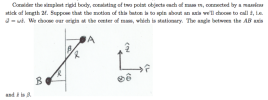 Consider the simplest rigid body, consisting of two point objects each of mass m, connected by a massless stick of length 2f. Suppose that the motion of this baton is to spin about an axis we'll choose to call , i.e. w = w2. We choose our origin at the center of mass, which is stationary. The angle between the AB axis and i is B. 6. Express in the êk basis. Likewise, express the system's angular momentum L, and...
 2. Consider a particle of mass M attached to a rigid massless rod of fixed length R whose other end is fixed at the origin. The rod is free to rotate about its fixed point. (a) Give an argument why the Hamiltonian for the system may be written as 21 21 with/-MR2 (b) If the particle carries charge q, and the rotor is placed in a constant magnetic field B, what is the modified Hamiltonian? (e) What is the energy...
 5. A diatomic molecule (like H2) can be modeled as two atoms of equal mass m, connected by a rigid massless rod of length a. The system is free to rotate in 3-D. I claim the moment of inertia of this molecule around its ceater of mass is a. (Feel free to convince yourself that factor of k is coect!) Big hint if you 're having trouble getting started: this problem is directly related to McIntyre's Ch A) The energy...
 1- 5. Two particles each of mass m are fixed at the end of a rigid rod of length 2a. This rod lies in the xy plane and is free to rotate in that plane about an axis passing through the midpoint of the rod and perpendicular to it (that is, parallel to the z-axis). Neglect the inertial properties of the rod in the rest of this question z-axis 1. Derive the classical expression for the kinetic energy of the...
 1- 5. Two particles each of mass m are fixed at the end of a rigid rod of length 2a. This rod lies in the xy plane and is free to rotate in that plane about an axis passing through the midpoint of the rod and perpendicular to it (that is, parallel to the z-axis). Neglect the inertial properties of the rod in the rest of this question z-axis 1. Derive the classical expression for the kinetic energy of the...
 2. (35 points) A pendulum consists of a point mass (m) attached to the end of a spring (massless spring, equilibrium length-Lo and spring constant- k). The other end of the spring is attached to the ceiling. Initially the spring is un-sketched but is making an angle θ° with the vertical, the mass is released from rest, see figure below. Let the instantaneous length of the spring be r. Let the acceleration due to gravity be g celing (a) (10...
 Consider two pendula consisting of a piece of clay stuck to a massless rigid rod, which is pivoted at its end. The two L- CEILING pendula are released from a horizontal orientation, as pivotV o pivot a drawn here, and allowed to swing down. On pendulum 1, the clay s stuck to the midpoint of the rod·On pendulum Pendulum 2, it's stuck to the end of the rod. In both cases, the rods have the same length, and the pieces...
 Consider the simplest rigid body, consisting of two point objects each of mass m, connected by a massless stick of length 2f. Suppose that the motion of this baton is to spin about an axis we'll choose to call , i.e. w = w2. We choose our origin at the center of mass, which is stationary. The angle between the AB axis and i is B. 6. Express in the êk basis. Likewise, express the system's angular momentum L, and...
Most questions answered within 3 hours.
-
Where is the error in this code sequence?
String s1 = "Hello";
String s2 = "ello";...
asked 11 months ago -
Financial data for Joel de Paris, Inc., for last year
follow:
Joel de Paris, Inc.
Balance...
asked 11 months ago -
Consider this reaction:
Al2(SO4)3 (aq)+ BaCl3
(aq) Al2Cl6 (aq)- +
3BaSO4(s) . What is the...
asked 11 months ago -
Suppose that Savneet is considering increasing her
recent random sample from 20 car rentals to 40...
asked 11 months ago -
Trucks arrive at an unloading terminal at an average rate of 120
per hour.
Trucks arrive...
asked 11 months ago -
Why are methanol and ethanol completely soluble in water while
octanol is not very little soluble....
asked 11 months ago -
A facilities manager at a university reads in a research report
that the mean amount of...
asked 11 months ago -
When the CuSO4 is rehydrated by adding water to the anhydrous
compound, is this an endothermic...
asked 11 months ago -
A ray of sunlight is passing from diamond into crown glass; the
angle of incidence is...
asked 11 months ago -
A block of mass 0.249 kg is placed on top of a light, vertical
spring of...
asked 11 months ago -
how do the kidneys compensate in the presences of acidosis
a) trigger hyperventilate
b) reserve acid...
asked 11 months ago -
Question 501 pts
The rental rate of capital to the firm increases. Which of the
following...
asked 11 months ago