This is actuarial science. Problem 1 - Unknown and Varying Interest The PV of an annuity-immediate...
This is actuarial science.
Problem 1 - Unknown and Varying Interest
The PV of an annuity-immediate with quarterly payments of $450 for
6 years is $9457.59 .
a) Determine the nominal annual rate of interest compounded
quarterly.
i(4)= %
b) Determine the effective annual rate of interest.
i= %
Problem 2 - Unknown and Varying Interest
The PV of an annuity-due with annual payments of $555 for 16 years
is $6520.78 .
Determine the effective annual rate of interest.
i= %
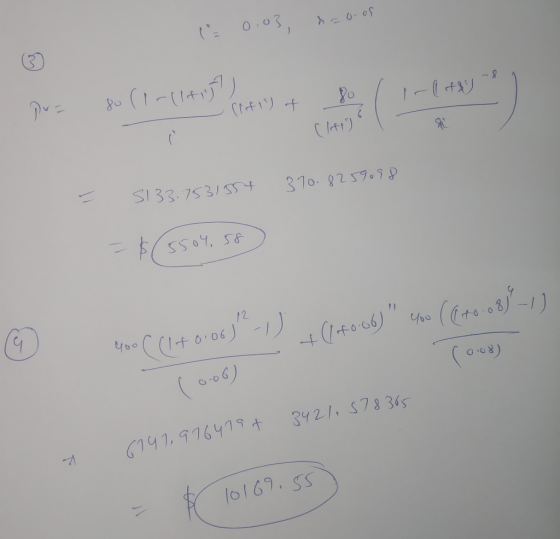
3.
Annual deposits of $80 are made at the beginning of each year
for 15 years. Find the PV of this annuity-due if the effective
annual rate of interest is 3% for the first 6 years and 5% for the
last 9 years.
PV =
4.
Annual deposits of $400 are made at the end of each year for 15
years.
The first 4 deposits are invested in a fund that pays an effective
annual rate of interest of 8%
The remaining deposits are invested in another fund that pays 6%
effective.
Find the AV of these deposits at the end of 15 years.
AV =
5.
Annual deposits of $20 are made at the beginning of each year
for 18 years. Find the AV of this annuity at the end of 18 years if
the effective annual rate of interest is 6% for the first 5 years
and 8% for the last 13 years.
AV =
Homework Answers
By rules and regulations we are allow to do only one problem at a time.. i solve two problems ... 3rd and 4th.
Problem in answer then comment below..i will help you..
.
Please thumbs up for this solution..thanks..
.
Add Answer to:
This is actuarial science.
Problem 1 - Unknown and Varying Interest
The PV of an annuity-immediate...
(1 point) An annuity-immediate makes payments of 200 per year payable quarterly for 8 years at...
 (1 point) An annuity-immediate makes payments of 200 per year payable quarterly for 8 years at an effective annual interest rate i = 3%. The accumulated value of this annuity is AV = (1 point) An annuity makes payments of 1700 at the end of every 9 years over 81 years at a nominal annual interest rate of 5.6% compounded quarterly. The present value of this annuity is PV =
(1 point) Problem 3 -Unknown and Varying Interest At an annual effective rate of interest i, the following 2 payment streams have equal present values. (i) $550 paid at the end of each year for 1...
 (1 point) Problem 3 -Unknown and Varying Interest At an annual effective rate of interest i, the following 2 payment streams have equal present values. (i) $550 paid at the end of each year for 13 years. (i) A 13-year deferred perpetuity-immediate of $275 per year (i.e. first payment at time 14) Determine the effective annual rate of interest
(1 point) Problem 3 -Unknown and Varying Interest At an annual effective rate of interest i, the following 2 payment streams...
(1 point) Problem 3 -Unknown and Varying Interest At an annual effective rate of interest i, the following 2 payment streams have equal present values. (i) $550 paid at the end of each year for 13 years. (i) A 13-year deferred perpetuity-immediate of $275 per year (i.e. first payment at time 14) Determine the effective annual rate of interest
(1 point) Problem 3 -Unknown and Varying Interest At an annual effective rate of interest i, the following 2 payment streams...
• An annuity immediate pays 15 at the end of years 1 and 2, 14 at...
 • An annuity immediate pays 15 at the end of years 1 and 2, 14 at the end of years 3 and 4 and so on. • The payments decrease by 1 every second year until nothing is paid. • The effective annual interest rate is 6%. Calculate the present value of this annuity.
Two annuities have equal present values. The first is an annuity-immediate with quarterly payments of $X...
Two annuities have equal present values. The first is an annuity-immediate with quarterly payments of $X for 10 years. The second is an increasing annuity-immediate with 10 annual payments, where the first payment is $500 and subsequent payments increase by 10% per year. Find X if the annual effective interest rate is 5%. (Answer: 188.28)
Problem 2.10 A 10-year annuity-immediate pays 100 quarterly for the first five years. Starting year 6,...
 Problem 2.10 A 10-year annuity-immediate pays 100 quarterly for the first five years. Starting year 6, the annuity immediate pays 300 quarterly for the remaining five years. There is a nominal annual interest of 8% convertible quarterly. Find the present value of this annuity
Wiseman Video plans to make four annual deposits of $6,500 each to a special building fund. The fund’s assets will be invested in mortgage instruments expected to pay interest at 12% on the fund’s balance. (FV of $1, PV of $1, FVA of $1, PVA of $1, FVAD o
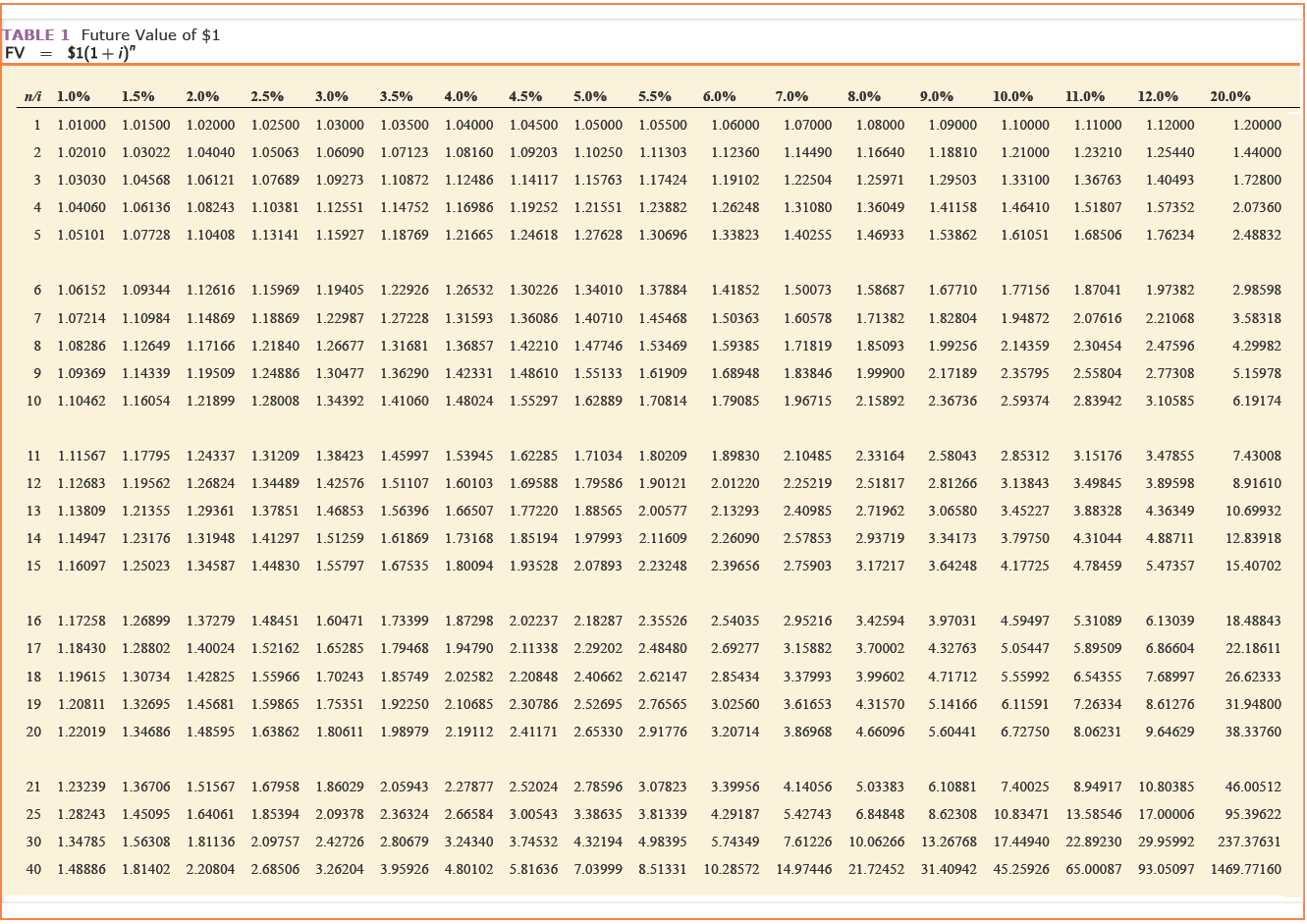 Wiseman Video plans to make four annual deposits of $6,500 each to a special building fund. The fund’s assets will be invested in mortgage instruments expected to pay interest at 12% on the fund’s balance. (FV of $1, PV of $1, FVA of $1, PVA of $1, FVAD of $1 and PVAD of $1) (Use appropriate factor(s) from the tables provided.)Determine how much will be accumulated in the fund on December 31, 2024 after four years, under each of the...
This is actuarial science. Please answer asap. thank you! Problem 6 - Equations of Value A...
This is actuarial science. Please answer asap. thank you! Problem 6 - Equations of Value A deposit X is to be made today and a second deposit, which is twice the first, is to be made 6 years from now, to provide for withdrawals of $4000 two years from now and $9500 9 years from now. At an effective annual interest rate of 3%, calculate the size of the first deposit.
Please show the formula and answer in Excel f. Find the PV of an ordinary annuity...
Please show the formula and answer in Excel f. Find the PV of an ordinary annuity that pays $1,000 at the end of each of the next 5 years if the interest rate is 15%. Then find the FV of that same annuity. Inputs: PMT = $ 1,000 N = 5 I/YR = 15% PV: Use function wizard (PV) PV = FV: Use function wizard (FV) FV =
Problem 5 - Annuities with Block Payments & Perpetuities Michael made the following deposits in a...
Problem 5 - Annuities with Block Payments & Perpetuities Michael made the following deposits in a fund paying annual effective rate of interest of 5.1%: (i) $70 at the beginning of years 1 - 13 (ii) No deposits at the beginning of years 14 - 18 (iii) $120 at the beginning of years 19 - 37. How much did Michael accumulate at the end of 37 years? AV=
9. You are offered an investment with a quoted annual interest rate of 6.75% with quarterly...
9. You are offered an investment with a quoted annual interest rate of 6.75% with quarterly compounding of interest. What is your effective annual interest rate? 10. You are offered an annuity that will pay $15,000 per year for 20 years (the first payment will occur one year from today). If you feel that the appropriate discount rate is 3%, what is the annuity worth to you today? 11. If you deposit $6,500 per year (each deposit is made at...
 (1 point) An annuity-immediate makes payments of 200 per year payable quarterly for 8 years at an effective annual interest rate i = 3%. The accumulated value of this annuity is AV = (1 point) An annuity makes payments of 1700 at the end of every 9 years over 81 years at a nominal annual interest rate of 5.6% compounded quarterly. The present value of this annuity is PV =
 (1 point) Problem 3 -Unknown and Varying Interest At an annual effective rate of interest i, the following 2 payment streams have equal present values. (i) $550 paid at the end of each year for 13 years. (i) A 13-year deferred perpetuity-immediate of $275 per year (i.e. first payment at time 14) Determine the effective annual rate of interest
(1 point) Problem 3 -Unknown and Varying Interest At an annual effective rate of interest i, the following 2 payment streams...
(1 point) Problem 3 -Unknown and Varying Interest At an annual effective rate of interest i, the following 2 payment streams have equal present values. (i) $550 paid at the end of each year for 13 years. (i) A 13-year deferred perpetuity-immediate of $275 per year (i.e. first payment at time 14) Determine the effective annual rate of interest
(1 point) Problem 3 -Unknown and Varying Interest At an annual effective rate of interest i, the following 2 payment streams...
 • An annuity immediate pays 15 at the end of years 1 and 2, 14 at the end of years 3 and 4 and so on. • The payments decrease by 1 every second year until nothing is paid. • The effective annual interest rate is 6%. Calculate the present value of this annuity.
 Problem 2.10 A 10-year annuity-immediate pays 100 quarterly for the first five years. Starting year 6, the annuity immediate pays 300 quarterly for the remaining five years. There is a nominal annual interest of 8% convertible quarterly. Find the present value of this annuity
Most questions answered within 3 hours.
-
Where is the error in this code sequence?
String s1 = "Hello";
String s2 = "ello";...
asked 10 months ago -
Financial data for Joel de Paris, Inc., for last year
follow:
Joel de Paris, Inc.
Balance...
asked 10 months ago -
Consider this reaction:
Al2(SO4)3 (aq)+ BaCl3
(aq) Al2Cl6 (aq)- +
3BaSO4(s) . What is the...
asked 10 months ago -
Suppose that Savneet is considering increasing her
recent random sample from 20 car rentals to 40...
asked 10 months ago -
Trucks arrive at an unloading terminal at an average rate of 120
per hour.
Trucks arrive...
asked 10 months ago -
Why are methanol and ethanol completely soluble in water while
octanol is not very little soluble....
asked 10 months ago -
A facilities manager at a university reads in a research report
that the mean amount of...
asked 10 months ago -
When the CuSO4 is rehydrated by adding water to the anhydrous
compound, is this an endothermic...
asked 10 months ago -
A ray of sunlight is passing from diamond into crown glass; the
angle of incidence is...
asked 10 months ago -
A block of mass 0.249 kg is placed on top of a light, vertical
spring of...
asked 10 months ago -
how do the kidneys compensate in the presences of acidosis
a) trigger hyperventilate
b) reserve acid...
asked 10 months ago -
Question 501 pts
The rental rate of capital to the firm increases. Which of the
following...
asked 10 months ago