I'm having trouble with question 6.41 (A ∧ B) ∨ ¬A ∨ ¬B in the textbook...
I'm having trouble with question 6.41 (A ∧ B) ∨ ¬A ∨ ¬B in the textbook Language Proof and Logic (2nd edition) how do I write a formal proof without using Taut Con? I wrote one using Taut Con but I am unsure how to write it differently without using the rule.
Thanks
Homework Answers

Add Answer to:
I'm having trouble with question 6.41 (A ∧ B) ∨ ¬A ∨ ¬B in the
textbook...
Use Fitch to construct formal proofs for the following arguments. In two cases, you may find...
Use Fitch to construct formal proofs for the following arguments. In two cases, you may find yourself re-proving an instance of the law of Excluded Middle, PV¬P, in order to complete your proof. If you've forgotten how to do that, look back at your solution to Exercise 6.33 in Language Proof and Logic 2nd Edition. Alternatively, with the permission of your instructor, you may use TAUT Con to justify an instance of Excluded Middle. (P->Q)<->(¬PVQ)
Use Fitch to construct formal proofs for the following arguments. In two cases, you may find...
Use Fitch to construct formal proofs for the following arguments. In two cases, you may find yourself re-proving an instance of the law of Excluded Middle, PV¬P, in order to complete your proof. If you've forgotten how to do that, look back at your solution to Exercise 6.33 in Language Proof and Logic 2nd Edition. Alternatively, with the permission of your instructor, you may use TAUT Con to justify an instance of Excluded Middle. (P->Q)<->(¬PVQ)
I'm having a little bit of trouble and not sure If I am entering it right...
 I'm having a little bit of trouble and not sure If I am entering
it right on my calculator.
I put 2nd--> VARS--> normalCDF
lower: -1E99
upper: z score
and pressing enter
Whenever I do this, it says I am wrong. Please help!
Using a TI-84 calculator, find the area under the standard normal curve to the left of the following z-values. Round the answers to four decimal places. Part 1 of 4 is .35171x The area to the left...
I'm having a little bit of trouble and not sure If I am entering
it right on my calculator.
I put 2nd--> VARS--> normalCDF
lower: -1E99
upper: z score
and pressing enter
Whenever I do this, it says I am wrong. Please help!
Using a TI-84 calculator, find the area under the standard normal curve to the left of the following z-values. Round the answers to four decimal places. Part 1 of 4 is .35171x The area to the left...
I am studying from the Guyton and Hall 13th edition Advanced pathophysiology textbook. I am having...
I am studying from the Guyton and Hall 13th edition Advanced pathophysiology textbook. I am having trouble with understanding the membrane potential differences for Cl-, Na+, K+ and how cardiac medication works involving differences in these membrane potentials and concentration gradients. Any advice to assist with understanding?
I have the answers here from the textbook but am having trouble figuring out how to...
 I have the answers here from
the textbook but am having trouble figuring out how to set up
equations. Any help is appreciated thanks!
P 6.4-6 + Determine the node voltages for the circuit shown in Figure P 6.4-6. Answer: va = -0.75 V, Vb = 0 V, and Vc = -0.9375 V 10 k 40 k 20 k MMM- b 25 k W 12 v 340k 3 15k Figure P 6.4-6
I have the answers here from
the textbook but am having trouble figuring out how to set up
equations. Any help is appreciated thanks!
P 6.4-6 + Determine the node voltages for the circuit shown in Figure P 6.4-6. Answer: va = -0.75 V, Vb = 0 V, and Vc = -0.9375 V 10 k 40 k 20 k MMM- b 25 k W 12 v 340k 3 15k Figure P 6.4-6
I'm having trouble with this. Please show work so I can see where I'm messing up....
I'm having trouble with this. Please show work so I can see where I'm messing up. Thanks 1. For each sample, state the sample size, mean, and standard deviation. Sample A: 0.75, 1.38, 2.13, 2.45, 4.7 Sample B: 2.18, 3.5, 4.7, 5.63, 7.35 2. State Hypotheses in statistical format: a. H0: b. H1: 3. State Significance Level: Use significance level α = .05 4. State critical t (explain how it was found) 5. State decision rule 6. Calculate the test...
Hi. I'm having trouble solving the rate law for my chemistry lab report sheet. I'm unsure...
 Hi. I'm having trouble solving the rate law for my chemistry lab
report sheet. I'm unsure if I'm doing it right. Below is my
trials
To calculate rate law, I choose experiment 1
and 2 for [I]x and experiment 2 and 3 for
[H2O2]y. I got x=1 and y=1. This would make my rate law:
rate = k [I-] [H2O2]
Is this correct? Please help! Thanks in advance
Trial [1] [H202] Rate (M/s) 1 3.00 x 10^-2 M 1.50 x...
Hi. I'm having trouble solving the rate law for my chemistry lab
report sheet. I'm unsure if I'm doing it right. Below is my
trials
To calculate rate law, I choose experiment 1
and 2 for [I]x and experiment 2 and 3 for
[H2O2]y. I got x=1 and y=1. This would make my rate law:
rate = k [I-] [H2O2]
Is this correct? Please help! Thanks in advance
Trial [1] [H202] Rate (M/s) 1 3.00 x 10^-2 M 1.50 x...
I am having trouble understanding the right hand rule and determining the missing B-field or velocity....
I am having trouble understanding the right hand rule and determining the missing B-field or velocity. Please explain teh simplistic terms of using the right hand rule
I'm having trouble with question c and d. Originally for question C, I wrote 0.30 but...
 I'm having trouble with question c and d. Originally for
question C, I wrote 0.30 but that was incorrect.
For problem d, I wrote 0.60. I haven't input these answers yet.
The options that are listed are 0, 0.01, 0.30, 0.60, 0.99 and
1.
c. This event is extremely unlikely, but it will occur once in a while in a long sequence of trials:0.01 This is not quite right. A probability of 0.30 represents an event that will occur less...
I'm having trouble with question c and d. Originally for
question C, I wrote 0.30 but that was incorrect.
For problem d, I wrote 0.60. I haven't input these answers yet.
The options that are listed are 0, 0.01, 0.30, 0.60, 0.99 and
1.
c. This event is extremely unlikely, but it will occur once in a while in a long sequence of trials:0.01 This is not quite right. A probability of 0.30 represents an event that will occur less...
Hi, I am having trouble with using the matplotlib function in python. A tutorial in this...
 Hi, I am having trouble with using the matplotlib function in
python. A tutorial in this question and a lesson on how to use it
would be great. Thanks so much.
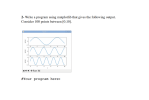
2- Write a program using matplotlib that gives the following output Consider 100 points between [0,10] Fiqure 1 10 8 10 #Your program here:
Hi, I am having trouble with using the matplotlib function in
python. A tutorial in this question and a lesson on how to use it
would be great. Thanks so much.
2- Write a program using matplotlib that gives the following output Consider 100 points between [0,10] Fiqure 1 10 8 10 #Your program here:
 I'm having a little bit of trouble and not sure If I am entering
it right on my calculator.
I put 2nd--> VARS--> normalCDF
lower: -1E99
upper: z score
and pressing enter
Whenever I do this, it says I am wrong. Please help!
Using a TI-84 calculator, find the area under the standard normal curve to the left of the following z-values. Round the answers to four decimal places. Part 1 of 4 is .35171x The area to the left...
I'm having a little bit of trouble and not sure If I am entering
it right on my calculator.
I put 2nd--> VARS--> normalCDF
lower: -1E99
upper: z score
and pressing enter
Whenever I do this, it says I am wrong. Please help!
Using a TI-84 calculator, find the area under the standard normal curve to the left of the following z-values. Round the answers to four decimal places. Part 1 of 4 is .35171x The area to the left...
 I have the answers here from
the textbook but am having trouble figuring out how to set up
equations. Any help is appreciated thanks!
P 6.4-6 + Determine the node voltages for the circuit shown in Figure P 6.4-6. Answer: va = -0.75 V, Vb = 0 V, and Vc = -0.9375 V 10 k 40 k 20 k MMM- b 25 k W 12 v 340k 3 15k Figure P 6.4-6
I have the answers here from
the textbook but am having trouble figuring out how to set up
equations. Any help is appreciated thanks!
P 6.4-6 + Determine the node voltages for the circuit shown in Figure P 6.4-6. Answer: va = -0.75 V, Vb = 0 V, and Vc = -0.9375 V 10 k 40 k 20 k MMM- b 25 k W 12 v 340k 3 15k Figure P 6.4-6
 Hi. I'm having trouble solving the rate law for my chemistry lab
report sheet. I'm unsure if I'm doing it right. Below is my
trials
To calculate rate law, I choose experiment 1
and 2 for [I]x and experiment 2 and 3 for
[H2O2]y. I got x=1 and y=1. This would make my rate law:
rate = k [I-] [H2O2]
Is this correct? Please help! Thanks in advance
Trial [1] [H202] Rate (M/s) 1 3.00 x 10^-2 M 1.50 x...
Hi. I'm having trouble solving the rate law for my chemistry lab
report sheet. I'm unsure if I'm doing it right. Below is my
trials
To calculate rate law, I choose experiment 1
and 2 for [I]x and experiment 2 and 3 for
[H2O2]y. I got x=1 and y=1. This would make my rate law:
rate = k [I-] [H2O2]
Is this correct? Please help! Thanks in advance
Trial [1] [H202] Rate (M/s) 1 3.00 x 10^-2 M 1.50 x...
 I'm having trouble with question c and d. Originally for
question C, I wrote 0.30 but that was incorrect.
For problem d, I wrote 0.60. I haven't input these answers yet.
The options that are listed are 0, 0.01, 0.30, 0.60, 0.99 and
1.
c. This event is extremely unlikely, but it will occur once in a while in a long sequence of trials:0.01 This is not quite right. A probability of 0.30 represents an event that will occur less...
I'm having trouble with question c and d. Originally for
question C, I wrote 0.30 but that was incorrect.
For problem d, I wrote 0.60. I haven't input these answers yet.
The options that are listed are 0, 0.01, 0.30, 0.60, 0.99 and
1.
c. This event is extremely unlikely, but it will occur once in a while in a long sequence of trials:0.01 This is not quite right. A probability of 0.30 represents an event that will occur less...
 Hi, I am having trouble with using the matplotlib function in
python. A tutorial in this question and a lesson on how to use it
would be great. Thanks so much.
2- Write a program using matplotlib that gives the following output Consider 100 points between [0,10] Fiqure 1 10 8 10 #Your program here:
Hi, I am having trouble with using the matplotlib function in
python. A tutorial in this question and a lesson on how to use it
would be great. Thanks so much.
2- Write a program using matplotlib that gives the following output Consider 100 points between [0,10] Fiqure 1 10 8 10 #Your program here:
Most questions answered within 3 hours.
-
Where is the error in this code sequence?
String s1 = "Hello";
String s2 = "ello";...
asked 10 months ago -
Financial data for Joel de Paris, Inc., for last year
follow:
Joel de Paris, Inc.
Balance...
asked 10 months ago -
Consider this reaction:
Al2(SO4)3 (aq)+ BaCl3
(aq) Al2Cl6 (aq)- +
3BaSO4(s) . What is the...
asked 10 months ago -
Suppose that Savneet is considering increasing her
recent random sample from 20 car rentals to 40...
asked 10 months ago -
Trucks arrive at an unloading terminal at an average rate of 120
per hour.
Trucks arrive...
asked 10 months ago -
Why are methanol and ethanol completely soluble in water while
octanol is not very little soluble....
asked 10 months ago -
A facilities manager at a university reads in a research report
that the mean amount of...
asked 10 months ago -
When the CuSO4 is rehydrated by adding water to the anhydrous
compound, is this an endothermic...
asked 10 months ago -
A ray of sunlight is passing from diamond into crown glass; the
angle of incidence is...
asked 10 months ago -
A block of mass 0.249 kg is placed on top of a light, vertical
spring of...
asked 10 months ago -
how do the kidneys compensate in the presences of acidosis
a) trigger hyperventilate
b) reserve acid...
asked 10 months ago -
Question 501 pts
The rental rate of capital to the firm increases. Which of the
following...
asked 10 months ago