A muon is created 60 km above the surface of the earth. In the earth’s frame,...
A muon is created 60 km above the surface of the earth. In the earth’s frame, the muon is traveling directly downward at 0.9999c.
a) In the earth’s frame of reference, how much time elapses between the muon’s creation and the time it reaches the surface?
b) Use time dilation to determine, in the muon’s frame, how much time elapses between the muon’s creation and the time it reaches the surface.
c) In the muon’s frame of reference, length contraction reduces the distance between the point at which it is created and the surface of the earth. What is this distance?
d) The ratio of the distance you calculated in part c and the time you calculated in part b is a speed. Calculate this speed; what do you notice?
Homework Answers

#Hi, if you are happy and find this useful please thumbs up. In case, if you have any query regarding the solution please let me know in the comments section below. We can discuss. Thanks!!
Add Answer to:
A muon is created 60 km above the surface of the earth. In the
earth’s frame,...
Consider a muon that was created at a height the same as the top of a...
Consider a muon that was created at a height the same as the top of a nearby mountain, traveled straight down towards the Earth through the atmosphere at 0.9 times the speed of light, and then decayed at a point the same height as that of a tree it reaches, after exactly 2.2 microseconds in the muon frame. In the rest frame of someone standing on the mountain, and using relativistic length contraction (that is, the muon sees a contracted...
Muons are particles created about 10 km above Earth's surface when cosmic rays interact with nuclei...
Muons are particles created about 10 km above Earth's surface when cosmic rays interact with nuclei in atmospheric molecules. If Special Relativity did not exist, these muons which are traveling 99.7% the speed of light, would only go about 0.660 km before decaying (their lifetime is 2.2 microseconds). But Special Relativity does apply in our Universe. How far do the muons travel before decaying (at 99.7% the speed of light and created 10 km above the Earth)? The muon flux...
1. Subatomic particles called muons can be created in the upper atmosphere by collisions of cosmic...
1. Subatomic particles called muons can be created in the upper atmosphere by collisions of cosmic rays (energetic particles coming from astrophysical sources). As we shall see in a few lectures, muons quickly decay (in 2.2 microseconds on average) into other particles. Consider a muon that was created at a height the same as the top of a nearby mountain, traveled straight down towards the Earth through the atmosphere at 0.9 times the speed of light, and then decayed at...
A satellite is in orbit around Earth at a height of 120 km above Earth’s surface....
A satellite is in orbit around Earth at a height of 120 km above Earth’s surface. Find the orbital speed of the satellite. (Mass of the earth is 6*1024 kg and the radius of Earth is 6371 km)
An unstable particle is created in the upper atmosphere from a cosmic ray and travels straight...
 An unstable particle is created in the upper atmosphere from a cosmic ray and travels straight down toward the surface of the earth with a speed of 0.99539 c relative to the earth. A scientist at rest on the earth's surface measures that the particle is created at an altitude of 48.0 km. Part A As measured by the scientist, how much time does it take the particle to travel the 48.0 km to the surface of the earth? IVO...
» Problem 2-13: Consider a muon traveling straight down towards the surface of the Earth at...
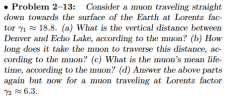 » Problem 2-13: Consider a muon traveling straight down towards the surface of the Earth at Lorentz fac- tor γι ~ 18.8. (a) What is the vertical distance between Denver and Echo Lake, according to the muon? (b) How long does it take the muon to traverse this distance, ac- cording to the muon? (c) What is the muon's mean life- time, according to the muon? (d) Answer the above parts again but now for a muon traveling at Lorentz...
You are an observer in a 100-m long spacecraft traveling from the earth to the moon...
You are an observer in a 100-m long spacecraft traveling from the earth to the moon at 0.8c. (a) What is the proper length of the spacecraft? (b) For a proper time interval of 1 sec., the relativistic time interval for the spacecraft measured from the earth reference frame would be: (c) Time dilation does not apply to all time-dependent physical and biological processes. T/F? (d) What is the relativistic length, DL measured from the reference frame of earth? (e)...
An unstable high-energy particle is created in the laboratory, and it moves at a speed of...
An unstable high-energy particle is created in the laboratory, and it moves at a speed of 0.994c. Relative to a stationary reference frame fixed to the laboratory, the particle travels a distance of 1.84 × 10⁻³ m before disintegrating. What is (a) the proper distance and (b) the distance measured by a hypothetical person traveling with the particle? Determine the particle's (c) proper lifetime and (d) its dilated lifetime. Numerical answer is not important...a) I do not understand why 1.84...
At time t = 0, two starships set out from their homebase on Earth, which they...
At time t = 0, two starships set out from their homebase on Earth, which they all agree is at x = 0. Both ships head directly for planet LV-426, which is infested with vicious aliens. According to earth controllers, LV-426 is 3 lightyears away. The starship Flyby travels at a constant speed 0.8 c; its mission is to take photos of the situation on LV-426 as it flies past the planet. The second ship, the Sulacco, travels at a...
this is one question but with multiple choice questions, sorry. Problem 1 You're in a spaceship...
 this is one question but with multiple choice questions,
sorry.
Problem 1 You're in a spaceship in deep space. Your engines are off, and you're far away from any reference points. a) You release a small ball from rest. The ball remains floating at rest in the same position where you released it. What kind of reference frame are you in? Is there any way to tell if you are moving at all? Let's designate your reference frame as S,...
this is one question but with multiple choice questions,
sorry.
Problem 1 You're in a spaceship in deep space. Your engines are off, and you're far away from any reference points. a) You release a small ball from rest. The ball remains floating at rest in the same position where you released it. What kind of reference frame are you in? Is there any way to tell if you are moving at all? Let's designate your reference frame as S,...
 An unstable particle is created in the upper atmosphere from a cosmic ray and travels straight down toward the surface of the earth with a speed of 0.99539 c relative to the earth. A scientist at rest on the earth's surface measures that the particle is created at an altitude of 48.0 km. Part A As measured by the scientist, how much time does it take the particle to travel the 48.0 km to the surface of the earth? IVO...
 » Problem 2-13: Consider a muon traveling straight down towards the surface of the Earth at Lorentz fac- tor γι ~ 18.8. (a) What is the vertical distance between Denver and Echo Lake, according to the muon? (b) How long does it take the muon to traverse this distance, ac- cording to the muon? (c) What is the muon's mean life- time, according to the muon? (d) Answer the above parts again but now for a muon traveling at Lorentz...
 this is one question but with multiple choice questions,
sorry.
Problem 1 You're in a spaceship in deep space. Your engines are off, and you're far away from any reference points. a) You release a small ball from rest. The ball remains floating at rest in the same position where you released it. What kind of reference frame are you in? Is there any way to tell if you are moving at all? Let's designate your reference frame as S,...
this is one question but with multiple choice questions,
sorry.
Problem 1 You're in a spaceship in deep space. Your engines are off, and you're far away from any reference points. a) You release a small ball from rest. The ball remains floating at rest in the same position where you released it. What kind of reference frame are you in? Is there any way to tell if you are moving at all? Let's designate your reference frame as S,...
Most questions answered within 3 hours.
-
Where is the error in this code sequence?
String s1 = "Hello";
String s2 = "ello";...
asked 11 months ago -
Financial data for Joel de Paris, Inc., for last year
follow:
Joel de Paris, Inc.
Balance...
asked 11 months ago -
Consider this reaction:
Al2(SO4)3 (aq)+ BaCl3
(aq) Al2Cl6 (aq)- +
3BaSO4(s) . What is the...
asked 11 months ago -
Suppose that Savneet is considering increasing her
recent random sample from 20 car rentals to 40...
asked 11 months ago -
Trucks arrive at an unloading terminal at an average rate of 120
per hour.
Trucks arrive...
asked 11 months ago -
Why are methanol and ethanol completely soluble in water while
octanol is not very little soluble....
asked 11 months ago -
A facilities manager at a university reads in a research report
that the mean amount of...
asked 11 months ago -
When the CuSO4 is rehydrated by adding water to the anhydrous
compound, is this an endothermic...
asked 11 months ago -
A ray of sunlight is passing from diamond into crown glass; the
angle of incidence is...
asked 11 months ago -
A block of mass 0.249 kg is placed on top of a light, vertical
spring of...
asked 11 months ago -
how do the kidneys compensate in the presences of acidosis
a) trigger hyperventilate
b) reserve acid...
asked 11 months ago -
Question 501 pts
The rental rate of capital to the firm increases. Which of the
following...
asked 11 months ago