12) Does an unanticipated inflation (actual inflation being higher than expected) increase or decrease the real...
12) Does an unanticipated inflation (actual inflation being higher than expected) increase or decrease the real interest rates in the economy? Does it favor borrowers or lenders?
Homework Answers
Answer
unanticipated inflation increase the real interest rate as actual inflation being higher than expected , money loose it value so protection to money to loose its value real interest rate increase and it favor borrowers as he has to pay less amount.
Add Answer to:
12) Does an unanticipated inflation (actual inflation being
higher than expected) increase or decrease the real...
True False Answer Bank Borrowers gain when inflation is higher than expected. Loan contracts specify the...
 True False Answer Bank Borrowers gain when inflation is higher than expected. Loan contracts specify the nominal interest rate. Real interest rates will never go negative. If inflation is higher than the nominal interest rate, the real interest rate is negative. Borrowers lose when inflation is higher than expected.
Unanticipated inflation: Select one: a. arbitrarily "taxes" fixed-income groups b. increases the real value of savings...
Unanticipated inflation: Select one: a. arbitrarily "taxes" fixed-income groups b. increases the real value of savings c. increases the purchasing power of the dollar d. benefits lenders at the expense of borrowers e. does not affect lenders or borrowers
If inflation this year is higher than expected, then both lenders and borrowers will gain and...
If inflation this year is higher than expected, then both lenders and borrowers will gain and the government will lose borrowers will gain at the expense of lenders both lenders and borrowers will lose lenders will gain at the expense of borrowers the government will lose unless it has implemented an indexed tax system
Compared with higher inflation rates, a lower inflation rate will (Increase or Decrease?) the after-tax real...
 Compared with higher inflation rates, a lower inflation rate
will (Increase or Decrease?) the after-tax real
interest rate when the government taxes nominal interest income.
This tends to (Encourage or Discourage?) saving,
thereby (Increasing or Decreasing) the quantity of
investment in the economy and (Increasing or Decreasing) the
economy's long-run growth rate.
Attempts: Keep the Highest: /2 8. Inflation-induced tax distortions Jacques receives a portion of his income from his holdings of interest-bearing government bonds. The bonds offer a real...
Compared with higher inflation rates, a lower inflation rate
will (Increase or Decrease?) the after-tax real
interest rate when the government taxes nominal interest income.
This tends to (Encourage or Discourage?) saving,
thereby (Increasing or Decreasing) the quantity of
investment in the economy and (Increasing or Decreasing) the
economy's long-run growth rate.
Attempts: Keep the Highest: /2 8. Inflation-induced tax distortions Jacques receives a portion of his income from his holdings of interest-bearing government bonds. The bonds offer a real...
Determine if each statement is true or false. True False Answer Bank Borrowers gain when inflation...
 Determine if each statement is true or false. True False Answer Bank Borrowers gain when inflation is lower than expected, If inflation is higher than the nominal interest rate, the real interest rate is negative Loan contracts specify the nominal interest rate, Real interest rates will never go negative. Lenders gain when inflation is lower than expected,
Suppose the nominal interest rate on savings accounts is 11% per year, and both actual and expected inflation are equal to 5%.
 6. The Fisher effect and the cost of unexpected inflation Suppose the nominal interest rate on savings accounts is 11% per year, and both actual and expected inflation are equal to 5%. Complete the first row of the table by filling in the expected real interest rate and the actual real interest rate before any change in the money supply. Now suppose the Fed unexpectedly increases the growth rate of the money supply, causing the inflation rate to rise unexpectedly from 5% to...
please print out words show the answer,thanks! 8. Suppose real interest rate r-4% and expected inflation...
 please print out words show the
answer,thanks!
8. Suppose real interest rate r-4% and expected inflation rate for the following year En 4%. (a) What is the nominal interest rate? (2 points) (b) What is the ex ante real interest rate? (2 points) Suppose the actual inflation rate at the end of the following year π turned out to be 6%. (c) What is the ex post real interest rate? (3 points) (d) Borrowers (gain/oseand lende and lenders (gain/lose) (4...
please print out words show the
answer,thanks!
8. Suppose real interest rate r-4% and expected inflation rate for the following year En 4%. (a) What is the nominal interest rate? (2 points) (b) What is the ex ante real interest rate? (2 points) Suppose the actual inflation rate at the end of the following year π turned out to be 6%. (c) What is the ex post real interest rate? (3 points) (d) Borrowers (gain/oseand lende and lenders (gain/lose) (4...
Males Hase ii. Real GDP Decrease iii. Unemployment Rate Increase iv. Inflation Rate Decrease Use an...
 Males Hase ii. Real GDP Decrease iii. Unemployment Rate Increase iv. Inflation Rate Decrease Use an Aggregate Demand - Aggregate Supply model beginning at full employment (RGDP=PGDP) to show the effects that an easy money" policy of low interest rates and easy credit by the Fed would have on the U.S. economy. LRAS SRAS To AD Yo 12) (Bonus) We are given the follqwing information about the assets and liabilities or a bank:
1. The best definition of inflation is a(n): a temporary increase in prices. b. increase in...
 1. The best definition of inflation is a(n): a temporary increase in prices. b. increase in the price of one important commodity such as food. c. persistent increase in the general level of prices as measured by a price index. d. increase in the purchasing power of the dollar. 2. Inflation: a. reduces the cost-of-living of the typical worker. b. is measured by changes in the cost of a typical market basket of goods between time periods. c. causes the...
QUESTION 8 Higher rates of inflation would tend to: O a. increase velocity and decrease nominal...
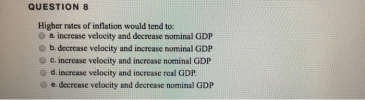 QUESTION 8 Higher rates of inflation would tend to: O a. increase velocity and decrease nominal GDP b. decrease velocity and increase nominal GDP c. increase velocity and increase nominal GDP e d. increase velocity and increase real GDP e. decrease velocity and decrease nominal GDP
 True False Answer Bank Borrowers gain when inflation is higher than expected. Loan contracts specify the nominal interest rate. Real interest rates will never go negative. If inflation is higher than the nominal interest rate, the real interest rate is negative. Borrowers lose when inflation is higher than expected.
 Compared with higher inflation rates, a lower inflation rate
will (Increase or Decrease?) the after-tax real
interest rate when the government taxes nominal interest income.
This tends to (Encourage or Discourage?) saving,
thereby (Increasing or Decreasing) the quantity of
investment in the economy and (Increasing or Decreasing) the
economy's long-run growth rate.
Attempts: Keep the Highest: /2 8. Inflation-induced tax distortions Jacques receives a portion of his income from his holdings of interest-bearing government bonds. The bonds offer a real...
Compared with higher inflation rates, a lower inflation rate
will (Increase or Decrease?) the after-tax real
interest rate when the government taxes nominal interest income.
This tends to (Encourage or Discourage?) saving,
thereby (Increasing or Decreasing) the quantity of
investment in the economy and (Increasing or Decreasing) the
economy's long-run growth rate.
Attempts: Keep the Highest: /2 8. Inflation-induced tax distortions Jacques receives a portion of his income from his holdings of interest-bearing government bonds. The bonds offer a real...
 Determine if each statement is true or false. True False Answer Bank Borrowers gain when inflation is lower than expected, If inflation is higher than the nominal interest rate, the real interest rate is negative Loan contracts specify the nominal interest rate, Real interest rates will never go negative. Lenders gain when inflation is lower than expected,
 please print out words show the
answer,thanks!
8. Suppose real interest rate r-4% and expected inflation rate for the following year En 4%. (a) What is the nominal interest rate? (2 points) (b) What is the ex ante real interest rate? (2 points) Suppose the actual inflation rate at the end of the following year π turned out to be 6%. (c) What is the ex post real interest rate? (3 points) (d) Borrowers (gain/oseand lende and lenders (gain/lose) (4...
please print out words show the
answer,thanks!
8. Suppose real interest rate r-4% and expected inflation rate for the following year En 4%. (a) What is the nominal interest rate? (2 points) (b) What is the ex ante real interest rate? (2 points) Suppose the actual inflation rate at the end of the following year π turned out to be 6%. (c) What is the ex post real interest rate? (3 points) (d) Borrowers (gain/oseand lende and lenders (gain/lose) (4...
 Males Hase ii. Real GDP Decrease iii. Unemployment Rate Increase iv. Inflation Rate Decrease Use an Aggregate Demand - Aggregate Supply model beginning at full employment (RGDP=PGDP) to show the effects that an easy money" policy of low interest rates and easy credit by the Fed would have on the U.S. economy. LRAS SRAS To AD Yo 12) (Bonus) We are given the follqwing information about the assets and liabilities or a bank:
 1. The best definition of inflation is a(n): a temporary increase in prices. b. increase in the price of one important commodity such as food. c. persistent increase in the general level of prices as measured by a price index. d. increase in the purchasing power of the dollar. 2. Inflation: a. reduces the cost-of-living of the typical worker. b. is measured by changes in the cost of a typical market basket of goods between time periods. c. causes the...
 QUESTION 8 Higher rates of inflation would tend to: O a. increase velocity and decrease nominal GDP b. decrease velocity and increase nominal GDP c. increase velocity and increase nominal GDP e d. increase velocity and increase real GDP e. decrease velocity and decrease nominal GDP
Most questions answered within 3 hours.
-
Where is the error in this code sequence?
String s1 = "Hello";
String s2 = "ello";...
asked 10 months ago -
Financial data for Joel de Paris, Inc., for last year
follow:
Joel de Paris, Inc.
Balance...
asked 10 months ago -
Consider this reaction:
Al2(SO4)3 (aq)+ BaCl3
(aq) Al2Cl6 (aq)- +
3BaSO4(s) . What is the...
asked 10 months ago -
Suppose that Savneet is considering increasing her
recent random sample from 20 car rentals to 40...
asked 10 months ago -
Trucks arrive at an unloading terminal at an average rate of 120
per hour.
Trucks arrive...
asked 10 months ago -
Why are methanol and ethanol completely soluble in water while
octanol is not very little soluble....
asked 10 months ago -
A facilities manager at a university reads in a research report
that the mean amount of...
asked 10 months ago -
When the CuSO4 is rehydrated by adding water to the anhydrous
compound, is this an endothermic...
asked 10 months ago -
A ray of sunlight is passing from diamond into crown glass; the
angle of incidence is...
asked 10 months ago -
A block of mass 0.249 kg is placed on top of a light, vertical
spring of...
asked 10 months ago -
how do the kidneys compensate in the presences of acidosis
a) trigger hyperventilate
b) reserve acid...
asked 10 months ago -
Question 501 pts
The rental rate of capital to the firm increases. Which of the
following...
asked 10 months ago