A rich relative has bequeathed you a growing perpetuity. The first payment will occur in a...
A rich relative has bequeathed you a growing perpetuity. The first payment will occur in a year and will be $1,000. Each year after that, you will receive a payment on the anniversary of the last payment that is 6% larger than the last payment. This pattern of payments will go on forever. What is value (in $) of the bequest today if the interest rate is 11% per year?
$
--------------------------------------------------------------------------------------------------------------------------------------------------------------------------------
You are thinking of building a new machine that will save you $1,000 in the first year. The machine will then begin to wear out so that the savings decline at a rate of 5% per year forever. What is the present value (in $) of the savings if the interest rate is 2% per year? (Round your answer to the nearest cent.)
$
--------------------------------------------------------------------------------------------------------------------------------------------------------------------------------
Assume that Social Security promises you $30,000 per year starting when you retire 45 years from today (the first $30,000 will come 45 years from now). If your discount rate is 6%, and you expect to live for 15 years after retiring (so that you will get a total of 16 payments including the first one), what is the value today of Social Security's promise (in $)? (Round your answer to the nearest cent.)
$
--------------------------------------------------------------------------------------------------------------------------------------------------------------------------------
Suppose that a young couple has just had their first baby and they wish to ensure that enough money will be available to pay for their child's college education. They decide to make deposits into an educational savings account on each of their daughter's birthdays, starting with her first birthday until her 18th birthday. The parents deposit $3,500 on their daughter's first birthday and plan to increase the size of their deposits by 5% each year. Assume that the educational savings account will return a constant 6%.
How much will the parents deposit (in $) on the second birthday?
$
How much will the parents deposit (in $) on the 18th birthday? (Round your answer to the nearest cent.)
$
What is the total balance available for their daughter's college expenses (in $) on her 18th birthday right after they make their 18th and final deposit? (Round your answer to the nearest cent.)
$
Homework Answers
HI
As per policy we will solve only first question here.
Here This is example of growing perpetuity
first payment C1 = $1000
growth rate g = 6%
interest rate r = 11%
Present Value of perpetuity = C1/(r-g)
=1000/(11%-6%)
= $20,000
Thanks
Add Answer to:
A rich relative has bequeathed you a growing perpetuity. The
first payment will occur in a...
A rich relative has bequeathed you a growing perpetuity. The first payment will occur in a...
A rich relative has bequeathed you a growing perpetuity. The first payment will occur in a year and will be $ 1,000. Each year after that, you will receive a payment on the anniversary of the last payment that is nbsp 7 % larger than the last payment. This pattern of payments will go on forever. Assume that the interest rate is 15 % per year. a. What is today's value of the bequest? (Round to the nearest cent.) b....
A rich relative has bequeathed you a growing perpetuity. The first payment will occur in a...
 A rich relative has bequeathed you a growing perpetuity. The first payment will occur in a year and will be $1,000. Each year after that, you will receive a payment on the anniversary of the last payment that is 2% larger than the last payment. This pattern of payments will go on forever. Assume that the interest rate is 14% per year. a. What is today's value of the bequest? b. What is the value of the bequest immediately after...
A rich relative has bequeathed you a growing perpetuity. The first payment will occur in a...
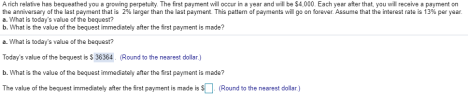 A rich relative has bequeathed you a growing perpetuity. The first payment will occur in a year and will be $4,000. Each year after that, you will receive a payment on the anniversary of the last payment that is 2% larger than the last payment. This pattern of payments will go on forever. Assume that the interest rate is 13% per year. a. What is today's value of the bequest? b. What is the value of the bequest immediately after...
A rich relative has bequeathed you a growing perpetuity. The first payment will occur in a...
A rich relative has bequeathed you a growing perpetuity. The first payment will occur in a year and will be $ 1 comma 000$1,000. Each year after that, you will receive a payment on the anniversary of the last payment that is nbsp 3 % 3% larger than the last payment. This pattern of payments will go on forever. Assume that the interest rate is 12 %12% per year. a. What is today's value of the bequest? b. What is...
rich relative has bequeathed you a growing perpetuity. The first payment will occur in a year...
rich relative has bequeathed you a growing perpetuity. The first payment will occur in a year and will be $ 3 comma 000$3,000. Each year after that, you will receive a payment on the anniversary of the last payment that is nbsp 3 % 3% larger than the last payment. This pattern of payments will go on forever. Assume that the interest rate is 14 %14% per year. a. What is today's value of the bequest? b. What is the...
A rich relative has bequeathed you a growing perpetuity. The first payment will occur one year...
A rich relative has bequeathed you a growing perpetuity. The first payment will occur one year from now and will be $1,000. Each year after that, you will receive a payment on the anniversary of the previous payment that is 8% larger than the previous payment. This pattern of payments will go on forever. Assume that the interest rate is 12% per year. a) What is today’s value of the bequest? b) What is the value of the bequest immediately...
Suppose that a young couple has just had their first baby and they wish to insure...
Suppose that a young couple has just had their first baby and they wish to insure that enough money will be available to pay for their child's college education. They decide to make deposits into an educational savings account on each of their daughter's birthdays, starting with her first birthday. Assume that the educational savings account will return a constant 10%. The parents deposit $ 1,500 on their daughter's first birthday and plan to increase the size of their deposits...
Suppose that a young couple has just had their first baby and they wish to insure...
Suppose that a young couple has just had their first baby and they wish to insure that enough money will be available to pay for their child's college education. They decide to make deposits into an educational savings account on each of their daughter's birthdays, starting with her first birthday. Assume that the educational savings account will return a constant 10%. The parents deposit $ 2,500 on their daughter's first birthday and plan to increase the size of their deposits...
Suppose that a young couple has just had their first baby and they wish to insure...
Suppose that a young couple has just had their first baby and they wish to insure that enough money will be available to pay for their child's college education. They decide to make deposits into an educational savings account on each of their daughter's birthdays, starting with her first birthday. Assume that the educational savings account will return a constant 9%. The parents deposit $2400 on their daughter's first birthday. After 10 payments, they increase the annual amount to $4,000....
QUESTION 6 Suppose that a young couple has just had their first baby and they wish...
 QUESTION 6 Suppose that a young couple has just had their first baby and they wish to insure that enough money will be available to pay for their child's college education. They decide to make deposits into an educational savings account on each of their daughter's birthdays, starting with her first birthday. Assume that the educational savings account will return a constant 9%. The parents deposit $2400 on their daughter's first birthday and plan to increase the size of their...
 A rich relative has bequeathed you a growing perpetuity. The first payment will occur in a year and will be $1,000. Each year after that, you will receive a payment on the anniversary of the last payment that is 2% larger than the last payment. This pattern of payments will go on forever. Assume that the interest rate is 14% per year. a. What is today's value of the bequest? b. What is the value of the bequest immediately after...
 A rich relative has bequeathed you a growing perpetuity. The first payment will occur in a year and will be $4,000. Each year after that, you will receive a payment on the anniversary of the last payment that is 2% larger than the last payment. This pattern of payments will go on forever. Assume that the interest rate is 13% per year. a. What is today's value of the bequest? b. What is the value of the bequest immediately after...
 QUESTION 6 Suppose that a young couple has just had their first baby and they wish to insure that enough money will be available to pay for their child's college education. They decide to make deposits into an educational savings account on each of their daughter's birthdays, starting with her first birthday. Assume that the educational savings account will return a constant 9%. The parents deposit $2400 on their daughter's first birthday and plan to increase the size of their...
Most questions answered within 3 hours.
-
Where is the error in this code sequence?
String s1 = "Hello";
String s2 = "ello";...
asked 11 months ago -
Financial data for Joel de Paris, Inc., for last year
follow:
Joel de Paris, Inc.
Balance...
asked 11 months ago -
Consider this reaction:
Al2(SO4)3 (aq)+ BaCl3
(aq) Al2Cl6 (aq)- +
3BaSO4(s) . What is the...
asked 11 months ago -
Suppose that Savneet is considering increasing her
recent random sample from 20 car rentals to 40...
asked 11 months ago -
Trucks arrive at an unloading terminal at an average rate of 120
per hour.
Trucks arrive...
asked 11 months ago -
Why are methanol and ethanol completely soluble in water while
octanol is not very little soluble....
asked 11 months ago -
A facilities manager at a university reads in a research report
that the mean amount of...
asked 11 months ago -
When the CuSO4 is rehydrated by adding water to the anhydrous
compound, is this an endothermic...
asked 11 months ago -
A ray of sunlight is passing from diamond into crown glass; the
angle of incidence is...
asked 11 months ago -
A block of mass 0.249 kg is placed on top of a light, vertical
spring of...
asked 11 months ago -
how do the kidneys compensate in the presences of acidosis
a) trigger hyperventilate
b) reserve acid...
asked 11 months ago -
Question 501 pts
The rental rate of capital to the firm increases. Which of the
following...
asked 11 months ago