Networks and telecom Which layer of the OSI model handles data formatting and translation? a. Application...
Networks and telecom
Which layer of the OSI model handles data formatting and translation?
| a. |
Application |
|
| b. |
Physical |
|
| c. |
Presentation |
|
| d. |
Data Link |
Homework Answers

Add Answer to:
Networks and telecom
Which layer of the OSI
model handles data formatting and translation?
a.
Application...
Networks and telecom Which layer of the OSI model handles flow control and acknowledgements? a. Session...
Networks and telecom Which layer of the OSI model handles flow control and acknowledgements? a. Session b. Data Link c. Network d. Transport
What layer of the OSI is where the port numbers are defined? Application Presentation Session Transport...
What layer of the OSI is where the port numbers are defined? Application Presentation Session Transport Network Data Link Physical What layer of the OSI is responsible for path selection? Application Presentation Session Transport Network Data Link Physical What layer of the OSI is responsible for MP4 and WAV files? Application Presentation Session Transport Network Data Link Physical What layer of the OSI responsible for a common language to be used? Application Presentation Session Transport Network Data Link Physical
Relate the OSI model layer to its proper role. Physical Data Link Net Transport Session Presentation...
Relate the OSI model layer to its proper role. Physical Data Link Net Transport Session Presentation Application A. Provides network services to users and programs. B. Establish reliable connections between terminal devices. C. Determine the best way to transport a message to its destination. D. Convert data to signals. E. Controls the dialogue between terminal device applications. F. Controls access to the transmission medium between directly connected devices. G. Determine the correct format of the data.
Determine which layer(s) of the seven layers of the OSI model has (have) the following functions....
Determine which layer(s) of the seven layers of the OSI model has (have) the following functions. List all the layers if more than one layer have the function, e.g. PL (Physical Layer), DL (Data Link Layer), NL (Network Layer), TL (Transport Layer), & AL (Application Layer – OSI layers 5 - 7). addressing end-to-end network packet delivery connection-oriented or connectionless segmentation or streaming end-to-end user data delivery
Determine which layer(s) of the seven layers of the OSI model has (have) the following functions....
Determine which layer(s) of the seven layers of the OSI model has (have) the following functions. List all the layers if more than one layer have the function, e.g. PL (Physical Layer), DL (Data Link Layer), NL (Network Layer), TL (Transport Layer), & AL (Application Layer – OSI layers 5 - 7). (10 points – 1 points for each sub-question) modulation flow controls error detection & error controls multiplexing collision detection addressing end-to-end network packet delivery connection-oriented or connectionless segmentation...
The OSI Presentation layer true Ofalse - handles checking if users are loggin in true false...
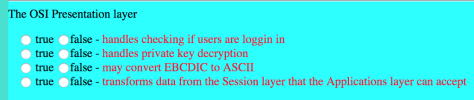 The OSI Presentation layer true Ofalse - handles checking if users are loggin in true false - handles private key decryption true false - may convert EBCDIC to ASCII true false - transforms data from the Session layer that the Applications layer can accept
Which of the following are true when comparing TCP/IP to the OSI Reference Model? (Choose two.)...
Which of the following are true when comparing TCP/IP to the OSI Reference Model? (Choose two.) A. The TCP/IP model has seven layers, while the OSI model has only four layers. B. The TCP/IP model has four layers, while the OSI model has seven layers. C. The TCP/IP Application layer maps to the Application, Session, and Presentation layers of the OSI Reference Model. D. The TCP/IP Application layer is virtually identical to the OSI Application layer.
Question 26 In the TCP/IP model, what layer combines the responsibilities of the Application, Presentation, and...
Question 26 In the TCP/IP model, what layer combines the responsibilities of the Application, Presentation, and Session layers from the OSI model? a. Internet b. Application c. Transport d. Link 1.25 points Question 27 In the TCP/IP model, what layer is considered so simple that it is ignored entirely? a. Network b. Data Link c. Application d. Physical 1.25 points Question 28 In the United States, who is able to activate the Emergency Alert System at the national level? a....
Explain how the Physical Layer of the OSI model works. Identify which layer of the OSI...
Explain how the Physical Layer of the OSI model works. Identify which layer of the OSI model the IP Protocol and HTTP operates. Identify the layer of the OSI model a router operates. Explain the difference between IPCONFIG vs. IPCONFIG /ALL. Explain the purpose of an IPv4 loopback address and how it works. What TCP/IP utility would you use to find another computer’s IP address? Explain the difference between a static route and a default route. Explain the difference between...
Consider removing the Session and Presentation layers from the 7-layer OSI model resulting in the 5-layer...
Consider removing the Session and Presentation layers from the 7-layer OSI model resulting in the 5-layer Internet model discussed in class. What is the impact os us as the application developers? In other words, how does this change impact us? Consider changing the algorithms but maintaining the same functionality in the Session and Presentation layers from the 7-layer OSI discussed in class. What is the impact os us as the application developers? In other words, how does this change impact...
 The OSI Presentation layer true Ofalse - handles checking if users are loggin in true false - handles private key decryption true false - may convert EBCDIC to ASCII true false - transforms data from the Session layer that the Applications layer can accept
Most questions answered within 3 hours.
-
Where is the error in this code sequence?
String s1 = "Hello";
String s2 = "ello";...
asked 11 months ago -
Financial data for Joel de Paris, Inc., for last year
follow:
Joel de Paris, Inc.
Balance...
asked 11 months ago -
Consider this reaction:
Al2(SO4)3 (aq)+ BaCl3
(aq) Al2Cl6 (aq)- +
3BaSO4(s) . What is the...
asked 11 months ago -
Suppose that Savneet is considering increasing her
recent random sample from 20 car rentals to 40...
asked 11 months ago -
Trucks arrive at an unloading terminal at an average rate of 120
per hour.
Trucks arrive...
asked 11 months ago -
Why are methanol and ethanol completely soluble in water while
octanol is not very little soluble....
asked 11 months ago -
A facilities manager at a university reads in a research report
that the mean amount of...
asked 11 months ago -
When the CuSO4 is rehydrated by adding water to the anhydrous
compound, is this an endothermic...
asked 11 months ago -
A ray of sunlight is passing from diamond into crown glass; the
angle of incidence is...
asked 11 months ago -
A block of mass 0.249 kg is placed on top of a light, vertical
spring of...
asked 11 months ago -
how do the kidneys compensate in the presences of acidosis
a) trigger hyperventilate
b) reserve acid...
asked 11 months ago -
Question 501 pts
The rental rate of capital to the firm increases. Which of the
following...
asked 11 months ago