in the 1970's a loaf of bread was $.00, what would the price of a loaf...
in the 1970's a loaf of bread was $.00, what would the price of a loaf be in 2018?
the losf was a $1.00
Homework Answers
The price of a loaf of bread in 2018 is around $2.50. A loaf of bread is basic necessity item of food and the demand of the good is relatively inelastic. Thus, the price of the loaf of bread has not increased much in 2018 as compared to its increase in 1970. The price of necessities do not rise by a high margin which is also the case of milk where the prices have not increased much compared to their prices in 1970s.
Add Answer to:
in the 1970's a loaf of bread was $.00, what would the
price of a loaf...
Suppose the equilibrium price of bread is $2 per loaf. What would be the efficiency implications...
Suppose the equilibrium price of bread is $2 per loaf. What would be the efficiency implications of a government policy that prevents the price of bread from rising above $1? A. The outcome would be inefficient since the marginal cost of producing bread is less than the marginal benefit to the consumers. B. The outcome would be inefficient since the marginal benefit to consumers is less than the marginal cost of producing the bread. C. The outcome would be efficient...
There are two grocers. Each grocer charges its own price for a loaf of bread, either...
There are two grocers. Each grocer charges its own price for a loaf of bread, either $1, $4, or $5. The cost of obtaining and selling the bread can be neglected. 8000 loafs of bread per month are bought from a grocer by seniors who will choose randomly from one of the two grocers. 4000 loafs of bread per month are bought by local residents who go to the grocer with the lower price, and split evenly in both grocers...
please show work!! If the price of a loaf of bread has tripled over the past...
 please show work!!
If the price of a loaf of bread has tripled over the past 8 years, what has been the annual rate of inflation in the price of bread over that time period? Round your answer to 2 decimal places and enter your answer as a percent, but without a percent sign. For example, enter 25.486% as 25.49.
please show work!!
If the price of a loaf of bread has tripled over the past 8 years, what has been the annual rate of inflation in the price of bread over that time period? Round your answer to 2 decimal places and enter your answer as a percent, but without a percent sign. For example, enter 25.486% as 25.49.
A loaf of bread weighs 5.30N on earth
A loaf of bread weighs 5.30N on earth. A) What would it weigh, in newtons, on Mars, where the acceleration due to gravity is 0.378 times that on Earth? B) What would it weigh on Neptune where "g" is 1.14 times that on Earth?
Bakery A sells bread for $2 per loaf that costs $0.50 per loaf to make. Bakery...
Bakery A sells bread for $2 per loaf that costs $0.50 per loaf to make. Bakery A gives an 80% discount for its bread at the end of the day. What is the overage cost? $0.40 $1.50 $0.10 $0.50
A loaf of bread is about $2 on sale today. If the rate of inflation was...
A loaf of bread is about $2 on sale today. If the rate of inflation was 4% and compounded monthly, what would have you parents paid 50 years ago for the same loaf? a. 2 cents b. 5 cents c. 10 cents d. 12 cents e. 25 cents
Bakery ABC sells bread for $2.1 per loaf that costs $0.78 per loaf to make. Bakery ABC knows that at the end of the day,...
Bakery ABC sells bread for $2.1 per loaf that costs $0.78 per loaf to make. Bakery ABC knows that at the end of the day, he can sell all remaining bread for $0.45. Assuming Bakery ABC behaves optimally, what is the probability he would have a stockout each day? Note: If your answer is 12.345%, record 0.1235
The two goods are bread and water. The person's budget is $1200. The price of bread...
The two goods are bread and water. The person's budget is $1200. The price of bread is $1/loaf. The price of water is $4/unit. What is the maximum amount of bread on the person's budget constraint?
1. Consider a consumer who chooses between apples and bread. Bread costs 2 a loaf and...
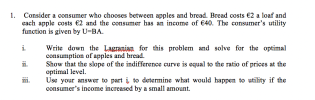 1. Consider a consumer who chooses between apples and bread. Bread costs 2 a loaf and each apple costs 2 and the consumer has an income of 40. The consumer's utility function is given by U-BA i. Write down the Lagranian for this problem and solve for the optimal 11. Show that the slope of the indifference curve is equal to the ratio of prices at the iii. Use your answer to part i, to determine what would happen to...
Consider the following descriptive statistics from Excel for a sample of bread loaf weights (in grams) baked in a Towns...
Consider the following descriptive statistics from Excel for a sample of bread loaf weights (in grams) baked in a Townsville bakery. Median 428 Standard Deviation 27.2406 Sample Variance 11130.8095 Range 314 Minimum 201 Maximum 515 Sum 5810 Count 15 What is the 99% confidence interval for the population mean weight of a bread loaf baked in this bakery? a
 please show work!!
If the price of a loaf of bread has tripled over the past 8 years, what has been the annual rate of inflation in the price of bread over that time period? Round your answer to 2 decimal places and enter your answer as a percent, but without a percent sign. For example, enter 25.486% as 25.49.
please show work!!
If the price of a loaf of bread has tripled over the past 8 years, what has been the annual rate of inflation in the price of bread over that time period? Round your answer to 2 decimal places and enter your answer as a percent, but without a percent sign. For example, enter 25.486% as 25.49.
 1. Consider a consumer who chooses between apples and bread. Bread costs 2 a loaf and each apple costs 2 and the consumer has an income of 40. The consumer's utility function is given by U-BA i. Write down the Lagranian for this problem and solve for the optimal 11. Show that the slope of the indifference curve is equal to the ratio of prices at the iii. Use your answer to part i, to determine what would happen to...
Most questions answered within 3 hours.
-
Where is the error in this code sequence?
String s1 = "Hello";
String s2 = "ello";...
asked 11 months ago -
Financial data for Joel de Paris, Inc., for last year
follow:
Joel de Paris, Inc.
Balance...
asked 11 months ago -
Consider this reaction:
Al2(SO4)3 (aq)+ BaCl3
(aq) Al2Cl6 (aq)- +
3BaSO4(s) . What is the...
asked 11 months ago -
Suppose that Savneet is considering increasing her
recent random sample from 20 car rentals to 40...
asked 11 months ago -
Trucks arrive at an unloading terminal at an average rate of 120
per hour.
Trucks arrive...
asked 11 months ago -
Why are methanol and ethanol completely soluble in water while
octanol is not very little soluble....
asked 11 months ago -
A facilities manager at a university reads in a research report
that the mean amount of...
asked 11 months ago -
When the CuSO4 is rehydrated by adding water to the anhydrous
compound, is this an endothermic...
asked 11 months ago -
A ray of sunlight is passing from diamond into crown glass; the
angle of incidence is...
asked 11 months ago -
A block of mass 0.249 kg is placed on top of a light, vertical
spring of...
asked 11 months ago -
how do the kidneys compensate in the presences of acidosis
a) trigger hyperventilate
b) reserve acid...
asked 11 months ago -
Question 501 pts
The rental rate of capital to the firm increases. Which of the
following...
asked 11 months ago