Inflation started to creep up in the late 1960's. By 1968, inflation was about 4% and...
Homework Answers
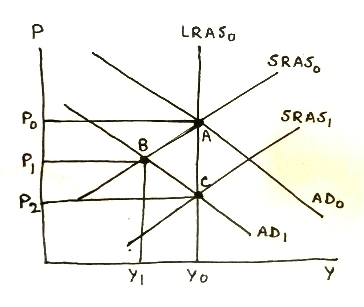
Fed can disinflate the economy by decreasing money supply, which will increase interest rate, lowering investment demand and reducing aggregate demand. AD curve will shift to left, reducing both price level and real GDP, giving rise to a recessionary gap in short run.
In the long run, lower price level will decrease wages and production costs. Firms will increase output, increasing aggregate supply. SRAS shifts rightward, intersecting new AD curve at further lower price level but restoring real GDP to potential GDP level, wiping out the short-run recessionary gap.
In following graph, initial long-run equilibrium is at point A where AD0 (aggregate demand), LRAS0 (long-run aggregate supply) and SRAS0 (short-run aggregate supply) curves intersect with long-run equilibrium price level P0 and long-run equilibrium real GDP (= potential GDP) Y0. When aggregate demand falls, AD curve will shift leftward from AD0 to AD1, intersecting SRAS0 at point B with lower price level P1 and lower real output Y1, with short run recessionary gap of (Y0 - Y1). In the long run, SRAS0 shifts right to SRAS1, intersecting AD1 at point C with further lower price level P2 and restoring real GDP to potential GDP level Y0, removing the short-run recessionary gap.
Add Answer to:
Inflation started to creep up in the late 1960's. By 1968,
inflation was about 4% and...
Inflation started to creep up in the late 1960's. By 1968, inflation was about 4%, and...
Inflation started to creep up in the late 1960's. By 1968, inflation was about 4%, and by 1973, inflation was about 6%. By 1980, inflation was at 13.5%. The Fed, led by Chairman Paul Volcker, engineered a recession that eventually disinflated the economy. Using the economic the concepts learned in class, especially the economics fluctuation model, explain how the Fed disinflates the economy from 13.5% to 3.5%, and what the effects of that disinflation are in the SR and the...
1. Year Nominal GDP GDP Price deflator Real GDP Inflation Rate
1. Year Nominal GDP GDP Price deflator Real GDP Inflation Rate Growth Rate 2008 $14,833.60 99.23 -- -- 2009 14,417.90 100.00 2010 14,779.40 101.21 2011 15,052.40 103.20 2012 15,470.70 105.00 2013 15,759.00 106.59 2014 17,420.70 108.27 2015 18,287.20 110.01 2016 18,905.50 112.08 2017 19,738.90 114.27 a. Fill in the blanks in the table above and show your work. b. Over this time period, does inflation...
Most questions answered within 3 hours.
-
Where is the error in this code sequence?
String s1 = "Hello";
String s2 = "ello";...
asked 11 months ago -
Financial data for Joel de Paris, Inc., for last year
follow:
Joel de Paris, Inc.
Balance...
asked 11 months ago -
Consider this reaction:
Al2(SO4)3 (aq)+ BaCl3
(aq) Al2Cl6 (aq)- +
3BaSO4(s) . What is the...
asked 11 months ago -
Suppose that Savneet is considering increasing her
recent random sample from 20 car rentals to 40...
asked 11 months ago -
Trucks arrive at an unloading terminal at an average rate of 120
per hour.
Trucks arrive...
asked 11 months ago -
Why are methanol and ethanol completely soluble in water while
octanol is not very little soluble....
asked 11 months ago -
A facilities manager at a university reads in a research report
that the mean amount of...
asked 11 months ago -
When the CuSO4 is rehydrated by adding water to the anhydrous
compound, is this an endothermic...
asked 11 months ago -
A ray of sunlight is passing from diamond into crown glass; the
angle of incidence is...
asked 11 months ago -
A block of mass 0.249 kg is placed on top of a light, vertical
spring of...
asked 11 months ago -
how do the kidneys compensate in the presences of acidosis
a) trigger hyperventilate
b) reserve acid...
asked 11 months ago -
Question 501 pts
The rental rate of capital to the firm increases. Which of the
following...
asked 11 months ago