the major product formed in the bromination of (E)- Stilbene can be described as; check all...
Homework Answers
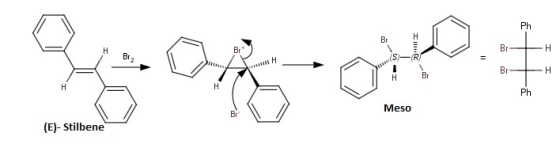
(E)- Stilbene reaction with Br2 to give cyclic bromonium ion intermediate is unstable because of the strain in the three membered it will reacts rapidly with nucleophile (Br- ) to give meso -(1,2-dibromo-2-phenylethyl)benzene
If trans substituents are identical it will give meso compound via stereochemically anti addition
it has chiral carbon present but plane of symmetry present
meso-(1,2-dibromo-2-phenylethyl)benzene is optically inactive due to plane of symmetry present
Add Answer to:
the
major product formed in the bromination of (E)- Stilbene can be
described as; check all...
1. What is the expected product melting point if the bromination of stilbene by PHPB is...
1. What is the expected product melting point if the bromination of stilbene by PHPB is completely stereospecific (anti addition)? 2. How would the melting point be affected if the reaction is not completely stereospecific and the dibromide product contains significant amounts of dl-stilbene dibromide, as well as the expected meso stilbene dibromide? Note the widely differing melting points of the meso and dl isomers. 3. What is the theoretical yield of dibromide product in the bromination reaction? 4. How...
alswering these questions. 1. If the bromination of trans-stilbene proceeded by syn addition what isomer(s) of...
 alswering these questions. 1. If the bromination of trans-stilbene proceeded by syn addition what isomer(s) of stilbene dibromide would be formed? 2. If the bromination of trans-stilbene proceeded by anti addition what isomer(s) of stilbene dibromide would be formed? 3. Which isomer(s) of stilbene dibromide would be formed if the reaction followed Mechanism 4? Mechanism 4: Bromination is a multi-step process. In this mechanism, the pi bond attacks the bromine molecule as in Mechanism 1. Some time after the carbocation...
1. Most of the class will be brominating trans-stilbene (part B) and the rest cis-stilbene (part...
 1. Most of the class will be brominating trans-stilbene (part B) and the rest cis-stilbene (part A). For this assignment write a detailed procedure in your lab notebook for Part B. Upload a picture/scanned copy (5 pts). Tip: If you write the procedure down the left half of the page, you can leave space to record your measurements/observations down the right side of the page. If you end up using cis-stilbene in the experimental there will only be a few...
2. Your lab manual proposes 3 possible mechanisms for bromination. During this lab, you will determine...
 2. Your lab manual proposes 3 possible mechanisms for bromination. During this lab, you will determine which iroduct(s) formed during the bromination of stilbene. (9 pts) a. Four possible products from the bromination of trans-stilbene are shown below. Label the chiral centers as Sor R. Ph Br Br H iph H Phil Br Ph Ph Br B. HINH Philiph Phí By HP b. The enantiomer of structure A is: c. The enantiomer of structure Dis: d. Ust the letters corresponding...
UCLEIC VIIICILIUUULLIS IULICU UUII LIUIUNTA LIUIUISLIUCIC. PLS a. Four possible products from the bromination of trans-stilbene...
 UCLEIC VIIICILIUUULLIS IULICU UUII LIUIUNTA LIUIUISLIUCIC. PLS a. Four possible products from the bromination of trans-stilbene are shown below. Label the chiral centers as Sor R. Ph HBr Br Ph phir H Br Ph Br Phuph Br Ph BrH b. The enantiomer of structure A is: C. The enantiomer of structure Dis: d. List the letters corresponding to the meso structures, if any:_ e. Which structures, if any, are chiral molecules:___ f. Which structures, if any, are achiral molecules:
Although the stereochemistry of the alkene cannot be determined from an NMR spectrum, it can be...
Although the stereochemistry of the alkene cannot be determined from an NMR spectrum, it can be deduced from the stereochemistry of the final dibromide product (see Chapter 7 in Carey). 1) clearly depict allof the stereoisomers for the final dibromide that could be formed from each stilbene isomer; 2) for the dibromide products, clearly label each chiral carbon with the appropriate R/S designation; 3) be sure to identify which dibromides form from which stilbene; 4) when two chiral centers are...
From the lab hand-out: “In this experiment, you will synthesize stilbene dibromide by reacting the alkene,...
From the lab hand-out: “In this experiment, you will synthesize stilbene dibromide by reacting the alkene, trans-stilbene, with Br2 formed in situ from pyridinium tribromide (Figure 1). This reaction takes place and produces two stereocenters, therefore up to three products can be formed; S,S and R,R enantiomers and/or racemic mixture of R,S and S,R which are meso compounds (by definition a meso compound is a molecule with multiple stereocenters that is superimposable on its mirror image)…” After you complete your...
help with limiting reagents and percent yield needed the reactions are the bromination of cis-stilbene and...
 help with limiting reagents and percent yield needed
the
reactions are the bromination of cis-stilbene and trans-stilbene.
The reagents and the moles of each reagent are in my data, as is
the moles of the products formed. The volume and mass of the
reagents are given as well. I need to know how to find the percent
yield and what the limiting reagents are for both the trans and cis
stilbene brominations. The information is there.
Name Physical Properties of...
help with limiting reagents and percent yield needed
the
reactions are the bromination of cis-stilbene and trans-stilbene.
The reagents and the moles of each reagent are in my data, as is
the moles of the products formed. The volume and mass of the
reagents are given as well. I need to know how to find the percent
yield and what the limiting reagents are for both the trans and cis
stilbene brominations. The information is there.
Name Physical Properties of...
determine limiting reagent and theoritical yield .9g of (E)-stilbene 10ml CH2Cl2 5ml of 1M bromine Bromination of (...
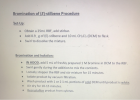 determine limiting reagent and theoritical yield
.9g of (E)-stilbene
10ml CH2Cl2
5ml of 1M bromine
Bromination of (E)-stilbene Procedure Set-Up: • Obtain a 25ml RBF, add stirbar. Add 0.9 g of (E)-stilbene and 10 mL CH2Cl2 (DCM) to flask. • Swirl to dissolve the mixture. Bromination and Isolation: • IN HOOD, add 5 mL of freshly prepared 1 M bromine in DCM to the RBF. • Swirl gently during the addition to mix the contents. Loosely stopper the RBF and...
determine limiting reagent and theoritical yield
.9g of (E)-stilbene
10ml CH2Cl2
5ml of 1M bromine
Bromination of (E)-stilbene Procedure Set-Up: • Obtain a 25ml RBF, add stirbar. Add 0.9 g of (E)-stilbene and 10 mL CH2Cl2 (DCM) to flask. • Swirl to dissolve the mixture. Bromination and Isolation: • IN HOOD, add 5 mL of freshly prepared 1 M bromine in DCM to the RBF. • Swirl gently during the addition to mix the contents. Loosely stopper the RBF and...
Can you guys tell me the exact answer and why that is the answer? Please and...
 Can you guys tell me the exact answer and why that is the
answer? Please and thank you!
Question 2: Circle all that apply for a 50:50 mixture of these compounds. Optically active Not optically active Mixture of diastereomers same molecule does not Racemic mixture Both chiral pertgin to this Both achiral
Can you guys tell me the exact answer and why that is the
answer? Please and thank you!
Question 2: Circle all that apply for a 50:50 mixture of these compounds. Optically active Not optically active Mixture of diastereomers same molecule does not Racemic mixture Both chiral pertgin to this Both achiral
 alswering these questions. 1. If the bromination of trans-stilbene proceeded by syn addition what isomer(s) of stilbene dibromide would be formed? 2. If the bromination of trans-stilbene proceeded by anti addition what isomer(s) of stilbene dibromide would be formed? 3. Which isomer(s) of stilbene dibromide would be formed if the reaction followed Mechanism 4? Mechanism 4: Bromination is a multi-step process. In this mechanism, the pi bond attacks the bromine molecule as in Mechanism 1. Some time after the carbocation...
 1. Most of the class will be brominating trans-stilbene (part B) and the rest cis-stilbene (part A). For this assignment write a detailed procedure in your lab notebook for Part B. Upload a picture/scanned copy (5 pts). Tip: If you write the procedure down the left half of the page, you can leave space to record your measurements/observations down the right side of the page. If you end up using cis-stilbene in the experimental there will only be a few...
 2. Your lab manual proposes 3 possible mechanisms for bromination. During this lab, you will determine which iroduct(s) formed during the bromination of stilbene. (9 pts) a. Four possible products from the bromination of trans-stilbene are shown below. Label the chiral centers as Sor R. Ph Br Br H iph H Phil Br Ph Ph Br B. HINH Philiph Phí By HP b. The enantiomer of structure A is: c. The enantiomer of structure Dis: d. Ust the letters corresponding...
 UCLEIC VIIICILIUUULLIS IULICU UUII LIUIUNTA LIUIUISLIUCIC. PLS a. Four possible products from the bromination of trans-stilbene are shown below. Label the chiral centers as Sor R. Ph HBr Br Ph phir H Br Ph Br Phuph Br Ph BrH b. The enantiomer of structure A is: C. The enantiomer of structure Dis: d. List the letters corresponding to the meso structures, if any:_ e. Which structures, if any, are chiral molecules:___ f. Which structures, if any, are achiral molecules:
 help with limiting reagents and percent yield needed
the
reactions are the bromination of cis-stilbene and trans-stilbene.
The reagents and the moles of each reagent are in my data, as is
the moles of the products formed. The volume and mass of the
reagents are given as well. I need to know how to find the percent
yield and what the limiting reagents are for both the trans and cis
stilbene brominations. The information is there.
Name Physical Properties of...
help with limiting reagents and percent yield needed
the
reactions are the bromination of cis-stilbene and trans-stilbene.
The reagents and the moles of each reagent are in my data, as is
the moles of the products formed. The volume and mass of the
reagents are given as well. I need to know how to find the percent
yield and what the limiting reagents are for both the trans and cis
stilbene brominations. The information is there.
Name Physical Properties of...
 determine limiting reagent and theoritical yield
.9g of (E)-stilbene
10ml CH2Cl2
5ml of 1M bromine
Bromination of (E)-stilbene Procedure Set-Up: • Obtain a 25ml RBF, add stirbar. Add 0.9 g of (E)-stilbene and 10 mL CH2Cl2 (DCM) to flask. • Swirl to dissolve the mixture. Bromination and Isolation: • IN HOOD, add 5 mL of freshly prepared 1 M bromine in DCM to the RBF. • Swirl gently during the addition to mix the contents. Loosely stopper the RBF and...
determine limiting reagent and theoritical yield
.9g of (E)-stilbene
10ml CH2Cl2
5ml of 1M bromine
Bromination of (E)-stilbene Procedure Set-Up: • Obtain a 25ml RBF, add stirbar. Add 0.9 g of (E)-stilbene and 10 mL CH2Cl2 (DCM) to flask. • Swirl to dissolve the mixture. Bromination and Isolation: • IN HOOD, add 5 mL of freshly prepared 1 M bromine in DCM to the RBF. • Swirl gently during the addition to mix the contents. Loosely stopper the RBF and...
 Can you guys tell me the exact answer and why that is the
answer? Please and thank you!
Question 2: Circle all that apply for a 50:50 mixture of these compounds. Optically active Not optically active Mixture of diastereomers same molecule does not Racemic mixture Both chiral pertgin to this Both achiral
Can you guys tell me the exact answer and why that is the
answer? Please and thank you!
Question 2: Circle all that apply for a 50:50 mixture of these compounds. Optically active Not optically active Mixture of diastereomers same molecule does not Racemic mixture Both chiral pertgin to this Both achiral
Most questions answered within 3 hours.
-
Where is the error in this code sequence?
String s1 = "Hello";
String s2 = "ello";...
asked 11 months ago -
Financial data for Joel de Paris, Inc., for last year
follow:
Joel de Paris, Inc.
Balance...
asked 11 months ago -
Consider this reaction:
Al2(SO4)3 (aq)+ BaCl3
(aq) Al2Cl6 (aq)- +
3BaSO4(s) . What is the...
asked 11 months ago -
Suppose that Savneet is considering increasing her
recent random sample from 20 car rentals to 40...
asked 11 months ago -
Trucks arrive at an unloading terminal at an average rate of 120
per hour.
Trucks arrive...
asked 11 months ago -
Why are methanol and ethanol completely soluble in water while
octanol is not very little soluble....
asked 11 months ago -
A facilities manager at a university reads in a research report
that the mean amount of...
asked 11 months ago -
When the CuSO4 is rehydrated by adding water to the anhydrous
compound, is this an endothermic...
asked 11 months ago -
A ray of sunlight is passing from diamond into crown glass; the
angle of incidence is...
asked 11 months ago -
A block of mass 0.249 kg is placed on top of a light, vertical
spring of...
asked 11 months ago -
how do the kidneys compensate in the presences of acidosis
a) trigger hyperventilate
b) reserve acid...
asked 11 months ago -
Question 501 pts
The rental rate of capital to the firm increases. Which of the
following...
asked 11 months ago