Five of the following statements are negations of the other five. Pair each statement with its...
Five of the following statements are negations of the other
five. Pair each
statement with its negation.
(a) p ⊕ q
(b) ¬p ∧ q
(c) p⇒(q⇒p)
(d) p⇒q
(e) p ∧ ¬q
(f) q ∧ (p ∧ ¬p)
(g) p ∨ ¬q
(h) p⇔q
(i) p ∧ (q ∨ ¬q)
(j) (p⇒q)⇒p
I'm really struggling with formulas and negations, so a brief explanation for each matching would really be appreciated! Thank you!
Homework Answers
Explnation:
See the images for the explanation:
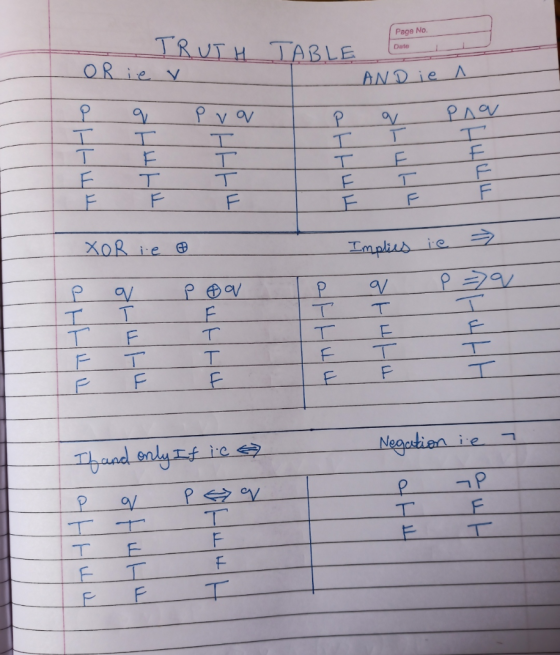
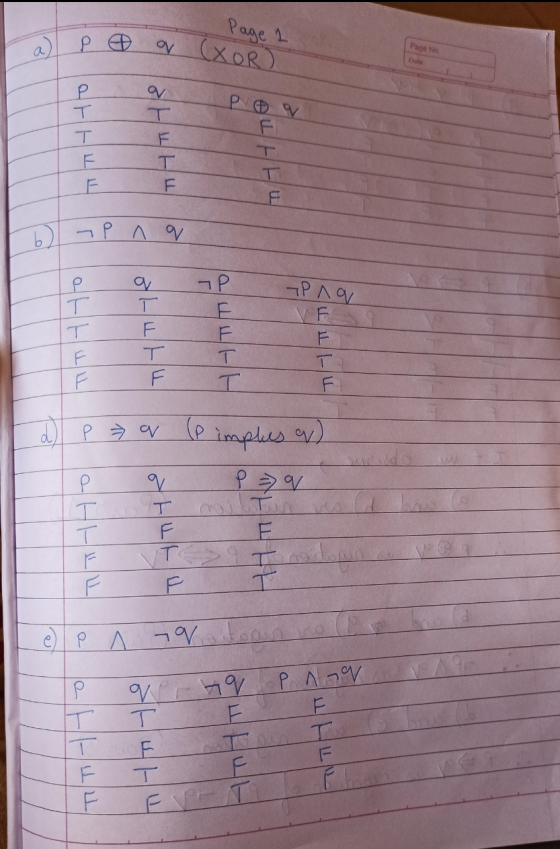
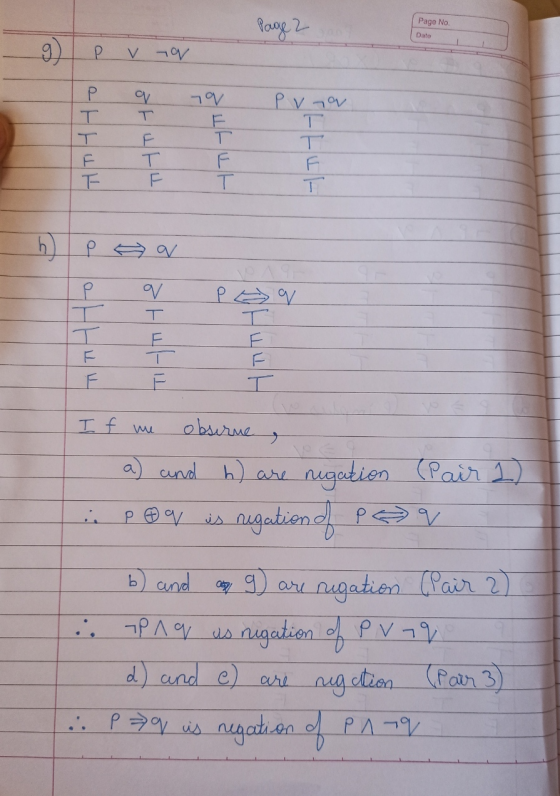
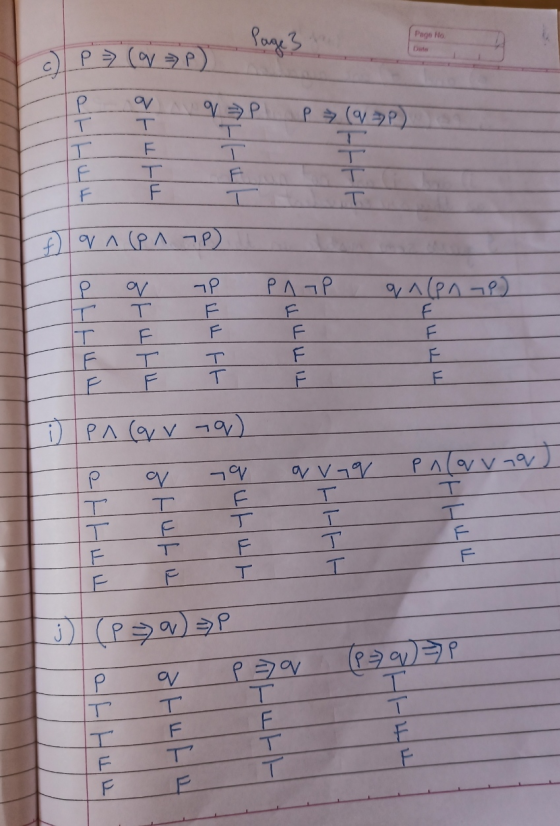
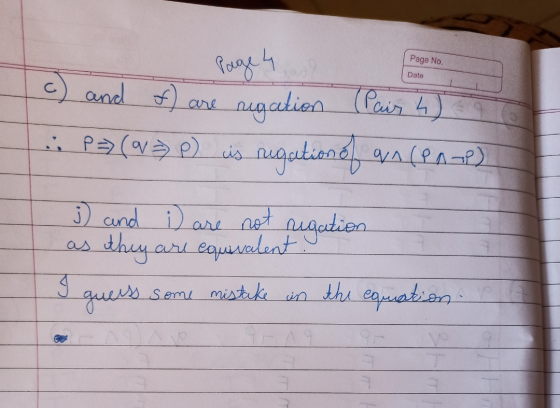
Please provide the feedback!!
Thank You!!
Add Answer to:
Five of the following statements are negations of the other
five. Pair each
statement with its...
a. Define what it means for two logical statements to be equivalent b. If P and Q are two statements, show that the statement ( P) л (PvQ) is equivalent to the statement Q^ P c. Write the converse a...
 a. Define what it means for two logical statements to be equivalent b. If P and Q are two statements, show that the statement ( P) л (PvQ) is equivalent to the statement Q^ P c. Write the converse and the contrapositive of the statement "If you earn an A in Math 52, then you understand modular arithmetic and you understand equivalence relations." Which of these d. Write the negation of the following statement in a way that changes the...
16 pts) #4. TRUE/FALSE. Determine the truth value of each sentence (no explanation required). ________(a) A statement...
16 pts) #4. TRUE/FALSE. Determine the truth value of each sentence (no explanation required). ________(a) A statement is a sentence that is true. ________(b) In logic, p q refers to the "inclusive or, " true when either p or q or both are true. ________(c) The phrase "not p and not q" means "not both p and q." ________(d) The conditional statement p q is true if p is false. ________(e) The negation of p q is p ~q. #5....
Write true or false for each of the following statements. Provide justification for each answer—if true,...
 Write true or false for each of the following statements. Provide justification for each answer—if true, give a brief explanation. If false, either provide a counterexample or contrast the statement with a similar true statement, explaining why the two cases differ. (5 points) The functions ePX and eq* are linearly independent when p + q.
Would you please by so kind as to help me with some explanation as to how you came to your conclu...
 Would you please by so kind as to help me with some explanation
as to how you came to your conclusions and your method for solving
this type of problem.
(c) Given a function XY show that each of the following statements are equivalent: (i) f is injective (or, one-to-one) (ii) there exists a function Y → X such that h of 1x (iii) for every pair of functions U- X , if f op f o q then p-q...
Would you please by so kind as to help me with some explanation
as to how you came to your conclusions and your method for solving
this type of problem.
(c) Given a function XY show that each of the following statements are equivalent: (i) f is injective (or, one-to-one) (ii) there exists a function Y → X such that h of 1x (iii) for every pair of functions U- X , if f op f o q then p-q...
Write true or false for each of the following statements. Provide justification for each answer—if true,...
 Write true or false for each of the following statements. Provide justification for each answer—if true, give a brief explanation. If false, either provide a counterexample or contrast the statement with a similar true statement, explaining why the two cases differ. (5 points) If an nxn matrix A is diagonalizable then it has eigenvalues 11,...In with li #lj when i #j
Write true or false for each of the following statements. Provide justification for each answer—if true,...
 Write true or false for each of the following statements. Provide justification for each answer—if true, give a brief explanation. If false, either provide a counterexample or contrast the statement with a similar true statement, explaining why the two cases differ. (5 points) Suppose a fish population obeys the differential equation de la = P(20 – P) –h, where h is the harvesting rate. Then 20 is the maximum harvesting rate.
Circle the stronger BASE in each pair. No explanation, no incomplete answers. I have 4 of these correct so I will know...
 Circle the stronger BASE in each pair. No explanation, no
incomplete answers. I have 4 of these correct so I will know if
you’re getting them wrong.
3. Circle the stronger base in each pair. (0.2 pts ea = 2.0 pts) a. (CH3) 3COK vs. CH3OK b. HCECNa vs. CH3CH2ONa C. NaNH2 vs. HCECNa d. NacN vs. NaI e. NaHCO3 vs. NaOH f. NaOH vs. CoH5CO2Na g. C6H5COzNa vs. CoH5ONa h. CH3CO2Na vs. CH3ONa i. CH3ONa vs. NaH j. NH3...
Circle the stronger BASE in each pair. No explanation, no
incomplete answers. I have 4 of these correct so I will know if
you’re getting them wrong.
3. Circle the stronger base in each pair. (0.2 pts ea = 2.0 pts) a. (CH3) 3COK vs. CH3OK b. HCECNa vs. CH3CH2ONa C. NaNH2 vs. HCECNa d. NacN vs. NaI e. NaHCO3 vs. NaOH f. NaOH vs. CoH5CO2Na g. C6H5COzNa vs. CoH5ONa h. CH3CO2Na vs. CH3ONa i. CH3ONa vs. NaH j. NH3...
Read through each of the following 3 statements. Statement I: Even though a country may have...
Read through each of the following 3 statements. Statement I: Even though a country may have no absolute advantage in any goods, it may have a comparative advantage in some good. Statement II: If a country has a comparative advantage in some goods, it must have a comparative disadvantage in other goods. Statement III: Even though a country may have an absolute advantage in all goods, it cannot have a comparative advantage in all goods. Which of the following statements...
8. Indicate whether each of the following statements is true or false. If a statement is...
 8. Indicate whether each of the following statements is true or false. If a statement is false, explain why a) Two structural isomers may be chiral. : True b) A compound must be chiral in order to have an enantiomer. True c) A chiral compound with an asymmetric carbon atom designated always has a positive optical rotation. False (R) as d) Mirror-image molecules are always enantiomers. False chiral. False e) All compounds with asymmetric carbon atoms are f)The relative configuration...
Indicate the financial statement on which each of the following items appears. Use I for income statement, E for statement of owner's equity, and B for balance sheet.
QS 2-9 Classifying accounts in financial statements p3 Indicate the financial statement on which each of the following items appears. Use I for income statement, E for statement of owner's equity, and B for balance sheet. a. Services Revenue b. Interest Payable c. Accounts Receivable d. Salaries Expense e. Equipment f. Prepaid Insurance g. Buildings h. Rental Revenue i. Owner Withdrawals j. Office Supplies k. Interest Expense i. Insurance Expense
 a. Define what it means for two logical statements to be equivalent b. If P and Q are two statements, show that the statement ( P) л (PvQ) is equivalent to the statement Q^ P c. Write the converse and the contrapositive of the statement "If you earn an A in Math 52, then you understand modular arithmetic and you understand equivalence relations." Which of these d. Write the negation of the following statement in a way that changes the...
 Write true or false for each of the following statements. Provide justification for each answer—if true, give a brief explanation. If false, either provide a counterexample or contrast the statement with a similar true statement, explaining why the two cases differ. (5 points) The functions ePX and eq* are linearly independent when p + q.
 Would you please by so kind as to help me with some explanation
as to how you came to your conclusions and your method for solving
this type of problem.
(c) Given a function XY show that each of the following statements are equivalent: (i) f is injective (or, one-to-one) (ii) there exists a function Y → X such that h of 1x (iii) for every pair of functions U- X , if f op f o q then p-q...
Would you please by so kind as to help me with some explanation
as to how you came to your conclusions and your method for solving
this type of problem.
(c) Given a function XY show that each of the following statements are equivalent: (i) f is injective (or, one-to-one) (ii) there exists a function Y → X such that h of 1x (iii) for every pair of functions U- X , if f op f o q then p-q...
 Write true or false for each of the following statements. Provide justification for each answer—if true, give a brief explanation. If false, either provide a counterexample or contrast the statement with a similar true statement, explaining why the two cases differ. (5 points) If an nxn matrix A is diagonalizable then it has eigenvalues 11,...In with li #lj when i #j
 Write true or false for each of the following statements. Provide justification for each answer—if true, give a brief explanation. If false, either provide a counterexample or contrast the statement with a similar true statement, explaining why the two cases differ. (5 points) Suppose a fish population obeys the differential equation de la = P(20 – P) –h, where h is the harvesting rate. Then 20 is the maximum harvesting rate.
 Circle the stronger BASE in each pair. No explanation, no
incomplete answers. I have 4 of these correct so I will know if
you’re getting them wrong.
3. Circle the stronger base in each pair. (0.2 pts ea = 2.0 pts) a. (CH3) 3COK vs. CH3OK b. HCECNa vs. CH3CH2ONa C. NaNH2 vs. HCECNa d. NacN vs. NaI e. NaHCO3 vs. NaOH f. NaOH vs. CoH5CO2Na g. C6H5COzNa vs. CoH5ONa h. CH3CO2Na vs. CH3ONa i. CH3ONa vs. NaH j. NH3...
Circle the stronger BASE in each pair. No explanation, no
incomplete answers. I have 4 of these correct so I will know if
you’re getting them wrong.
3. Circle the stronger base in each pair. (0.2 pts ea = 2.0 pts) a. (CH3) 3COK vs. CH3OK b. HCECNa vs. CH3CH2ONa C. NaNH2 vs. HCECNa d. NacN vs. NaI e. NaHCO3 vs. NaOH f. NaOH vs. CoH5CO2Na g. C6H5COzNa vs. CoH5ONa h. CH3CO2Na vs. CH3ONa i. CH3ONa vs. NaH j. NH3...
 8. Indicate whether each of the following statements is true or false. If a statement is false, explain why a) Two structural isomers may be chiral. : True b) A compound must be chiral in order to have an enantiomer. True c) A chiral compound with an asymmetric carbon atom designated always has a positive optical rotation. False (R) as d) Mirror-image molecules are always enantiomers. False chiral. False e) All compounds with asymmetric carbon atoms are f)The relative configuration...
Most questions answered within 3 hours.
-
Where is the error in this code sequence?
String s1 = "Hello";
String s2 = "ello";...
asked 11 months ago -
Financial data for Joel de Paris, Inc., for last year
follow:
Joel de Paris, Inc.
Balance...
asked 11 months ago -
Consider this reaction:
Al2(SO4)3 (aq)+ BaCl3
(aq) Al2Cl6 (aq)- +
3BaSO4(s) . What is the...
asked 11 months ago -
Suppose that Savneet is considering increasing her
recent random sample from 20 car rentals to 40...
asked 11 months ago -
Trucks arrive at an unloading terminal at an average rate of 120
per hour.
Trucks arrive...
asked 11 months ago -
Why are methanol and ethanol completely soluble in water while
octanol is not very little soluble....
asked 11 months ago -
A facilities manager at a university reads in a research report
that the mean amount of...
asked 11 months ago -
When the CuSO4 is rehydrated by adding water to the anhydrous
compound, is this an endothermic...
asked 11 months ago -
A ray of sunlight is passing from diamond into crown glass; the
angle of incidence is...
asked 11 months ago -
A block of mass 0.249 kg is placed on top of a light, vertical
spring of...
asked 11 months ago -
how do the kidneys compensate in the presences of acidosis
a) trigger hyperventilate
b) reserve acid...
asked 11 months ago -
Question 501 pts
The rental rate of capital to the firm increases. Which of the
following...
asked 11 months ago