A.The earth's acceleration due to gravity varies from 9.780 m/s2 at the equator to 9.832 m/s2...
A.The earth's acceleration due to gravity varies from 9.780 m/s2 at the equator to 9.832 m/s2 at the poles. A pendulum whose length is precisely 1.000 m can be used to measure g. Such a device is called a gravimeter.
a. How long do 100 oscillations take at the equator?
b.How long do 100 oscillations take at the north pole?
B) An infant's toy has a 120 g wooden animal hanging from a spring. If pulled down gently, the animal oscillates up and down with a period of 0.52 s . His older sister pulls the spring a bit more than intended. She pulls the animal 27 cm below its equilibrium position, then lets go. The animal flies upward and detaches from the spring right at the animal's equilibrium position.
a. If the animal does not hit anything on the way up, how far above its equilibrium position will it go?
Homework Answers


Add Answer to:
A.The earth's acceleration due to gravity varies from 9.780 m/s2
at the equator to 9.832 m/s2...
ReviewI Constants PartA The earth's acceleration due to gravity varies from 9.780 m/s2 at the equator...
 ReviewI Constants PartA The earth's acceleration due to gravity varies from 9.780 m/s2 at the equator to 9.832 m/s at the poles. A pendulum whose ength is precisely 1.000 m can be used to measure g. Such a device is called a gravimeter How long do 100 oscillations take at the equator? Express your answer to four significant figures and include the appropriate units. tValue Units Submit Request Answer Part B How long do 100 oscillations take at the north...
Need some help on this question TIA Part A An infant's toy has a 120 g...
 Need some help on this question TIA
Part A An infant's toy has a 120 g wooden animal hanging from a spring. If pulled down gently, the animal oscillates up and down with a period of 0.49 S. His older sister pulls the spring a bit more than intended. She pulls the animal 34 cm below its equilibrium position, then lets go. The animal flies upward and detaches from the spring right at the animal's equilibrium position If the animal...
Need some help on this question TIA
Part A An infant's toy has a 120 g wooden animal hanging from a spring. If pulled down gently, the animal oscillates up and down with a period of 0.49 S. His older sister pulls the spring a bit more than intended. She pulls the animal 34 cm below its equilibrium position, then lets go. The animal flies upward and detaches from the spring right at the animal's equilibrium position If the animal...
Problem 14.73 17 of 18 〉 Review I Constants Periodic Table Part A An infant's toy...
 Problem 14.73 17 of 18 〉 Review I Constants Periodic Table Part A An infant's toy has a 120 g wooden animal hanging from a spring. If pulled down gently, the animal oscillates up and down with a period of 0.47 S. His older sister pulls the spring a bit more than intended. She pulls the animal 32 cm below its equilibrium position, then lets go. The animal flies upward and detaches from the spring right at the animal's equilibrium...
A Review Constants Periodic Table Part A An infant's toy has a 120 g wooden animal...
 A Review Constants Periodic Table Part A An infant's toy has a 120 g wooden animal hanging from a spring. If pulled down gently, the animal oscillates up and down with a period of 0.42 s. His older sister pulls the spring a bit more than intended. She pulls the animal 30 cm below its equilibrium position, then lets go. The animal flies upward and detaches from the spring right at the animal's equilibrium position. If the animal does not...
Can you explain in detail and clear please Part A An infant's toy has a 120...
 Can you explain in detail and clear please
Part A An infant's toy has a 120 g wooden animal hanging from a spring. If pulled down gently, the animal oscillates up and down with a period of 0.51 s.His older sister pulls the spring a bit more than intended. She puls the animal 35 cm below its equilibrium position, then lets go. The animal fies upward and detaches from the spring right at the animal's equilibrium position. the animal does...
Can you explain in detail and clear please
Part A An infant's toy has a 120 g wooden animal hanging from a spring. If pulled down gently, the animal oscillates up and down with a period of 0.51 s.His older sister pulls the spring a bit more than intended. She puls the animal 35 cm below its equilibrium position, then lets go. The animal fies upward and detaches from the spring right at the animal's equilibrium position. the animal does...
Review | Constants Per Part A An Infant's toy has a 120 g wooden animal hanging...
 Review | Constants Per Part A An Infant's toy has a 120 g wooden animal hanging from a spring. If pulled down gently, the animal oscillates up and down with a period of 0.42 s. His older sister pulls the spring a bit more than intended. She pulls the animal 30 cm below its equilibrium position, then lets go. The animal flies upward and detaches from the spring right at the animal's equilibrium position If the animal does not hit...
Question9 A 0.151-kg ball is hung vertically from a spring. The spring stretches by 2.27 cm...
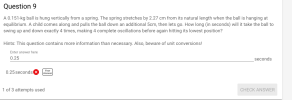 Question9 A 0.151-kg ball is hung vertically from a spring. The spring stretches by 2.27 cm from its natural length when the ball is hanging at equilibrium. A child comes along and pulls the ball down an additional 5cm, then lets go. How long (in seconds) will it take the ball to swing up and down exactly 4 times, making 4 complete oscillations before again hitting its lowest position? Hints: This question contains more information than necessary. Also, beware of...
Question 8 The nylon rope from which a mountain climber is suspended has a force constant...
 Question 8 The nylon rope from which a mountain climber is suspended has a force constant of 1.40 x 10⁴ N/m. How much would this rope stretch to break the climber's fall if he free-falls 2.16 m before the rope runs out of slack, given his mass plus and the mass of his equipment are 91.6 kg? Hint: Use conservation of energy. You can assume the amount the rope stretches is small compared to the distance of his fall. Select...
Can someone please help with 1) part A of top and 2) part B of bottom?...
 Can someone please help with 1) part A of top and 2) part B of
bottom? Can't seem to get them!
Part a A 0.561-kg ball is hung vertically from a spring. The spring stretches by 5.38 cm from its natural length when the ball is hanging at equilibrium. A child comes along and pulls the ball down an additional 5cm, then lets go. How long (in seconds) will t take the ball to swing up and down exactly 4...
Can someone please help with 1) part A of top and 2) part B of
bottom? Can't seem to get them!
Part a A 0.561-kg ball is hung vertically from a spring. The spring stretches by 5.38 cm from its natural length when the ball is hanging at equilibrium. A child comes along and pulls the ball down an additional 5cm, then lets go. How long (in seconds) will t take the ball to swing up and down exactly 4...
Pendulum Clocks Are Very Important...
 1. Pendulum clocks are very important for the history of exploration. Accurate time was the best way to determine one's longitude, since the time of sunrise or sunset depends sensitively on your longitude. In this regard, the great enemy of accuracy was thermal expansion of the pendulum used for the chronometer. We are considering a large mass attached at the end of a brass rod. The mass at the end is much greater than the mass of the rod, so we...
 ReviewI Constants PartA The earth's acceleration due to gravity varies from 9.780 m/s2 at the equator to 9.832 m/s at the poles. A pendulum whose ength is precisely 1.000 m can be used to measure g. Such a device is called a gravimeter How long do 100 oscillations take at the equator? Express your answer to four significant figures and include the appropriate units. tValue Units Submit Request Answer Part B How long do 100 oscillations take at the north...
 Need some help on this question TIA
Part A An infant's toy has a 120 g wooden animal hanging from a spring. If pulled down gently, the animal oscillates up and down with a period of 0.49 S. His older sister pulls the spring a bit more than intended. She pulls the animal 34 cm below its equilibrium position, then lets go. The animal flies upward and detaches from the spring right at the animal's equilibrium position If the animal...
Need some help on this question TIA
Part A An infant's toy has a 120 g wooden animal hanging from a spring. If pulled down gently, the animal oscillates up and down with a period of 0.49 S. His older sister pulls the spring a bit more than intended. She pulls the animal 34 cm below its equilibrium position, then lets go. The animal flies upward and detaches from the spring right at the animal's equilibrium position If the animal...
 Problem 14.73 17 of 18 〉 Review I Constants Periodic Table Part A An infant's toy has a 120 g wooden animal hanging from a spring. If pulled down gently, the animal oscillates up and down with a period of 0.47 S. His older sister pulls the spring a bit more than intended. She pulls the animal 32 cm below its equilibrium position, then lets go. The animal flies upward and detaches from the spring right at the animal's equilibrium...
 A Review Constants Periodic Table Part A An infant's toy has a 120 g wooden animal hanging from a spring. If pulled down gently, the animal oscillates up and down with a period of 0.42 s. His older sister pulls the spring a bit more than intended. She pulls the animal 30 cm below its equilibrium position, then lets go. The animal flies upward and detaches from the spring right at the animal's equilibrium position. If the animal does not...
 Can you explain in detail and clear please
Part A An infant's toy has a 120 g wooden animal hanging from a spring. If pulled down gently, the animal oscillates up and down with a period of 0.51 s.His older sister pulls the spring a bit more than intended. She puls the animal 35 cm below its equilibrium position, then lets go. The animal fies upward and detaches from the spring right at the animal's equilibrium position. the animal does...
Can you explain in detail and clear please
Part A An infant's toy has a 120 g wooden animal hanging from a spring. If pulled down gently, the animal oscillates up and down with a period of 0.51 s.His older sister pulls the spring a bit more than intended. She puls the animal 35 cm below its equilibrium position, then lets go. The animal fies upward and detaches from the spring right at the animal's equilibrium position. the animal does...
 Review | Constants Per Part A An Infant's toy has a 120 g wooden animal hanging from a spring. If pulled down gently, the animal oscillates up and down with a period of 0.42 s. His older sister pulls the spring a bit more than intended. She pulls the animal 30 cm below its equilibrium position, then lets go. The animal flies upward and detaches from the spring right at the animal's equilibrium position If the animal does not hit...
 Question9 A 0.151-kg ball is hung vertically from a spring. The spring stretches by 2.27 cm from its natural length when the ball is hanging at equilibrium. A child comes along and pulls the ball down an additional 5cm, then lets go. How long (in seconds) will it take the ball to swing up and down exactly 4 times, making 4 complete oscillations before again hitting its lowest position? Hints: This question contains more information than necessary. Also, beware of...
 Question 8 The nylon rope from which a mountain climber is suspended has a force constant of 1.40 x 10⁴ N/m. How much would this rope stretch to break the climber's fall if he free-falls 2.16 m before the rope runs out of slack, given his mass plus and the mass of his equipment are 91.6 kg? Hint: Use conservation of energy. You can assume the amount the rope stretches is small compared to the distance of his fall. Select...
 Can someone please help with 1) part A of top and 2) part B of
bottom? Can't seem to get them!
Part a A 0.561-kg ball is hung vertically from a spring. The spring stretches by 5.38 cm from its natural length when the ball is hanging at equilibrium. A child comes along and pulls the ball down an additional 5cm, then lets go. How long (in seconds) will t take the ball to swing up and down exactly 4...
Can someone please help with 1) part A of top and 2) part B of
bottom? Can't seem to get them!
Part a A 0.561-kg ball is hung vertically from a spring. The spring stretches by 5.38 cm from its natural length when the ball is hanging at equilibrium. A child comes along and pulls the ball down an additional 5cm, then lets go. How long (in seconds) will t take the ball to swing up and down exactly 4...
Most questions answered within 3 hours.
-
Where is the error in this code sequence?
String s1 = "Hello";
String s2 = "ello";...
asked 10 months ago -
Financial data for Joel de Paris, Inc., for last year
follow:
Joel de Paris, Inc.
Balance...
asked 10 months ago -
Consider this reaction:
Al2(SO4)3 (aq)+ BaCl3
(aq) Al2Cl6 (aq)- +
3BaSO4(s) . What is the...
asked 10 months ago -
Suppose that Savneet is considering increasing her
recent random sample from 20 car rentals to 40...
asked 10 months ago -
Trucks arrive at an unloading terminal at an average rate of 120
per hour.
Trucks arrive...
asked 10 months ago -
Why are methanol and ethanol completely soluble in water while
octanol is not very little soluble....
asked 10 months ago -
A facilities manager at a university reads in a research report
that the mean amount of...
asked 10 months ago -
When the CuSO4 is rehydrated by adding water to the anhydrous
compound, is this an endothermic...
asked 10 months ago -
A ray of sunlight is passing from diamond into crown glass; the
angle of incidence is...
asked 10 months ago -
A block of mass 0.249 kg is placed on top of a light, vertical
spring of...
asked 10 months ago -
how do the kidneys compensate in the presences of acidosis
a) trigger hyperventilate
b) reserve acid...
asked 10 months ago -
Question 501 pts
The rental rate of capital to the firm increases. Which of the
following...
asked 10 months ago