Question 2: Consider an array of numbers. Give an algorithm that finds the maximum contiguous subarray...
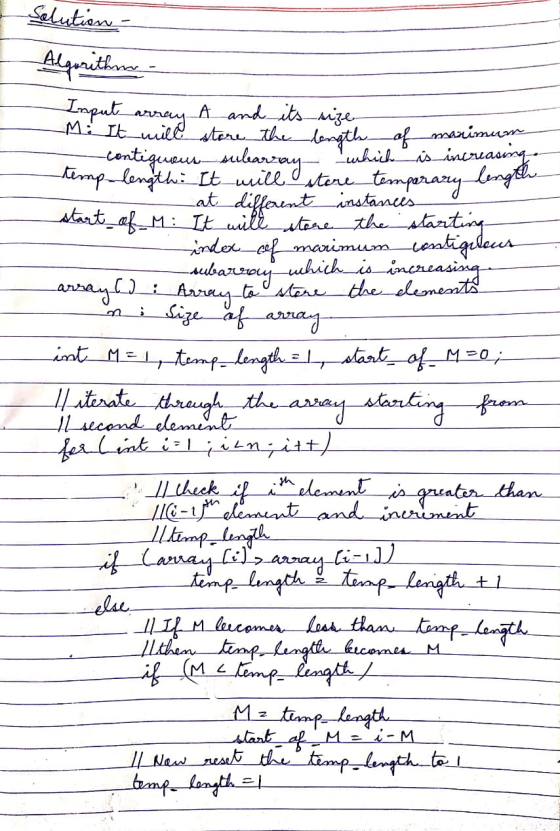
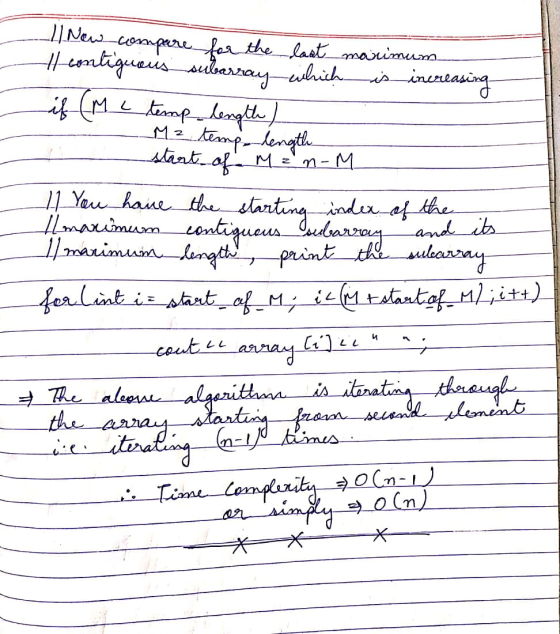
Question 2: Consider an array of numbers. Give an algorithm that finds the maximum contiguous subarray that is increasing, Example: A = [1, 7, 2, 5, 4, 6, 8, 9, 3, 14, 16, 11, 30]. The maximum contiguous increasing sequence is 4, 6, 8, 9.
Please write an explanation of the algorithm in words and state the run time as well.
Homework Answers
The approach to the above problem along with the algorithm and its explanation and time complexity is attached is the images below :
Add Answer to:
Question 2: Consider an array of numbers. Give an algorithm that
finds the maximum contiguous subarray...
Question 3: Give an algorithm that finds the maximum size sub-array that is increasing (the entries...
Question 3: Give an algorithm that finds the maximum size sub-array that is increasing (the entries may not be contiguous. It may be any set but you need to keep the order). In the array, A = [1, 7, 2, 5, 4, 6, 8, 9, 3, 14, 16, 11, 30], the maximum non contiguous increasing subset is 1, 2, 4, 6, 8, 9, 14, 16, 30 that forms an increasing sequence. Please explain the algorithm in words and state the...
Give an algorithm that finds the maximum size subarray that is increas- ing (the entries may...
Give an algorithm that finds the maximum size subarray that is increas- ing (the entries may not be contiguous. It may be any set but you need to keep the order.). In the above array the maximum non contiguous increasing subset is 1, 2, 4, 6, 8, 9, 14, 16, 30 that forms an increasing sequence. There are no other array provided in this question, thank you
Design And analysis algorithm course . Remarks: In all the algorithms, always explain their correctness and...
 Design And analysis algorithm
course .
Remarks: In all the
algorithms, always explain their correctness and analyze their com-
plexity. The complexity should be as small as possible. A correct
algorithm with large complexity, may not get full credit
Question 2: Give an algorithm that finds the maximum size subarray (the entries may not be contiguous) that forms an increasing sequence.
Design And analysis algorithm
course .
Remarks: In all the
algorithms, always explain their correctness and analyze their com-
plexity. The complexity should be as small as possible. A correct
algorithm with large complexity, may not get full credit
Question 2: Give an algorithm that finds the maximum size subarray (the entries may not be contiguous) that forms an increasing sequence.
A Sub-Array of an array A is a collection of numbers A[i1], A[i2], . . ....
A Sub-Array of an array A is a collection of numbers A[i1], A[i2], . . . A[ip] so that ij < ij+1 but ij+1 −ij > 1 is legal. For example given an array A = [9,5,2,6,3,7,2,9] [5,6,7,9] is a sub-array of A. Give an algorithm that finds the largest increasing sub-array. Note that < 5, 6, 7, 9 > is the longest increasing sub-array for the above array.
Consider a non-empty int array ints. A contiguous subarray ints[ start .. start + len -1...
Consider a non-empty int array ints. A contiguous subarray ints[ start .. start + len -1 ] (with starting index start and length len) is called a flat if all elements of that subarray are equal. Furthermore, such a subarray is called a plateau if it is flat and each of the elements ints[start -1] and ints[start + len] that immediately proceed/succeed the subarray are either nonexistent (i.e., out of array’s index range) or are strictly smaller than the elements...
Give an O(n2 ) algorithm (Pseudocode) that, given a sequence S, finds the longest subsequence that...
Give an O(n2 ) algorithm (Pseudocode) that, given a sequence S, finds the longest subsequence that first increases then decreases. For instance, in the sequence S = [10, 4, 5, 11, 2, 7, 4, 3, 9] the longest such subsequence is [4,5,11,7,4,3]. The subsequence does not have to be consecutive. (Hint: Use two arrays, one for increasing subsequences and the other for decreasing subsequences.)
Let A be an array containing n numbers (positive and negative). Develop a divide and conquer algo...
 need help in this algorithm question
Let A be an array containing n numbers (positive and negative). Develop a divide and conquer algorithm that finds the two indices 1 sisjsn such that A[k] (the sum of the elements from i to j) is maximized. For example, in the array A [10,-5,-6,5, 7,-2,4, -11], the sub-array A[4:6] has the sum 5+ 7-2+4-14 and no other sub-array contains elements that sum to a value greater than 14, so for this input the...
need help in this algorithm question
Let A be an array containing n numbers (positive and negative). Develop a divide and conquer algorithm that finds the two indices 1 sisjsn such that A[k] (the sum of the elements from i to j) is maximized. For example, in the array A [10,-5,-6,5, 7,-2,4, -11], the sub-array A[4:6] has the sum 5+ 7-2+4-14 and no other sub-array contains elements that sum to a value greater than 14, so for this input the...
Consider a table of numbers from 1-13. Give me a sql query that finds out the...
Consider a table of numbers from 1-13. Give me a sql query that finds out the list of missing numbers by start and end. Example 1, 5, 6, 7 Answer: start end 2 4 8 13
F a as a sequence of adjacent array elements such that each value in the run array was of size 10...
 f a as a sequence of adjacent array elements such that each value in the run array was of size 10 9. We define a "run" of elements o (except for the first) is one greater than the previous and looked like: value. For example, say the 3 2 16 9 7 8 9 2 a: position 0 3 We have three runs in this array: (1) between 9,10,1, 12) and, (3) between positions 7 and 8, (15, 16) positions...
6. Consider the following algorithm, where P is an array containing random numbers. The function swap(v1,v2)...
 6. Consider the following algorithm, where P is an array containing random numbers. The function swap(v1,v2) will swap the values stored in the variables v1 and v2. Note that % is the modulus operation, and will return the integer remainder r of a/b, i.e., r-a%b Require: Array P with n > 0 values 1: i-1, j-n-l 2: while i<=j do for a=i to j by i do 4: 5: 6: 7: if Pla>Pat 11 and Pla]%2--0 then swap(Plal, Pla+1l) end...
 Design And analysis algorithm
course .
Remarks: In all the
algorithms, always explain their correctness and analyze their com-
plexity. The complexity should be as small as possible. A correct
algorithm with large complexity, may not get full credit
Question 2: Give an algorithm that finds the maximum size subarray (the entries may not be contiguous) that forms an increasing sequence.
Design And analysis algorithm
course .
Remarks: In all the
algorithms, always explain their correctness and analyze their com-
plexity. The complexity should be as small as possible. A correct
algorithm with large complexity, may not get full credit
Question 2: Give an algorithm that finds the maximum size subarray (the entries may not be contiguous) that forms an increasing sequence.
 need help in this algorithm question
Let A be an array containing n numbers (positive and negative). Develop a divide and conquer algorithm that finds the two indices 1 sisjsn such that A[k] (the sum of the elements from i to j) is maximized. For example, in the array A [10,-5,-6,5, 7,-2,4, -11], the sub-array A[4:6] has the sum 5+ 7-2+4-14 and no other sub-array contains elements that sum to a value greater than 14, so for this input the...
need help in this algorithm question
Let A be an array containing n numbers (positive and negative). Develop a divide and conquer algorithm that finds the two indices 1 sisjsn such that A[k] (the sum of the elements from i to j) is maximized. For example, in the array A [10,-5,-6,5, 7,-2,4, -11], the sub-array A[4:6] has the sum 5+ 7-2+4-14 and no other sub-array contains elements that sum to a value greater than 14, so for this input the...
 f a as a sequence of adjacent array elements such that each value in the run array was of size 10 9. We define a "run" of elements o (except for the first) is one greater than the previous and looked like: value. For example, say the 3 2 16 9 7 8 9 2 a: position 0 3 We have three runs in this array: (1) between 9,10,1, 12) and, (3) between positions 7 and 8, (15, 16) positions...
 6. Consider the following algorithm, where P is an array containing random numbers. The function swap(v1,v2) will swap the values stored in the variables v1 and v2. Note that % is the modulus operation, and will return the integer remainder r of a/b, i.e., r-a%b Require: Array P with n > 0 values 1: i-1, j-n-l 2: while i<=j do for a=i to j by i do 4: 5: 6: 7: if Pla>Pat 11 and Pla]%2--0 then swap(Plal, Pla+1l) end...
Most questions answered within 3 hours.
-
Where is the error in this code sequence?
String s1 = "Hello";
String s2 = "ello";...
asked 10 months ago -
Financial data for Joel de Paris, Inc., for last year
follow:
Joel de Paris, Inc.
Balance...
asked 10 months ago -
Consider this reaction:
Al2(SO4)3 (aq)+ BaCl3
(aq) Al2Cl6 (aq)- +
3BaSO4(s) . What is the...
asked 10 months ago -
Suppose that Savneet is considering increasing her
recent random sample from 20 car rentals to 40...
asked 10 months ago -
Trucks arrive at an unloading terminal at an average rate of 120
per hour.
Trucks arrive...
asked 10 months ago -
Why are methanol and ethanol completely soluble in water while
octanol is not very little soluble....
asked 10 months ago -
A facilities manager at a university reads in a research report
that the mean amount of...
asked 10 months ago -
When the CuSO4 is rehydrated by adding water to the anhydrous
compound, is this an endothermic...
asked 10 months ago -
A ray of sunlight is passing from diamond into crown glass; the
angle of incidence is...
asked 10 months ago -
A block of mass 0.249 kg is placed on top of a light, vertical
spring of...
asked 10 months ago -
how do the kidneys compensate in the presences of acidosis
a) trigger hyperventilate
b) reserve acid...
asked 10 months ago -
Question 501 pts
The rental rate of capital to the firm increases. Which of the
following...
asked 10 months ago