During an action potential, Na+ ions move into the cell at a rate of about 3×10⁻⁷mol/m2⋅s....
During an action potential, Na+ ions move into the cell at a rate of about 3×10⁻⁷mol/m2⋅s.
Part A
How much power must be produced by the "active Na+ pumping" system to produce this flow against a +30−mV potential difference? Assume that the axon is 20 cm long and 20 μm in diameter.
Express your answer using two significant figures.
ANSWER:
| P = | v |
Homework Answers

Add Answer to:
During an action potential, Na+ ions move into the cell at a
rate of about 3×10⁻⁷mol/m2⋅s....
1- During an action potential, Na+Na+ ions move into the cell at a rate of about...
1- During an action potential, Na+Na+ ions move into the cell at a rate of about 3×10⁻⁷mol/m2⋅s3×10−7mol/m2⋅s. How much power must be produced by the "active Na+Na+ pumping" system to produce this flow against a +30−mV+30−mV potential difference? Assume that the axon is 60 cmcm long and 30 μmμm in diameter. Express your answer using two significant figures. 2- A 4.80-mm length of 2.6-mmmm-diameter wire carries a 850 mAmA current when 19.0 mVmV is applied to its ends. If the...
5 II During an acon potenti. Nov he cell at a rate of İlhout 3x 10...
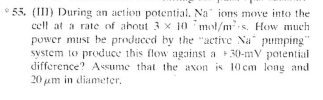 5 II During an acon potenti. Nov he cell at a rate of İlhout 3x 10 -mol/m,.. How much powcr mu he produced by the "active Na pumping system to produce against a 50-mV potential difference? Assume that the axon i$ 10cm long and 20 um in ameter. !ni)
The capacitance of the cell membrane is estimated to be 89 pF, and approximately 10000 Na+...
The capacitance of the cell membrane is estimated to be 89 pF, and approximately 10000 Na+ ions flow through an ion channel when it opens. 1. Based on this information and what you learned in this chapter about the action potential, estimate the total number of sodium ion channels in the membrane of a nerve cell. Express your answer using two significant figures. (N = ???)
What is the current in amperes if 1500 Na+ ions flow across a cell membrane in...
What is the current in amperes if 1500 Na+ ions flow across a cell membrane in 3.6 μs ? The charge on the sodium is the same as on an electron, but positive. Express your answer to two significant figures and include the appropriate units.
Under certain circumstances, potassium ions K++ move across the 8.0-nm-thick cell membrane from the inside to...
 Under certain circumstances, potassium ions K++ move across the
8.0-nm-thick cell membrane from the inside to the outside. The
potential inside the cell is -80.0 mV, and the potential outside is
zero. Assume that a potassium ion carries a charge of
1.602××10−19−19 C.
Unit 3: Prelecture Problems Problems: Electric Potential & Capacitor Deadline: 100% until Sunday, January 27 at 11:59 PM ▼ Cumulative Problem 6 Under certain circumstances, potassium ions K+ move across the 8.0-nm-thick cell membrane from the inside...
Under certain circumstances, potassium ions K++ move across the
8.0-nm-thick cell membrane from the inside to the outside. The
potential inside the cell is -80.0 mV, and the potential outside is
zero. Assume that a potassium ion carries a charge of
1.602××10−19−19 C.
Unit 3: Prelecture Problems Problems: Electric Potential & Capacitor Deadline: 100% until Sunday, January 27 at 11:59 PM ▼ Cumulative Problem 6 Under certain circumstances, potassium ions K+ move across the 8.0-nm-thick cell membrane from the inside...
A cell membrane has a surface area of 1.2 × 10⁻⁷ m2, a dielectric constant of...
A cell membrane has a surface area of 1.2 × 10⁻⁷ m2, a dielectric constant of 5.5, and a thickness of 7.1 nm. The potential difference across the membrane is 60 mV. Round youranswers to two significant figures. (a) What is the magnitude of the charge on each surface of the membrane? Q = pC (b) How many ions are on each surface of the membrane, assuming they are singly charged (|q| = e)? ___ × 10
1. Animal cells have a Na,K pump that couples the energy of ATP hydrolysis to transport 3 Na ions out of the cell and 2 K ions into the cell. Inside astrocytes, the concentration of Na is 20 mM and th...
1. Animal cells have a Na,K pump that couples the energy of ATP hydrolysis to transport 3 Na ions out of the cell and 2 K ions into the cell. Inside astrocytes, the concentration of Na is 20 mM and the concentration of K is 130 mM. The extracellular concentrations of Na and K are 145 mM and 5 mM, respectively. Calculate the energy required for the transport of Na and K , with this stoichiometry; assume that the cell...
#2 please In this part, we will explore electrostatics as it relates to the nerve cell,...
 #2 please
In this part, we will explore electrostatics as it relates to the nerve cell, a critical electrostatic device for almost all life. We will use a rather simplified picture of the nerve cell, and treat it as a parallel plate capacitor. Although oversimplified, this model does correctly describe the underlying physics. As shown in the diagram below, the nerve cell is a fluid-filled tube (the axon) that is surrounded by another fluid. The nerve cell wall (membrane) separates...
#2 please
In this part, we will explore electrostatics as it relates to the nerve cell, a critical electrostatic device for almost all life. We will use a rather simplified picture of the nerve cell, and treat it as a parallel plate capacitor. Although oversimplified, this model does correctly describe the underlying physics. As shown in the diagram below, the nerve cell is a fluid-filled tube (the axon) that is surrounded by another fluid. The nerve cell wall (membrane) separates...
Lo 10: Electrochemical Gradient The difference in voltage across the membrane is called the __________________________________. The...
Lo 10: Electrochemical Gradient The difference in voltage across the membrane is called the __________________________________. The inside of a normal cell is ___________________ (+/-); while the outside is ___________(+/-). The resting membrane potential of a neuron is ___________mV. Diagram the relative ratios of Ca++, Na+ and K+ in a cell under resting conditions. Draw an arrow for each of the molecules indicating which direction would be passive transport (into or out of the cell). For each of the following sentences, fill in...
Blood contains positive and negative ions and thus is a conductor. A blood vessel, therefore, can...
Blood contains positive and negative ions and thus is a conductor. A blood vessel, therefore, can be viewed as an electrical wire. We can even picture the flowing blood as a series of parallel conducting slabs whose thickness is the diameter 5.12 mm of the vessel moving with speed . (See in the following figure) A) If the blood vessel is placed in a magnetic field B perpendicular to the vessel, as in the figure, show that the motional potential...
 5 II During an acon potenti. Nov he cell at a rate of İlhout 3x 10 -mol/m,.. How much powcr mu he produced by the "active Na pumping system to produce against a 50-mV potential difference? Assume that the axon i$ 10cm long and 20 um in ameter. !ni)
 Under certain circumstances, potassium ions K++ move across the
8.0-nm-thick cell membrane from the inside to the outside. The
potential inside the cell is -80.0 mV, and the potential outside is
zero. Assume that a potassium ion carries a charge of
1.602××10−19−19 C.
Unit 3: Prelecture Problems Problems: Electric Potential & Capacitor Deadline: 100% until Sunday, January 27 at 11:59 PM ▼ Cumulative Problem 6 Under certain circumstances, potassium ions K+ move across the 8.0-nm-thick cell membrane from the inside...
Under certain circumstances, potassium ions K++ move across the
8.0-nm-thick cell membrane from the inside to the outside. The
potential inside the cell is -80.0 mV, and the potential outside is
zero. Assume that a potassium ion carries a charge of
1.602××10−19−19 C.
Unit 3: Prelecture Problems Problems: Electric Potential & Capacitor Deadline: 100% until Sunday, January 27 at 11:59 PM ▼ Cumulative Problem 6 Under certain circumstances, potassium ions K+ move across the 8.0-nm-thick cell membrane from the inside...
 #2 please
In this part, we will explore electrostatics as it relates to the nerve cell, a critical electrostatic device for almost all life. We will use a rather simplified picture of the nerve cell, and treat it as a parallel plate capacitor. Although oversimplified, this model does correctly describe the underlying physics. As shown in the diagram below, the nerve cell is a fluid-filled tube (the axon) that is surrounded by another fluid. The nerve cell wall (membrane) separates...
#2 please
In this part, we will explore electrostatics as it relates to the nerve cell, a critical electrostatic device for almost all life. We will use a rather simplified picture of the nerve cell, and treat it as a parallel plate capacitor. Although oversimplified, this model does correctly describe the underlying physics. As shown in the diagram below, the nerve cell is a fluid-filled tube (the axon) that is surrounded by another fluid. The nerve cell wall (membrane) separates...
Most questions answered within 3 hours.
-
Where is the error in this code sequence?
String s1 = "Hello";
String s2 = "ello";...
asked 10 months ago -
Financial data for Joel de Paris, Inc., for last year
follow:
Joel de Paris, Inc.
Balance...
asked 10 months ago -
Consider this reaction:
Al2(SO4)3 (aq)+ BaCl3
(aq) Al2Cl6 (aq)- +
3BaSO4(s) . What is the...
asked 10 months ago -
Suppose that Savneet is considering increasing her
recent random sample from 20 car rentals to 40...
asked 10 months ago -
Trucks arrive at an unloading terminal at an average rate of 120
per hour.
Trucks arrive...
asked 10 months ago -
Why are methanol and ethanol completely soluble in water while
octanol is not very little soluble....
asked 10 months ago -
A facilities manager at a university reads in a research report
that the mean amount of...
asked 10 months ago -
When the CuSO4 is rehydrated by adding water to the anhydrous
compound, is this an endothermic...
asked 10 months ago -
A ray of sunlight is passing from diamond into crown glass; the
angle of incidence is...
asked 10 months ago -
A block of mass 0.249 kg is placed on top of a light, vertical
spring of...
asked 10 months ago -
how do the kidneys compensate in the presences of acidosis
a) trigger hyperventilate
b) reserve acid...
asked 10 months ago -
Question 501 pts
The rental rate of capital to the firm increases. Which of the
following...
asked 10 months ago