2. Suggest a method to measure hysteresis in a blood flow transducer.
2. Suggest a method to measure hysteresis in a blood flow transducer.
Homework Answers
The technique used for measuring hysteresis (lagging retardation effect) in a blood flow transducer is the most common technique. It is used to measure arterial blood flow by using flow probes or sensors.
- This technique can be divided into two categories by using ultrasonic and electromagnetic probes.
- Here, two types of ultrasonic probes are used and the first type of probe measures the flow of blood by employing doppler shifts.
- The second type of probe measures transit time which employs ultrasound wave.
- These probes must be highly accurate to exhibit signal linearity over the range of blood flow.
- They must also exhibit good biocompatibility.
- The reference sample hematogenously delivers microspheres. This can be used to assess blood flow in the entire body.
- The doppler ultrasound also helps in visualizing the blood flow.
- The probe is mechanically coupled to the 'resolver', which gives electrical output and the imaging is done by moving the probe through the skin.
- This develops a 3D image in computer, which gives the measurement of hysteresis.
Thank you!
Add Answer to:
2. Suggest a method to measure hysteresis in a blood flow
transducer.
b: The torque transducer specified in Table below is chosen to measure a nominal torque of 100°N.m. The ambient temperature is expected to vary between 1 5 and 2S"C during tests. Estimate the...
 b: The torque transducer specified in Table below is chosen to measure a nominal torque of 100°N.m. The ambient temperature is expected to vary between 1 5 and 2S"C during tests. Estimate the magnitude of the total error affecting the measured torque Operation 100N.m to10kNm :0.05% of reading +0,05% ofreading +0.05% ofreading 0.05% ofFSO Range Accuracy error Non-linearity error Hysteresis error Sensitivity error
b: The torque transducer specified in Table below is chosen to measure a nominal torque of 100°N.m....
b: The torque transducer specified in Table below is chosen to measure a nominal torque of 100°N.m. The ambient temperature is expected to vary between 1 5 and 2S"C during tests. Estimate the magnitude of the total error affecting the measured torque Operation 100N.m to10kNm :0.05% of reading +0,05% ofreading +0.05% ofreading 0.05% ofFSO Range Accuracy error Non-linearity error Hysteresis error Sensitivity error
b: The torque transducer specified in Table below is chosen to measure a nominal torque of 100°N.m....
2.) A capillary rheometer is used to measure viscosity. A pressure transducer records the pressure drop...
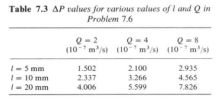 2.) A capillary rheometer is used to measure viscosity. A
pressure transducer records the pressure drop delta P across the
die, and the die capillary has a diameter of 2 mm. Experiments are
carried out at three volume flow rates Q, for dies of each of three
lengths l. The following is a table of values of delta P
(in MPa) measured for polupropylene at 190 C. For each flow rate Q
find the apparent viscosity, assuming Newtonian behaviour.
Table...
2.) A capillary rheometer is used to measure viscosity. A
pressure transducer records the pressure drop delta P across the
die, and the die capillary has a diameter of 2 mm. Experiments are
carried out at three volume flow rates Q, for dies of each of three
lengths l. The following is a table of values of delta P
(in MPa) measured for polupropylene at 190 C. For each flow rate Q
find the apparent viscosity, assuming Newtonian behaviour.
Table...
Problem 4 (20 points) A stain gauge differential pressure transducer with a range of 0 to...
 Problem 4 (20 points) A stain gauge differential pressure transducer with a range of 0 to 100 psi is to measure a pressure difference of 50 psi, with the following specifications: Output range: 0 to 10 Volts Linearity Error: +/-0.1% of reading Hysteresis Error: +/- 0.05% of reading Sensitivity Error: +/-0.01% of reading When transducer is installed for its intended use, installation effects are estimated to affect its reading by 0.1 psi. The output is measured using a 12 bit...
An echocardiogram uses 4.4 MHz ultrasound to measure blood flow in the aorta. The blood is...
An echocardiogram uses 4.4 MHz ultrasound to measure blood flow in the aorta. The blood is moving away from the probe at 1.6 m/s . A. What is the frequency shift of the reflected ultrasound? Use values given in the table if necessary. Enter a positive value if the received frequency is higher than the emitted frequency, and a negative value if the received frequency is lower than the emitted frequency.
A blood-flow meter emits a 1.1-MHz ultrasound pulse to measure the speed of blood moving directly...
A blood-flow meter emits a 1.1-MHz ultrasound pulse to measure the speed of blood moving directly away from the meter. The meter’s sensor detects the pulse reflected back from the blood at a frequency 21 Hz lower than the emitted frequency. Take the speed of sound in the tissues to be 1475 m/s. At what speed, in centimeters per second, is the blood moving?
A Doppler flow meter uses ultrasound waves to measure blood-flow speeds. Suppose the device emits sound...
A Doppler flow meter uses ultrasound waves to measure blood-flow speeds. Suppose the device emits sound at 3.9MHz , and the speed of sound in human tissue is about 1540 m/s. What is the expected beat frequency if blood is flowing in large leg arteries at 3.0 cm/s directly away from the sound source?
Question 1(10 Marks) Design a strain gage-transducer to measure the deflection of the cantilever beam (Fig.1) if the fo...
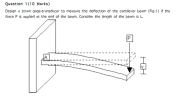 Question 1(10 Marks) Design a strain gage-transducer to measure the deflection of the cantilever beam (Fig.1) if the force P is applied at the end of the beam. Consider the length of the beam is L
Question 1(10 Marks) Design a strain gage-transducer to measure the deflection of the cantilever beam (Fig.1) if the force P is applied at the end of the beam. Consider the length of the beam is L
Question 1(10 Marks) Design a strain gage-transducer to measure the deflection of the cantilever beam (Fig.1) if the force P is applied at the end of the beam. Consider the length of the beam is L
ctromagnetic Induction HOOSE 2 QUESTIONS: a) A flow meter can be used to measure the speed of blood in situations when a blood essel is sufficiently exposed.Blood is conductive enough that it can...
 ctromagnetic Induction HOOSE 2 QUESTIONS: a) A flow meter can be used to measure the speed of blood in situations when a blood essel is sufficiently exposed.Blood is conductive enough that it can be treated as a moving conductor. When it flows perpendicularly with respect to a magnetic field, electrodes can be used to measure a small voltage across the vessel. Suppose the speed of the blood is 0.30 m/s and the diameter of the vessel is 5.6mm. In a...
A Doppler ultrasound is used to measure blood flow speeds, for instance, in a patient's artery....
 A Doppler ultrasound is used to measure blood flow speeds, for instance, in a patient's artery. Assume the probe emits ultrasound waves at a frequency of 5 x 1O^6 Hz and the speed of sound in human tissue is 1540 m/s. (a) Why is the Doppler effect the basis of the mechanism of an ultrasound machine? (b) What is the frequency, f" received by the probe if the beat frequency, that is, the frequency shift following reflection, is 400 Hz...
An ultrasound machine can measure blood flow speeds. Assume the machine emits acoustic energy at a...
 An ultrasound machine can measure blood flow speeds. Assume the machine emits acoustic energy at a frequency of 2.10 MHz, and the speed of the wave in human tissue is taken to be 1490.0 m/s. What is the beat frequency feat between the transmitted and reflected waves if blood is flowing in large arteries at 0.0260 m/s directly away from the sound source? feat Hz
 b: The torque transducer specified in Table below is chosen to measure a nominal torque of 100°N.m. The ambient temperature is expected to vary between 1 5 and 2S"C during tests. Estimate the magnitude of the total error affecting the measured torque Operation 100N.m to10kNm :0.05% of reading +0,05% ofreading +0.05% ofreading 0.05% ofFSO Range Accuracy error Non-linearity error Hysteresis error Sensitivity error
b: The torque transducer specified in Table below is chosen to measure a nominal torque of 100°N.m....
b: The torque transducer specified in Table below is chosen to measure a nominal torque of 100°N.m. The ambient temperature is expected to vary between 1 5 and 2S"C during tests. Estimate the magnitude of the total error affecting the measured torque Operation 100N.m to10kNm :0.05% of reading +0,05% ofreading +0.05% ofreading 0.05% ofFSO Range Accuracy error Non-linearity error Hysteresis error Sensitivity error
b: The torque transducer specified in Table below is chosen to measure a nominal torque of 100°N.m....
 2.) A capillary rheometer is used to measure viscosity. A
pressure transducer records the pressure drop delta P across the
die, and the die capillary has a diameter of 2 mm. Experiments are
carried out at three volume flow rates Q, for dies of each of three
lengths l. The following is a table of values of delta P
(in MPa) measured for polupropylene at 190 C. For each flow rate Q
find the apparent viscosity, assuming Newtonian behaviour.
Table...
2.) A capillary rheometer is used to measure viscosity. A
pressure transducer records the pressure drop delta P across the
die, and the die capillary has a diameter of 2 mm. Experiments are
carried out at three volume flow rates Q, for dies of each of three
lengths l. The following is a table of values of delta P
(in MPa) measured for polupropylene at 190 C. For each flow rate Q
find the apparent viscosity, assuming Newtonian behaviour.
Table...
 Problem 4 (20 points) A stain gauge differential pressure transducer with a range of 0 to 100 psi is to measure a pressure difference of 50 psi, with the following specifications: Output range: 0 to 10 Volts Linearity Error: +/-0.1% of reading Hysteresis Error: +/- 0.05% of reading Sensitivity Error: +/-0.01% of reading When transducer is installed for its intended use, installation effects are estimated to affect its reading by 0.1 psi. The output is measured using a 12 bit...
 Question 1(10 Marks) Design a strain gage-transducer to measure the deflection of the cantilever beam (Fig.1) if the force P is applied at the end of the beam. Consider the length of the beam is L
Question 1(10 Marks) Design a strain gage-transducer to measure the deflection of the cantilever beam (Fig.1) if the force P is applied at the end of the beam. Consider the length of the beam is L
Question 1(10 Marks) Design a strain gage-transducer to measure the deflection of the cantilever beam (Fig.1) if the force P is applied at the end of the beam. Consider the length of the beam is L
 ctromagnetic Induction HOOSE 2 QUESTIONS: a) A flow meter can be used to measure the speed of blood in situations when a blood essel is sufficiently exposed.Blood is conductive enough that it can be treated as a moving conductor. When it flows perpendicularly with respect to a magnetic field, electrodes can be used to measure a small voltage across the vessel. Suppose the speed of the blood is 0.30 m/s and the diameter of the vessel is 5.6mm. In a...
 A Doppler ultrasound is used to measure blood flow speeds, for instance, in a patient's artery. Assume the probe emits ultrasound waves at a frequency of 5 x 1O^6 Hz and the speed of sound in human tissue is 1540 m/s. (a) Why is the Doppler effect the basis of the mechanism of an ultrasound machine? (b) What is the frequency, f" received by the probe if the beat frequency, that is, the frequency shift following reflection, is 400 Hz...
 An ultrasound machine can measure blood flow speeds. Assume the machine emits acoustic energy at a frequency of 2.10 MHz, and the speed of the wave in human tissue is taken to be 1490.0 m/s. What is the beat frequency feat between the transmitted and reflected waves if blood is flowing in large arteries at 0.0260 m/s directly away from the sound source? feat Hz
Most questions answered within 3 hours.
-
Where is the error in this code sequence?
String s1 = "Hello";
String s2 = "ello";...
asked 10 months ago -
Financial data for Joel de Paris, Inc., for last year
follow:
Joel de Paris, Inc.
Balance...
asked 10 months ago -
Consider this reaction:
Al2(SO4)3 (aq)+ BaCl3
(aq) Al2Cl6 (aq)- +
3BaSO4(s) . What is the...
asked 10 months ago -
Suppose that Savneet is considering increasing her
recent random sample from 20 car rentals to 40...
asked 10 months ago -
Trucks arrive at an unloading terminal at an average rate of 120
per hour.
Trucks arrive...
asked 10 months ago -
Why are methanol and ethanol completely soluble in water while
octanol is not very little soluble....
asked 10 months ago -
A facilities manager at a university reads in a research report
that the mean amount of...
asked 10 months ago -
When the CuSO4 is rehydrated by adding water to the anhydrous
compound, is this an endothermic...
asked 10 months ago -
A ray of sunlight is passing from diamond into crown glass; the
angle of incidence is...
asked 10 months ago -
A block of mass 0.249 kg is placed on top of a light, vertical
spring of...
asked 10 months ago -
how do the kidneys compensate in the presences of acidosis
a) trigger hyperventilate
b) reserve acid...
asked 10 months ago -
Question 501 pts
The rental rate of capital to the firm increases. Which of the
following...
asked 10 months ago