Compute the change in entropy for an ideal dry gas of mass M which is heated...
Compute the change in entropy for an ideal dry gas of mass M which is heated at constant volume from T 1 to T 2 . Take M = 1 kg, T 1 = 300 K and T 2 = 310 K.
Homework Answers

Add Answer to:
Compute the change in entropy for an ideal dry gas of mass M
which is heated...
Clear handwriting Ideal gas (n 2.053 mol) is heated at constant volume from ti 124.00°C to...
 Clear handwriting
Ideal gas (n 2.053 mol) is heated at constant volume from ti 124.00°C to final temperature t = 244.00°C. Calculate the work and heat for the process and the change of entropy of the gas. The isobaric heat capacity of the gas is Cp,m = 28.609 J-K1-mol*
Ideal gas (n 2.053 mol) is heated at constant volume from ti 124.00°C to final temperature t = 244.00°C. Calculate the work and heat for the process and the change of...
Clear handwriting
Ideal gas (n 2.053 mol) is heated at constant volume from ti 124.00°C to final temperature t = 244.00°C. Calculate the work and heat for the process and the change of entropy of the gas. The isobaric heat capacity of the gas is Cp,m = 28.609 J-K1-mol*
Ideal gas (n 2.053 mol) is heated at constant volume from ti 124.00°C to final temperature t = 244.00°C. Calculate the work and heat for the process and the change of...
If 1.85 x 10⁵ atoms of a monatomic ideal gas are heated from 300 K to...
 If 1.85 x 10⁵ atoms of a monatomic ideal gas are heated from 300 K to 520 K in a sealed container that has a fixed volume of 0.0560 m1 what is the change in entropy of the gas?
The question is below the picture. Thanks What is the change in entropy per particle of...
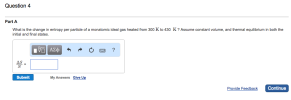 The question is below the picture. Thanks
What is the change in entropy per particle of a monatomic ideal gas heated from 300 K to 430 K ? Assume constant volume, and thermal equilibrium in both the initial and final states.
The question is below the picture. Thanks
What is the change in entropy per particle of a monatomic ideal gas heated from 300 K to 430 K ? Assume constant volume, and thermal equilibrium in both the initial and final states.
Calculate the change in entropy ΔS for 5.2 moles of an ideal gas when its thermodynamic...
Calculate the change in entropy ΔS for 5.2 moles of an ideal gas when its thermodynamic state changes from p1 = 1.50 atm and T1 = 400.0 K to p2 = 3.00 atm and T2 = 600.0 K. The molar heat capacity of the gas at constant volume is CV,m = (7/2) R, and is independent of the temperature.
2.80 moles of an ideal gas with CV,m=3R/2 undergoes the transformations described in the following list...
2.80 moles of an ideal gas with CV,m=3R/2 undergoes the transformations described in the following list from an initial state described by T = 310. K and P = 1.00 bar. The gas is heated to 615 K at a constant volume corresponding to the initial volume. Calculate q for this process
4. An ideal gas with constant specific heats undergoes a process from an initial pressure of...
4. An ideal gas with constant specific heats undergoes a process from an initial pressure of 50 kPa and initial specific volume of 4 m^3/kg to a final pressure of 80 kPa and final specific volume of 5 m^3/kg. The mass of the carbon monoxide is 3 kg. The gas has a molar mass of 44 kg/kmol and a specific heat at constant volume of 0.98 kJ/(kg∙K). Determine the entropy change of the gas during the process in kJ/K.
2. (5 Points) 3-kg of air (an ideal gas) is heated in a piston-cylinder device from...
 2. (5 Points) 3-kg of air (an ideal gas) is heated in a piston-cylinder device from 17°C to 117°C at a constant pressure of 100 kPa. Determine the entropy change in kJ/K, assuming: a. Constant specific heat. b. Variable specific heat.
13. One mole of an ideal gas is heated reversibly along a path such that T=...
 13. One mole of an ideal gas is heated reversibly along a path such that T= AV?, where A is a constant. If the initial temperature is T(K), what must the final temperature T (K)) be if the entropy change is equal to BOK-) (B is a constant value and cm = R (Jmol-'K™)
4) An ideal-gas mixture of helium and nitrogen with a nitrogen mass fraction of 35 percent...
 4) An ideal-gas mixture of helium and nitrogen with a nitrogen mass fraction of 35 percent is contained in a piston-cylinder device arranged to maintain a fixed pressure of 700 kPa. The mixture is heated from 300 K to 500 K a. Determine the molar mass and gas constant for the mixture. b. Determine the work produced, in kJ/kg. (Hint: Try finding the specific c. Determine the constant-volume and constant-pressure specific heats (Answer: 5.72 kg/kmol, 1.45 kJ/kg K) volumes at...
Physical Chemistry Calculate the change in entropy when one mole of metallic aluminum is heated at...
 Physical Chemistry
Calculate the change in entropy when one mole of metallic aluminum is heated at one bar pressure from an initial temperature of 25 °C to a final temperature of 750 °C. The molar heat capacities of solid and liquid aluminum at one bar pressure are 29.2 J mol K1 and 31.75 J mol K, respectively. The specific enthalpy of fusion of aluminum at its melting point (660.46 °C) is 396.57 J g1. The molar mass of aluminum is...
Physical Chemistry
Calculate the change in entropy when one mole of metallic aluminum is heated at one bar pressure from an initial temperature of 25 °C to a final temperature of 750 °C. The molar heat capacities of solid and liquid aluminum at one bar pressure are 29.2 J mol K1 and 31.75 J mol K, respectively. The specific enthalpy of fusion of aluminum at its melting point (660.46 °C) is 396.57 J g1. The molar mass of aluminum is...
 Clear handwriting
Ideal gas (n 2.053 mol) is heated at constant volume from ti 124.00°C to final temperature t = 244.00°C. Calculate the work and heat for the process and the change of entropy of the gas. The isobaric heat capacity of the gas is Cp,m = 28.609 J-K1-mol*
Ideal gas (n 2.053 mol) is heated at constant volume from ti 124.00°C to final temperature t = 244.00°C. Calculate the work and heat for the process and the change of...
Clear handwriting
Ideal gas (n 2.053 mol) is heated at constant volume from ti 124.00°C to final temperature t = 244.00°C. Calculate the work and heat for the process and the change of entropy of the gas. The isobaric heat capacity of the gas is Cp,m = 28.609 J-K1-mol*
Ideal gas (n 2.053 mol) is heated at constant volume from ti 124.00°C to final temperature t = 244.00°C. Calculate the work and heat for the process and the change of...
 If 1.85 x 10⁵ atoms of a monatomic ideal gas are heated from 300 K to 520 K in a sealed container that has a fixed volume of 0.0560 m1 what is the change in entropy of the gas?
 The question is below the picture. Thanks
What is the change in entropy per particle of a monatomic ideal gas heated from 300 K to 430 K ? Assume constant volume, and thermal equilibrium in both the initial and final states.
The question is below the picture. Thanks
What is the change in entropy per particle of a monatomic ideal gas heated from 300 K to 430 K ? Assume constant volume, and thermal equilibrium in both the initial and final states.
 2. (5 Points) 3-kg of air (an ideal gas) is heated in a piston-cylinder device from 17°C to 117°C at a constant pressure of 100 kPa. Determine the entropy change in kJ/K, assuming: a. Constant specific heat. b. Variable specific heat.
 13. One mole of an ideal gas is heated reversibly along a path such that T= AV?, where A is a constant. If the initial temperature is T(K), what must the final temperature T (K)) be if the entropy change is equal to BOK-) (B is a constant value and cm = R (Jmol-'K™)
 4) An ideal-gas mixture of helium and nitrogen with a nitrogen mass fraction of 35 percent is contained in a piston-cylinder device arranged to maintain a fixed pressure of 700 kPa. The mixture is heated from 300 K to 500 K a. Determine the molar mass and gas constant for the mixture. b. Determine the work produced, in kJ/kg. (Hint: Try finding the specific c. Determine the constant-volume and constant-pressure specific heats (Answer: 5.72 kg/kmol, 1.45 kJ/kg K) volumes at...
 Physical Chemistry
Calculate the change in entropy when one mole of metallic aluminum is heated at one bar pressure from an initial temperature of 25 °C to a final temperature of 750 °C. The molar heat capacities of solid and liquid aluminum at one bar pressure are 29.2 J mol K1 and 31.75 J mol K, respectively. The specific enthalpy of fusion of aluminum at its melting point (660.46 °C) is 396.57 J g1. The molar mass of aluminum is...
Physical Chemistry
Calculate the change in entropy when one mole of metallic aluminum is heated at one bar pressure from an initial temperature of 25 °C to a final temperature of 750 °C. The molar heat capacities of solid and liquid aluminum at one bar pressure are 29.2 J mol K1 and 31.75 J mol K, respectively. The specific enthalpy of fusion of aluminum at its melting point (660.46 °C) is 396.57 J g1. The molar mass of aluminum is...
Most questions answered within 3 hours.
-
Where is the error in this code sequence?
String s1 = "Hello";
String s2 = "ello";...
asked 10 months ago -
Financial data for Joel de Paris, Inc., for last year
follow:
Joel de Paris, Inc.
Balance...
asked 10 months ago -
Consider this reaction:
Al2(SO4)3 (aq)+ BaCl3
(aq) Al2Cl6 (aq)- +
3BaSO4(s) . What is the...
asked 10 months ago -
Suppose that Savneet is considering increasing her
recent random sample from 20 car rentals to 40...
asked 10 months ago -
Trucks arrive at an unloading terminal at an average rate of 120
per hour.
Trucks arrive...
asked 10 months ago -
Why are methanol and ethanol completely soluble in water while
octanol is not very little soluble....
asked 10 months ago -
A facilities manager at a university reads in a research report
that the mean amount of...
asked 10 months ago -
When the CuSO4 is rehydrated by adding water to the anhydrous
compound, is this an endothermic...
asked 10 months ago -
A ray of sunlight is passing from diamond into crown glass; the
angle of incidence is...
asked 10 months ago -
A block of mass 0.249 kg is placed on top of a light, vertical
spring of...
asked 10 months ago -
how do the kidneys compensate in the presences of acidosis
a) trigger hyperventilate
b) reserve acid...
asked 10 months ago -
Question 501 pts
The rental rate of capital to the firm increases. Which of the
following...
asked 10 months ago