A cemented carbide tool is used to turn a part with a length of 14.0 in...
A cemented carbide tool is used to turn a part with a
length of 14.0 in and diameter = 4.5 in. The parameters in the
Taylor equation are: n = 0.21 and C = 1100 (ft/min). The rate for
the operator and machine tool = $45.00/hr, and the tooling cost per
cutting edge = $2.10. It takes 2.5 min to load and unload
the workpart and 1.50 min to change tools. The feed =
0.015 in/rev. Determine:
(a) cutting speed for maximum production rate in
ft/min
686.59,729.48,764.85,808.34,855.42,906.77,658.75,724.42,769.48,818.39,835.21,926.66
(b) tool life of cutting in
min
6.39, 7.32,
8.50,4.50,5.02,5.64,6.39,7.32,8.50,4.50,5.02,5.64
(c) cycle time in min
4.44,
4.17,4.42,3.97,5.57,4.71,3.54,3.54,3.84,4.54,3.66,3.84
(d) cost per unit of product in $
3.01,
3.33,4.16,3.24,3.94,4.15,3.60,3.46,3.75,2.97,4.03,3.70
Homework Answers


Add Answer to:
A cemented carbide tool is used to turn a part with a
length of 14.0 in...
Question 3 Suppose a cemented carbide tool with a brazed insert is used to turn a steel workpart that is 375 mmlong and 62.5 mnm in diameter. The parameters in the Taylor equation are: n = 0.25 an...
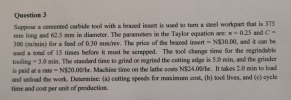 Question 3 Suppose a cemented carbide tool with a brazed insert is used to turn a steel workpart that is 375 mmlong and 62.5 mnm in diameter. The parameters in the Taylor equation are: n = 0.25 and C = 300 (m/min) for a feed of 0.30 mm/rev. The price of the brazed insert N$30.00, and it can be used a total of 15 times before it must be scrapped. The tool change time for the regrindable tooling 3.0 min....
Please solve 23.15 thank you! 3.14 (SI units) Solve the previous problem except that in partToo...
 Please solve 23.15 thank you!
3.14 (SI units) Solve the previous problem except that in partToo ting (a), determine the cutting speed for minimum cost. 23.15 (uSCS units) Cemented carbide inserts are used to turn 21.0 in and diameter = 4.0 in. Feed the a part with length incre that f what produ 0.015 in/rev. The parameters in the Taylor equation are n = 0.25 and C =800 (ft/nin) The operator and machine tool rate = S45.00/hr. and the tooling...
Please solve 23.15 thank you!
3.14 (SI units) Solve the previous problem except that in partToo ting (a), determine the cutting speed for minimum cost. 23.15 (uSCS units) Cemented carbide inserts are used to turn 21.0 in and diameter = 4.0 in. Feed the a part with length incre that f what produ 0.015 in/rev. The parameters in the Taylor equation are n = 0.25 and C =800 (ft/nin) The operator and machine tool rate = S45.00/hr. and the tooling...
a) A workpiece (φ-75 mm, 1 275 mm) is machined using turning at a feed rate of 0.25 mm/rev. At a cutting speed- 3.5 m/s, the turning tool is ineffective after machining 3 parts, and at a cutting s...
 a) A workpiece (φ-75 mm, 1 275 mm) is machined using turning at a feed rate of 0.25 mm/rev. At a cutting speed- 3.5 m/s, the turning tool is ineffective after machining 3 parts, and at a cutting speed = 2.5 m/s, the turning tool is effective for producing 20 parts. Calculate the Cutting Speed that will allow 30 parts to be machined between tool changes [20 marks] b) An aluminium alloy workpiece (tensile strength - 325 N/mm2 and yield...
Flank wear data were collected in a series of turming tests using a coated carbide tool...
 Flank wear data were collected in a series of turming tests using a coated carbide tool on hardened alloy steel at a feed of 0.3 mm/rev and a depth of 3.6 mm. At a speed of 120 m/min, flank wear 0.12 mm at 1 min, 0.27 mm at 5 min, 0.5 mm at 10 min, 0.58 mm at 15 min, 0.73 at 20 min, and 0.97 mm at 25 min. At a speed of 160 m/min, flank wear 0.2 mm...
Problem 1 Consider the drilling of Feature 3 (Thru Hole) on the flashlight head (Figure 1)...
 Problem 1 Consider the drilling of Feature 3 (Thru Hole) on the flashlight head (Figure 1) Assume the feed of the drilling opcration (i.e., the distance the drill penetrates per unit revolution) is,f= 0.01 inrev. " a) Calculate the material removal rate (in in3/s or mm3/s). b) Use the Taylor Tool Life equation to estimate the tool life (in minutes) for this operation. Use Table 1 to pick appropriate values of C and n (the flashlight material is aluminum and...
Question 1 A turning operation is carried out on aluminum. Based on the specific energy values...
 Question 1 A turning operation is carried out on aluminum. Based on the specific energy values in Table 20.2, determine material removal rate and cutting power in the operation under the following sets of cutting conditions: (a) Cutting speed 5.6 m/s, feed 0.25 mm/rev, and depth of cut 2.0 mm; and (b) cutting speed- 1.3 m/s, feed 0.75 mm/rev, and depth 4.0 mm. Question 2 Consider a turning operation performed on steel whose hardness 225 HB at a cutting speed...
 Question 3 Suppose a cemented carbide tool with a brazed insert is used to turn a steel workpart that is 375 mmlong and 62.5 mnm in diameter. The parameters in the Taylor equation are: n = 0.25 and C = 300 (m/min) for a feed of 0.30 mm/rev. The price of the brazed insert N$30.00, and it can be used a total of 15 times before it must be scrapped. The tool change time for the regrindable tooling 3.0 min....
 Please solve 23.15 thank you!
3.14 (SI units) Solve the previous problem except that in partToo ting (a), determine the cutting speed for minimum cost. 23.15 (uSCS units) Cemented carbide inserts are used to turn 21.0 in and diameter = 4.0 in. Feed the a part with length incre that f what produ 0.015 in/rev. The parameters in the Taylor equation are n = 0.25 and C =800 (ft/nin) The operator and machine tool rate = S45.00/hr. and the tooling...
Please solve 23.15 thank you!
3.14 (SI units) Solve the previous problem except that in partToo ting (a), determine the cutting speed for minimum cost. 23.15 (uSCS units) Cemented carbide inserts are used to turn 21.0 in and diameter = 4.0 in. Feed the a part with length incre that f what produ 0.015 in/rev. The parameters in the Taylor equation are n = 0.25 and C =800 (ft/nin) The operator and machine tool rate = S45.00/hr. and the tooling...
 a) A workpiece (φ-75 mm, 1 275 mm) is machined using turning at a feed rate of 0.25 mm/rev. At a cutting speed- 3.5 m/s, the turning tool is ineffective after machining 3 parts, and at a cutting speed = 2.5 m/s, the turning tool is effective for producing 20 parts. Calculate the Cutting Speed that will allow 30 parts to be machined between tool changes [20 marks] b) An aluminium alloy workpiece (tensile strength - 325 N/mm2 and yield...
 Flank wear data were collected in a series of turming tests using a coated carbide tool on hardened alloy steel at a feed of 0.3 mm/rev and a depth of 3.6 mm. At a speed of 120 m/min, flank wear 0.12 mm at 1 min, 0.27 mm at 5 min, 0.5 mm at 10 min, 0.58 mm at 15 min, 0.73 at 20 min, and 0.97 mm at 25 min. At a speed of 160 m/min, flank wear 0.2 mm...
 Problem 1 Consider the drilling of Feature 3 (Thru Hole) on the flashlight head (Figure 1) Assume the feed of the drilling opcration (i.e., the distance the drill penetrates per unit revolution) is,f= 0.01 inrev. " a) Calculate the material removal rate (in in3/s or mm3/s). b) Use the Taylor Tool Life equation to estimate the tool life (in minutes) for this operation. Use Table 1 to pick appropriate values of C and n (the flashlight material is aluminum and...
 Question 1 A turning operation is carried out on aluminum. Based on the specific energy values in Table 20.2, determine material removal rate and cutting power in the operation under the following sets of cutting conditions: (a) Cutting speed 5.6 m/s, feed 0.25 mm/rev, and depth of cut 2.0 mm; and (b) cutting speed- 1.3 m/s, feed 0.75 mm/rev, and depth 4.0 mm. Question 2 Consider a turning operation performed on steel whose hardness 225 HB at a cutting speed...
Most questions answered within 3 hours.
-
Where is the error in this code sequence?
String s1 = "Hello";
String s2 = "ello";...
asked 11 months ago -
Financial data for Joel de Paris, Inc., for last year
follow:
Joel de Paris, Inc.
Balance...
asked 11 months ago -
Consider this reaction:
Al2(SO4)3 (aq)+ BaCl3
(aq) Al2Cl6 (aq)- +
3BaSO4(s) . What is the...
asked 11 months ago -
Suppose that Savneet is considering increasing her
recent random sample from 20 car rentals to 40...
asked 11 months ago -
Trucks arrive at an unloading terminal at an average rate of 120
per hour.
Trucks arrive...
asked 11 months ago -
Why are methanol and ethanol completely soluble in water while
octanol is not very little soluble....
asked 11 months ago -
A facilities manager at a university reads in a research report
that the mean amount of...
asked 11 months ago -
When the CuSO4 is rehydrated by adding water to the anhydrous
compound, is this an endothermic...
asked 11 months ago -
A ray of sunlight is passing from diamond into crown glass; the
angle of incidence is...
asked 11 months ago -
A block of mass 0.249 kg is placed on top of a light, vertical
spring of...
asked 11 months ago -
how do the kidneys compensate in the presences of acidosis
a) trigger hyperventilate
b) reserve acid...
asked 11 months ago -
Question 501 pts
The rental rate of capital to the firm increases. Which of the
following...
asked 11 months ago