How to Write a function, called multGauss, to compute the sum of multiple Gaussian (normal) profiles...
How to Write a function, called multGauss, to compute the sum of multiple Gaussian (normal) profiles in Matlab.
Homework Answers
The Gaussian model equation to compute sum of multiple Gaussian profiles in Matlab is given below.
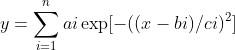
Where
a is the amplitude,
b is the centroid (location),
c is related to the peak width,
n is the number of peaks to fit,
and 1 ≤ n ≤ 8
Now to Write a function, called multGauss in Matlab is as below.
a> function S=sumInt(n) Defining function multGauss as "S"
S=0
for i=1:n
S=S+i
end
end
b> function s = halfsum(A)
[row col] = size(A);
if row ~= col
error('Expecting a square matrix here people...');
end
s = 0;
for ii = 1:row
for jj = ii:col
s = s + A(ii,jj);
end
end
c>
% Ask user for one integer number.
defaultValue = 45;
titleBar = 'Enter an integer value';
userPrompt = 'Enter the integer';
caUserInput = inputdlg(userPrompt, titleBar, 1, {num2str(defaultValue)});
if isempty(caUserInput),return,end; % Bail out if they clicked Cancel.
% Round to nearest integer in case they entered a floating point number.
integerValue = round(str2double(cell2mat(caUserInput)));
% Check for a valid integer.
if isnan(integerValue)
% They didn't enter a number.
% They clicked Cancel, or entered a character, symbols, or something else not allowed.
integerValue = defaultValue;
message = sprintf('I said it had to be an integer.\nTry replacing the user.\nI will use %d and continue.', integerValue);
uiwait(warndlg(message));
end
d>
n=500;
H1 = normrnd(14,5,n,1); % generate random numbers of normal distribution at mu and sigma
H2 = 24+ normrnd(14,5,n,1); % start from 24
H3 = 48+ normrnd(14,5,n,1);
H4 = 72+ normrnd(14,5,n,1);
H5 = 96+ normrnd(14,5,n,1);
figure
hhh = [H1 H2 H3 H4 H5];
hist(hhh,130)
edges = -20:140;
counts1 = histc(H1, edges);
counts2 = histc(H2, edges)
counts3 = histc(H3, edges);
counts4 = histc(H4, edges);
counts5 = histc(H5, edges);
% Get indexes of first overlap region.
mask = counts1>0 & counts2>0;
% Sum both histograms in that area.
sum1 = sum(counts1(mask)) + sum(counts2(mask))
% Get indexes of second overlap region.
mask = counts2>0 & counts3>0;
% Sum both histograms in that area.
sum2 = sum(counts2(mask)) + sum(counts3(mask))
% Get indexes of third overlap region.
mask = counts3>0 & counts4>0;
% Sum both histograms in that area.
sum3 = sum(counts3(mask)) + sum(counts4(mask))
% Get indexes of fourth overlap region.
mask = counts4>0 & counts5>0;
% Sum both histograms in that area.
sum4 = sum(counts4(mask)) + sum(counts5(mask))
Add Answer to:
How to Write a function, called multGauss, to compute the sum of
multiple Gaussian (normal) profiles...
Matlab Write a function called matrixsum that takes any matrix to calculate and return the sum...
Matlab Write a function called matrixsum that takes any matrix to calculate and return the sum of all matrix elements (this function must not use any array operations. It must instead use a for-loop.)
Problem 3: Write a MATLAB function called cubic_spline to compute the natural cubic spline for a...
 Problem 3: Write a MATLAB function called cubic_spline to compute the natural cubic spline for a given data set. The x and y data points and the rdesired values (a vector) should be the inputs, and the corresponding ydesired values (a vector) should be the output.
MATLAB QUESTION Write a MATLAB function called vector_input that takes no inputs and returns no outputs. Instead, when c...
MATLAB QUESTION Write a MATLAB function called vector_input that takes no inputs and returns no outputs. Instead, when called, it gives control to the user and asks the user to input a length-3 vector. Then the function prints: The sum of ___, ____, and ____ is ____. [new line] where the first three blanks are filled by each element in input vector, and the last blank is the sum of all three elements.
MATLAB HELP PLEASE Write a Matlab function that evaluates a sum of sines at a set...
 MATLAB HELP PLEASE
Write a Matlab function that evaluates a sum of sines at a set of points. The first term is just a constant (a coefficient with no sine term). Then, each sine term will have a coefficient before it and then an increasing multiple of the angle inside. For example, consider the sum 3 + 4 sin(9)-1.5 sin (20) 2 sin (40)3 sin (50) We recognize that this is the same as 344sin(101+-1.5 sin (20) + 0 sin...
MATLAB HELP PLEASE
Write a Matlab function that evaluates a sum of sines at a set of points. The first term is just a constant (a coefficient with no sine term). Then, each sine term will have a coefficient before it and then an increasing multiple of the angle inside. For example, consider the sum 3 + 4 sin(9)-1.5 sin (20) 2 sin (40)3 sin (50) We recognize that this is the same as 344sin(101+-1.5 sin (20) + 0 sin...
MATLAB QUESTION function Huge_Add = huge_add(number1,number2) sum= number1 + number2; sprintf(' %+5.2d',sum) end 3. Write function...
 MATLAB QUESTION
function Huge_Add = huge_add(number1,number2)
sum= number1 + number2;
sprintf(' %+5.2d',sum)
end
3. Write function called huge add that adds together two positive integers of any length specified as strings using decimal notation. The single output argument is the result and it is a string as well. The inputs and output must contain digits only; no commas, spaces or any other characters are allowed. If any of these assumptions are violated by the input, the function returns the number-1.
MATLAB QUESTION
function Huge_Add = huge_add(number1,number2)
sum= number1 + number2;
sprintf(' %+5.2d',sum)
end
3. Write function called huge add that adds together two positive integers of any length specified as strings using decimal notation. The single output argument is the result and it is a string as well. The inputs and output must contain digits only; no commas, spaces or any other characters are allowed. If any of these assumptions are violated by the input, the function returns the number-1.
Write a matlab function called strip Write a function called strip which takes in a single...
 Write a matlab function called strip
Write a function called strip which takes in a single string s, and returns a version of s with all the spaces removed. The format of the output is specified in the following examples >> strip ('This is a test') This is a test >> strip ('Another test') Another test
Write a matlab function called strip
Write a function called strip which takes in a single string s, and returns a version of s with all the spaces removed. The format of the output is specified in the following examples >> strip ('This is a test') This is a test >> strip ('Another test') Another test
This problem investigates how you can use random numbers to simulate a computer dice game write a function called twooice that simulates the rolling of two sik-sided dice. The function takes no input...
 This problem investigates how you can use random numbers to simulate a computer dice game write a function called twooice that simulates the rolling of two sik-sided dice. The function takes no inputs. Instead, it generates two random integers between 1 and 6, and output their sum. You may submit your work as many times as you want Try to get 100%) Your Function MATLAB Documentation Reset Code to call your function C Reset 1s-tuoDice ss-twoDice
This problem investigates how...
This problem investigates how you can use random numbers to simulate a computer dice game write a function called twooice that simulates the rolling of two sik-sided dice. The function takes no inputs. Instead, it generates two random integers between 1 and 6, and output their sum. You may submit your work as many times as you want Try to get 100%) Your Function MATLAB Documentation Reset Code to call your function C Reset 1s-tuoDice ss-twoDice
This problem investigates how...
Write a C++ program using a function called sum that calculates the following summation: p=2+5 F...
 Write a C++ program using a function called sum that calculates the following summation: p=2+5 F = i2 + 5 i=1 Where n is provided by the user in the main function. The function calculates the sum and return it to the main function to display it.
Please write program in C++ Write a function called randCount with no parameters. The function should...
Please write program in C++ Write a function called randCount with no parameters. The function should randomly generate 5 numbers between 8 to 15 and counts how many times a multiple of 2 occurred. Return the answer to the calling function. please write the program in C++
question on matlab. this is for a function. the question is "write a function called tri_area...
question on matlab. this is for a function. the question is "write a function called tri_area that returns the area of a triangle with base b and height h, where b and h are input arguments of the function in that order "
 Problem 3: Write a MATLAB function called cubic_spline to compute the natural cubic spline for a given data set. The x and y data points and the rdesired values (a vector) should be the inputs, and the corresponding ydesired values (a vector) should be the output.
 MATLAB HELP PLEASE
Write a Matlab function that evaluates a sum of sines at a set of points. The first term is just a constant (a coefficient with no sine term). Then, each sine term will have a coefficient before it and then an increasing multiple of the angle inside. For example, consider the sum 3 + 4 sin(9)-1.5 sin (20) 2 sin (40)3 sin (50) We recognize that this is the same as 344sin(101+-1.5 sin (20) + 0 sin...
MATLAB HELP PLEASE
Write a Matlab function that evaluates a sum of sines at a set of points. The first term is just a constant (a coefficient with no sine term). Then, each sine term will have a coefficient before it and then an increasing multiple of the angle inside. For example, consider the sum 3 + 4 sin(9)-1.5 sin (20) 2 sin (40)3 sin (50) We recognize that this is the same as 344sin(101+-1.5 sin (20) + 0 sin...
 MATLAB QUESTION
function Huge_Add = huge_add(number1,number2)
sum= number1 + number2;
sprintf(' %+5.2d',sum)
end
3. Write function called huge add that adds together two positive integers of any length specified as strings using decimal notation. The single output argument is the result and it is a string as well. The inputs and output must contain digits only; no commas, spaces or any other characters are allowed. If any of these assumptions are violated by the input, the function returns the number-1.
MATLAB QUESTION
function Huge_Add = huge_add(number1,number2)
sum= number1 + number2;
sprintf(' %+5.2d',sum)
end
3. Write function called huge add that adds together two positive integers of any length specified as strings using decimal notation. The single output argument is the result and it is a string as well. The inputs and output must contain digits only; no commas, spaces or any other characters are allowed. If any of these assumptions are violated by the input, the function returns the number-1.
 Write a matlab function called strip
Write a function called strip which takes in a single string s, and returns a version of s with all the spaces removed. The format of the output is specified in the following examples >> strip ('This is a test') This is a test >> strip ('Another test') Another test
Write a matlab function called strip
Write a function called strip which takes in a single string s, and returns a version of s with all the spaces removed. The format of the output is specified in the following examples >> strip ('This is a test') This is a test >> strip ('Another test') Another test
 This problem investigates how you can use random numbers to simulate a computer dice game write a function called twooice that simulates the rolling of two sik-sided dice. The function takes no inputs. Instead, it generates two random integers between 1 and 6, and output their sum. You may submit your work as many times as you want Try to get 100%) Your Function MATLAB Documentation Reset Code to call your function C Reset 1s-tuoDice ss-twoDice
This problem investigates how...
This problem investigates how you can use random numbers to simulate a computer dice game write a function called twooice that simulates the rolling of two sik-sided dice. The function takes no inputs. Instead, it generates two random integers between 1 and 6, and output their sum. You may submit your work as many times as you want Try to get 100%) Your Function MATLAB Documentation Reset Code to call your function C Reset 1s-tuoDice ss-twoDice
This problem investigates how...
 Write a C++ program using a function called sum that calculates the following summation: p=2+5 F = i2 + 5 i=1 Where n is provided by the user in the main function. The function calculates the sum and return it to the main function to display it.
Most questions answered within 3 hours.
-
Where is the error in this code sequence?
String s1 = "Hello";
String s2 = "ello";...
asked 10 months ago -
Financial data for Joel de Paris, Inc., for last year
follow:
Joel de Paris, Inc.
Balance...
asked 10 months ago -
Consider this reaction:
Al2(SO4)3 (aq)+ BaCl3
(aq) Al2Cl6 (aq)- +
3BaSO4(s) . What is the...
asked 10 months ago -
Suppose that Savneet is considering increasing her
recent random sample from 20 car rentals to 40...
asked 10 months ago -
Trucks arrive at an unloading terminal at an average rate of 120
per hour.
Trucks arrive...
asked 10 months ago -
Why are methanol and ethanol completely soluble in water while
octanol is not very little soluble....
asked 10 months ago -
A facilities manager at a university reads in a research report
that the mean amount of...
asked 10 months ago -
When the CuSO4 is rehydrated by adding water to the anhydrous
compound, is this an endothermic...
asked 10 months ago -
A ray of sunlight is passing from diamond into crown glass; the
angle of incidence is...
asked 10 months ago -
A block of mass 0.249 kg is placed on top of a light, vertical
spring of...
asked 10 months ago -
how do the kidneys compensate in the presences of acidosis
a) trigger hyperventilate
b) reserve acid...
asked 10 months ago -
Question 501 pts
The rental rate of capital to the firm increases. Which of the
following...
asked 10 months ago