What is the entry returned by the peek method after the following stack operations. push(A), peek(),...
Homework Answers
the entry returned by the peek method after the following stack operations is R

3. R
Add Answer to:
What is the entry returned by the peek method after the
following stack operations.
push(A), peek(),...
Name: Each question is worth 1 point. 20 1. In a linked-chain implementation of a Stack...
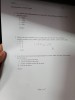 Name: Each question is worth 1 point. 20 1. In a linked-chain implementation of a Stack ADT, the performance of pushing an entry onto the stack is a. 0(2) b. О(n) С. 0(r) Answer: What is the entry returned by the peek method after the following stack operations. push(A), push(R), pop0. push(D), popO, push(L), pop0, pushJ), push(S), pop). pop 2. b.S c. L d. D Answer: n an efficient array-based chain implementation of a Stack ADT, the entry peek returns...
Suppose that we start with an empty stack and execute the operations: push(5) push(12) popo) push(3)...
 Suppose that we start with an empty stack and execute the operations: push(5) push(12) popo) push(3) push(7) popo) What values are returned by the two pop() operations above, in order? First pop(): Second pop(): Suppose that we start with an empty stack and execute the operations: enqueue(5) enqueue(12) dequeue enqueue(3) enqueue(7) dequeuel) What values are returned by the two pop() operations above, in order? First dequeue(): Second dequeue():
Stack manipulation: a) The following operations are performed on a stack: PUSH A, PUSH B, POP,...
 Stack manipulation: a) The following operations are performed on a stack: PUSH A, PUSH B, POP, PUSH C, POP, PUSH D, POP, PUSH E, POP, PUSH F What does the stack contain after each operation? 1 b) If the input stream is ZYXWV, create a sequence of pushes and pops such that the output stream is XYVWZ. (Note: The input stream of a stack is a list of all the elements we pushed onto the stack, in the order that...
) Consider Java's Stack class, and its five standard stack operations: push, pop, peek, isEmpty, and...
) Consider Java's Stack class, and its five standard stack operations: push, pop, peek, isEmpty, and clear. Complete the two unfinished methods. Do not modify any other parts of the class. // Looks at the top two elements of the stack, and removes and returns the larger // of the two elements from the stack, returning the other element to the stack. // For example, if the stack, from the top, is 8 10 7 2...
(Data Structure) Using only emptyCheck(), peek(), push(a), and pop() operations, write a function Middle(Stack S) that...
(Data Structure) Using only emptyCheck(), peek(), push(a), and pop() operations, write a function Middle(Stack S) that returns the value from stack S that is in the middle, (i.e., location [size / 2]). You may create additional stacks as needed, but S must be restored by the end of the routine.
Suppose we execute the following stack operations on a stack of ints. push(1); pop(); // #1...
Suppose we execute the following stack operations on a stack of ints. push(1); pop(); // #1 push(10); pop(); // #2 push(7); push(4); push(3); pop(); // #3 push(5); pop(); //#4 Write the final state of the stack, and for each pop() operation, write the value that will be popped off the stack (pops are numbered so you can refer to them).
A. Starting with an initially empty stack, after 6 push operations, 3 pop operations, and 2...
A. Starting with an initially empty stack, after 6 push operations, 3 pop operations, and 2 push operations, the number of elements in the stack would be: B. Starting with an initially empty queue, after 5 enqueue operations, 4 dequeue operations, and 6 enqueue operations, the number of elements in the queue would be:
Consider these functions: push() : push an element into the stack pop() : pop the top-of-the-stack...
Consider these functions: push() : push an element into the stack pop() : pop the top-of-the-stack element top() : returns the item stored in top-of-the-stack-node What will be the output after performing these sequence of operations (after performing top()) push(20); push(4); pop(); push(10); push(6); pop(); pop(); push(5); top();
1. a. Stack b. Queue c. Priority Queue d. List - (ADTs) Given the following steps: push(...
1. a. Stack b. Queue c. Priority Queue d. List - (ADTs) Given the following steps: push( "Jane" ); push( "Jess" ); push( "Jill" ); push( pop() ); push( "Jim" ); String name = pop(); push( peek() ); Write separate programs for each of the data structures Stack, Queue, PriorityQueue, and List. Use the appropriate push(), pop(), peek() for each of the respective ADT's. Use the Java class library of the ADT's as opposed to the author's implementation. What is in...
For java Review # 6: Stacks 1) Create a stack manually and automatically 2) PUSH (add...
For java Review # 6: Stacks 1) Create a stack manually and automatically 2) PUSH (add a new node to the TOP of the stack) 3) POP (remove the top node from the TOP of the stack) 4) PEEK
 Name: Each question is worth 1 point. 20 1. In a linked-chain implementation of a Stack ADT, the performance of pushing an entry onto the stack is a. 0(2) b. О(n) С. 0(r) Answer: What is the entry returned by the peek method after the following stack operations. push(A), push(R), pop0. push(D), popO, push(L), pop0, pushJ), push(S), pop). pop 2. b.S c. L d. D Answer: n an efficient array-based chain implementation of a Stack ADT, the entry peek returns...
 Suppose that we start with an empty stack and execute the operations: push(5) push(12) popo) push(3) push(7) popo) What values are returned by the two pop() operations above, in order? First pop(): Second pop(): Suppose that we start with an empty stack and execute the operations: enqueue(5) enqueue(12) dequeue enqueue(3) enqueue(7) dequeuel) What values are returned by the two pop() operations above, in order? First dequeue(): Second dequeue():
 Stack manipulation: a) The following operations are performed on a stack: PUSH A, PUSH B, POP, PUSH C, POP, PUSH D, POP, PUSH E, POP, PUSH F What does the stack contain after each operation? 1 b) If the input stream is ZYXWV, create a sequence of pushes and pops such that the output stream is XYVWZ. (Note: The input stream of a stack is a list of all the elements we pushed onto the stack, in the order that...
Most questions answered within 3 hours.
-
Where is the error in this code sequence?
String s1 = "Hello";
String s2 = "ello";...
asked 10 months ago -
Financial data for Joel de Paris, Inc., for last year
follow:
Joel de Paris, Inc.
Balance...
asked 10 months ago -
Consider this reaction:
Al2(SO4)3 (aq)+ BaCl3
(aq) Al2Cl6 (aq)- +
3BaSO4(s) . What is the...
asked 10 months ago -
Suppose that Savneet is considering increasing her
recent random sample from 20 car rentals to 40...
asked 10 months ago -
Trucks arrive at an unloading terminal at an average rate of 120
per hour.
Trucks arrive...
asked 10 months ago -
Why are methanol and ethanol completely soluble in water while
octanol is not very little soluble....
asked 10 months ago -
A facilities manager at a university reads in a research report
that the mean amount of...
asked 10 months ago -
When the CuSO4 is rehydrated by adding water to the anhydrous
compound, is this an endothermic...
asked 10 months ago -
A ray of sunlight is passing from diamond into crown glass; the
angle of incidence is...
asked 10 months ago -
A block of mass 0.249 kg is placed on top of a light, vertical
spring of...
asked 10 months ago -
how do the kidneys compensate in the presences of acidosis
a) trigger hyperventilate
b) reserve acid...
asked 10 months ago -
Question 501 pts
The rental rate of capital to the firm increases. Which of the
following...
asked 10 months ago