A fair die is rolled 2 times, and the results are Z1 and Z2. Define X...
A fair die is rolled 2 times, and the results are Z1 and Z2. Define X = Z1+Z2 and Y = Z1−Z2. (a) Show that Cov(X, Y ) = 0. (b) Prove that X and Y are not independent. (Hint: find a pair of numbers k and l for which P(X = k, Y = l) 6= P(X = k) × P(Y = l).)
Homework Answers
(a).
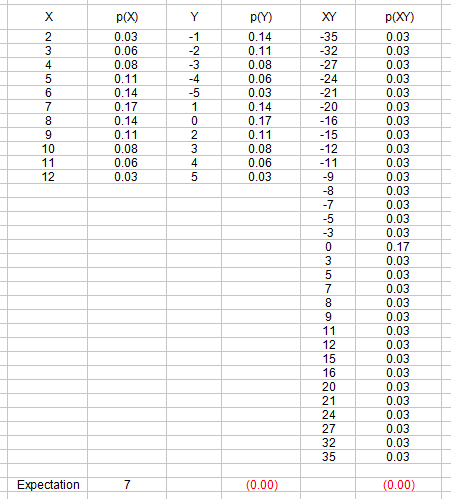
E(XY) = 0 = E(X) * E(Y) , thus covariance is 0.
(b). P(X=2,Y=-1) = 0
and P(X=2)*P(Y=-1)  0. Thus X and Y
are not independent.
0. Thus X and Y
are not independent.
Add Answer to:
A fair die is rolled 2 times, and the results are Z1 and Z2.
Define X...
3. A fair die is rolled twice. Let the first outcome be X and the second...
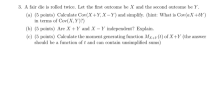 3. A fair die is rolled twice. Let the first outcome be X and the second outcome be Y (a) (5 points) Calculate Cov(XY, X -Y) and simplify. (hint: What is Cov(aX+bY) in terms of Cov(X, Y)?) (b) (5 points) Are X Y and X -Y independent? Explain. (c) (5 points) Calculate the moment generating function Mx+y(t) of X+Y (the answer should be a function of t and can contain unsimplified sums)
7. In n rolls of a fair die, let X be the number of times 1 is rolled, and Y the number of times ...
 7. In n rolls of a fair die, let X be the number of times 1 is rolled, and Y the number of times 2 is rolled. Find the conditional distribution of X given Y-m
7. In n rolls of a fair die, let X be the number of times 1 is rolled, and Y the number of times 2 is rolled. Find the conditional distribution of X given Y-m
7. In n rolls of a fair die, let X be the number of times 1 is rolled, and Y the number of times 2 is rolled. Find the conditional distribution of X given Y-m
5. A fair six sided die is rolled 10 times. Let X be the number of...
 5. A fair six sided die is rolled 10 times. Let X be the number of times the number '6' is rolled. Find P(X2)
b) Find Var(X) 5. A fair six sided die is rolled 10 times. Let X be...
 b) Find Var(X) 5. A fair six sided die is rolled 10 times. Let X be the number of times the number '6' is rolled. Find P(X2) B SEIKI
2. A fair red die and a fair blue die are rolled 2 times each. What...
2. A fair red die and a fair blue die are rolled 2 times each. What is the probability of the product of numbers on the red die is less then the sum of numbers on the blue die?
2. A fair red die and a fair blue die are rolled 2 times each. What...
2. A fair red die and a fair blue die are rolled 2 times each. What is the probability of the product of numbers on the red die is less then the sum of numbers on the blue die? -Ive already posted this question but the answer given didn't explain how to calculate the number of successful cases. I know the total possible cases is 6*6*6*6=1296, but how do you calculate the number of successful cases?
A fair die is rolled 100 times. Let X add the faces of all of the...
A fair die is rolled 100 times. Let X add the faces of all of the rolls together. Then µ = 350. Find an upper bound for P(X ≥ 400). Find the actual probability P(X = 100)
a player rolls a pair of fair die 10 times. the number X of 7's rolled...
a player rolls a pair of fair die 10 times. the number X of 7's rolled is recorded
Suppose a fair die numbered 1 to 5 is rolled 4 times. Complete parts (a) and...
 Suppose a fair die numbered 1 to 5 is rolled 4 times. Complete parts (a) and (b) below. (a) Find the probability distribution for the number of times 3 is rolled. 0 1 2 3 4 P(x) (Round to four decimal places as needed.) (b) What is the expected number of times 3 is rolled? E(x)=(Round to four decimal places as needed.)
Problem 1. Suppose that a fair six-sided die is rolled n times. Let N be the number of 1's rolled...
 I know Pk~1/k^5/2 just need the
work
Problem 1. Suppose that a fair six-sided die is rolled n times. Let N be the number of 1's rolled, N2 be the number of 2's rolled, etc, so that NN2+Ns-n Since the dice rolls are independent then the random vector < N,, ,Ne > has a multinomial distribution, which you could look up in any probability textbook or on the web. If n 6k is a multiple of 6, let Pa be...
I know Pk~1/k^5/2 just need the
work
Problem 1. Suppose that a fair six-sided die is rolled n times. Let N be the number of 1's rolled, N2 be the number of 2's rolled, etc, so that NN2+Ns-n Since the dice rolls are independent then the random vector < N,, ,Ne > has a multinomial distribution, which you could look up in any probability textbook or on the web. If n 6k is a multiple of 6, let Pa be...
 3. A fair die is rolled twice. Let the first outcome be X and the second outcome be Y (a) (5 points) Calculate Cov(XY, X -Y) and simplify. (hint: What is Cov(aX+bY) in terms of Cov(X, Y)?) (b) (5 points) Are X Y and X -Y independent? Explain. (c) (5 points) Calculate the moment generating function Mx+y(t) of X+Y (the answer should be a function of t and can contain unsimplified sums)
 7. In n rolls of a fair die, let X be the number of times 1 is rolled, and Y the number of times 2 is rolled. Find the conditional distribution of X given Y-m
7. In n rolls of a fair die, let X be the number of times 1 is rolled, and Y the number of times 2 is rolled. Find the conditional distribution of X given Y-m
7. In n rolls of a fair die, let X be the number of times 1 is rolled, and Y the number of times 2 is rolled. Find the conditional distribution of X given Y-m
 5. A fair six sided die is rolled 10 times. Let X be the number of times the number '6' is rolled. Find P(X2)
 b) Find Var(X) 5. A fair six sided die is rolled 10 times. Let X be the number of times the number '6' is rolled. Find P(X2) B SEIKI
 Suppose a fair die numbered 1 to 5 is rolled 4 times. Complete parts (a) and (b) below. (a) Find the probability distribution for the number of times 3 is rolled. 0 1 2 3 4 P(x) (Round to four decimal places as needed.) (b) What is the expected number of times 3 is rolled? E(x)=(Round to four decimal places as needed.)
 I know Pk~1/k^5/2 just need the
work
Problem 1. Suppose that a fair six-sided die is rolled n times. Let N be the number of 1's rolled, N2 be the number of 2's rolled, etc, so that NN2+Ns-n Since the dice rolls are independent then the random vector < N,, ,Ne > has a multinomial distribution, which you could look up in any probability textbook or on the web. If n 6k is a multiple of 6, let Pa be...
I know Pk~1/k^5/2 just need the
work
Problem 1. Suppose that a fair six-sided die is rolled n times. Let N be the number of 1's rolled, N2 be the number of 2's rolled, etc, so that NN2+Ns-n Since the dice rolls are independent then the random vector < N,, ,Ne > has a multinomial distribution, which you could look up in any probability textbook or on the web. If n 6k is a multiple of 6, let Pa be...
Most questions answered within 3 hours.
-
Where is the error in this code sequence?
String s1 = "Hello";
String s2 = "ello";...
asked 11 months ago -
Financial data for Joel de Paris, Inc., for last year
follow:
Joel de Paris, Inc.
Balance...
asked 11 months ago -
Consider this reaction:
Al2(SO4)3 (aq)+ BaCl3
(aq) Al2Cl6 (aq)- +
3BaSO4(s) . What is the...
asked 11 months ago -
Suppose that Savneet is considering increasing her
recent random sample from 20 car rentals to 40...
asked 11 months ago -
Trucks arrive at an unloading terminal at an average rate of 120
per hour.
Trucks arrive...
asked 11 months ago -
Why are methanol and ethanol completely soluble in water while
octanol is not very little soluble....
asked 11 months ago -
A facilities manager at a university reads in a research report
that the mean amount of...
asked 11 months ago -
When the CuSO4 is rehydrated by adding water to the anhydrous
compound, is this an endothermic...
asked 11 months ago -
A ray of sunlight is passing from diamond into crown glass; the
angle of incidence is...
asked 11 months ago -
A block of mass 0.249 kg is placed on top of a light, vertical
spring of...
asked 11 months ago -
how do the kidneys compensate in the presences of acidosis
a) trigger hyperventilate
b) reserve acid...
asked 11 months ago -
Question 501 pts
The rental rate of capital to the firm increases. Which of the
following...
asked 11 months ago