Would you expect the rate constant to change if you heated up the reactants before mixing?...
Would you expect the rate constant to change if you heated up the reactants before mixing? If the rate constant would change, would it be larger or smaller than at room temperature? Why or why not?
Homework Answers
Request Answer!
We need at least 10 more requests to produce the answer.
0 / 10 have requested this problem solution
The more requests, the faster the answer.
Add Answer to:
Would you expect the rate constant to change if you heated up
the reactants before mixing?...
5. a) Determine the maximum axial load the member shown can support before you would expect...
 5. a) Determine the maximum axial load the member shown can support before you would expect it to yield. The structure is made of A36 steel. The thickness of the structure is 2.0 in., the larger width is 12.0 in., and the smaller width is 8.0in. The fillet radius is 0.5in. b) A 35 ksi axial stress is applied to the beam cyclically (repeatedly applied then removed). How many times can this be done before you would expect the part...
A certain temperature and volume would you expect the pressure of a given number of moles...
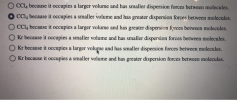 A certain temperature and volume would you expect the pressure
of a given number of moles of KR or CCL4 to deviate more from ideal
behavior? why?
O O O CCI, because it occupies a larger volume and has smaller dispersion forces between molecules. CCl4 because it occupies a smaller volume and has greater dispersion forces between molecules. CCl4 because it occupies a larger volume and has greater dispersion forces between molecules. Kr because it occupies a smaller volume and...
A certain temperature and volume would you expect the pressure
of a given number of moles of KR or CCL4 to deviate more from ideal
behavior? why?
O O O CCI, because it occupies a larger volume and has smaller dispersion forces between molecules. CCl4 because it occupies a smaller volume and has greater dispersion forces between molecules. CCl4 because it occupies a larger volume and has greater dispersion forces between molecules. Kr because it occupies a smaller volume and...
To a solution of sucrose, Benedict's reagent is added and the solution is heated. What reaction would you expect and why...
To a solution of sucrose, Benedict's reagent is added and the solution is heated. What reaction would you expect and why?
Would you expect hydrogen gas (H2) to have a smaller or larger first ionization energy than...
Would you expect hydrogen gas (H2) to have a smaller or larger first ionization energy than atomic hydrogen? Explain.
In setting up your 3 kinetics experiment, you will be mixing different volumes the two reactants...
In setting up your 3 kinetics experiment, you will be mixing different volumes the two reactants (oxalic acid (H2C2O4) and potassium permanganate (KMnO4)). If you mix 10 ml of 0.02 M with 20 ml of 0.5 M oxalic acid, what is the concentration of H2C2O4 in the mixture? Hint: Use M1V1 = M2 V2.
2. In the mixing process you analyzed, the inner calorimeter cup started how many degrees below...
 2. In the mixing process you analyzed, the inner calorimeter cup started how many degrees below room temperature and ended how many degrees above room temperature? Explain why using water from the water cooler, rather than tap water (or hot water or ice water or water from a bottle in your backpack) is a good choice for an accurate experiment. 3. Suppose that a student stirs the calorimeter very zealously, rather than gently, in step 5. Suppose the student exerts...
Titration of the carbonate buffer system lab 1. How would you expect buffer capacities to change...
Titration of the carbonate buffer system lab 1. How would you expect buffer capacities to change if larger masses of sodium carbonate and sodium bicarbonate were used in each titration? 2. How would you expect the buffer capacities to change if a more concentrated solution of HCl was used in the titration?
POST LAB QUESTIONS. 1. If you used more water in your calorimeter, would the observed temperature...
 POST LAB QUESTIONS. 1. If you used more water in your calorimeter, would the observed temperature change upon the addition of the hot solid object be larger or smaller than the temperature change you observed? Explain. 2. Your instructor handed you a 1-L sample of a liquid and asked you to determine its specific heat. How would you determine the specific heat of the liquid using the equipment in this lab? 3. What effect would not covering the calorimeter cup...
1. Would you expect the olfactory bulbs of a sheep to be larger, smaller, or about...
 1. Would you expect the olfactory bulbs of a sheep to be larger, smaller, or about the same relative size as those of a human? Briefly explain your answer. 2. Why does white matter appear different from gray matter? 3. Why are the hypothalamus and the pineal body considered part of the endocrine system as well as the nervous system?
(2pts) Post-lab Questions AH Choose. ΔΗ (1pts) 1. Do you expect the solubility of Borax to...
 (2pts) Post-lab Questions AH Choose. ΔΗ (1pts) 1. Do you expect the solubility of Borax to increase or decrease as temperature increases? Select the option that best explains why. A. Solubility will increase, because as Tincreases the term becomes smaller therefore will get larger. B. Solubility will increase, because as Tincreases the IT term becomes smaller therefore K will get smaller. C. Solubility will decrease, because as increases the term becomes smaller therefore Kwill get smaller. D. Solubility will decrease,...
 5. a) Determine the maximum axial load the member shown can support before you would expect it to yield. The structure is made of A36 steel. The thickness of the structure is 2.0 in., the larger width is 12.0 in., and the smaller width is 8.0in. The fillet radius is 0.5in. b) A 35 ksi axial stress is applied to the beam cyclically (repeatedly applied then removed). How many times can this be done before you would expect the part...
 A certain temperature and volume would you expect the pressure
of a given number of moles of KR or CCL4 to deviate more from ideal
behavior? why?
O O O CCI, because it occupies a larger volume and has smaller dispersion forces between molecules. CCl4 because it occupies a smaller volume and has greater dispersion forces between molecules. CCl4 because it occupies a larger volume and has greater dispersion forces between molecules. Kr because it occupies a smaller volume and...
A certain temperature and volume would you expect the pressure
of a given number of moles of KR or CCL4 to deviate more from ideal
behavior? why?
O O O CCI, because it occupies a larger volume and has smaller dispersion forces between molecules. CCl4 because it occupies a smaller volume and has greater dispersion forces between molecules. CCl4 because it occupies a larger volume and has greater dispersion forces between molecules. Kr because it occupies a smaller volume and...
 2. In the mixing process you analyzed, the inner calorimeter cup started how many degrees below room temperature and ended how many degrees above room temperature? Explain why using water from the water cooler, rather than tap water (or hot water or ice water or water from a bottle in your backpack) is a good choice for an accurate experiment. 3. Suppose that a student stirs the calorimeter very zealously, rather than gently, in step 5. Suppose the student exerts...
 POST LAB QUESTIONS. 1. If you used more water in your calorimeter, would the observed temperature change upon the addition of the hot solid object be larger or smaller than the temperature change you observed? Explain. 2. Your instructor handed you a 1-L sample of a liquid and asked you to determine its specific heat. How would you determine the specific heat of the liquid using the equipment in this lab? 3. What effect would not covering the calorimeter cup...
 1. Would you expect the olfactory bulbs of a sheep to be larger, smaller, or about the same relative size as those of a human? Briefly explain your answer. 2. Why does white matter appear different from gray matter? 3. Why are the hypothalamus and the pineal body considered part of the endocrine system as well as the nervous system?
 (2pts) Post-lab Questions AH Choose. ΔΗ (1pts) 1. Do you expect the solubility of Borax to increase or decrease as temperature increases? Select the option that best explains why. A. Solubility will increase, because as Tincreases the term becomes smaller therefore will get larger. B. Solubility will increase, because as Tincreases the IT term becomes smaller therefore K will get smaller. C. Solubility will decrease, because as increases the term becomes smaller therefore Kwill get smaller. D. Solubility will decrease,...
Most questions answered within 3 hours.
-
Where is the error in this code sequence?
String s1 = "Hello";
String s2 = "ello";...
asked 10 months ago -
Financial data for Joel de Paris, Inc., for last year
follow:
Joel de Paris, Inc.
Balance...
asked 10 months ago -
Consider this reaction:
Al2(SO4)3 (aq)+ BaCl3
(aq) Al2Cl6 (aq)- +
3BaSO4(s) . What is the...
asked 10 months ago -
Suppose that Savneet is considering increasing her
recent random sample from 20 car rentals to 40...
asked 10 months ago -
Trucks arrive at an unloading terminal at an average rate of 120
per hour.
Trucks arrive...
asked 10 months ago -
Why are methanol and ethanol completely soluble in water while
octanol is not very little soluble....
asked 10 months ago -
A facilities manager at a university reads in a research report
that the mean amount of...
asked 10 months ago -
When the CuSO4 is rehydrated by adding water to the anhydrous
compound, is this an endothermic...
asked 10 months ago -
A ray of sunlight is passing from diamond into crown glass; the
angle of incidence is...
asked 10 months ago -
A block of mass 0.249 kg is placed on top of a light, vertical
spring of...
asked 10 months ago -
how do the kidneys compensate in the presences of acidosis
a) trigger hyperventilate
b) reserve acid...
asked 10 months ago -
Question 501 pts
The rental rate of capital to the firm increases. Which of the
following...
asked 10 months ago