MULTIPLE CHOICE QUESTIONS I- To determine the work done on an object in a particular direction.......
MULTIPLE CHOICE QUESTIONS
I- To determine the work done on an object in a particular direction....
| A- |
we consider all forces on the object regardless of their direction. |
|
| B- |
we consider only frictional forces. |
|
| C- |
we consider only forces that are in the same direction as the position change. |
|
| D- |
- we don't consider forces at all. |
II- To determine the work done on an object in a particular direction....
| A- |
we consider all forces on the object regardless of their direction. |
|
| B- |
we consider only frictional forces. |
|
| C- |
we consider only forces that are in the same direction as the position change. |
|
| D- |
we don't consider forces at all. |
III- There are two types of collisions we discuss in physics: elastic and inelastic. A tennis ball hitting a racket is an example of...
| A- |
an elastic collision. |
|
| B- |
an inelastic collision. |
Homework Answers
Multiple questions posted, so answering only the first question:
1.
Work done is given by dot product of force and displacement vectors.
Now,Dot product of force and displacement vectors is equal to (magnitude of displacement)*(component of force along the displacement vector).
So, for calculating work, we consider only those components of forces that are in the same direction as position change.
So,option C is correct.
2. Same as part 1.
Add Answer to:
MULTIPLE CHOICE QUESTIONS
I- To determine the work done on an object in a particular
direction.......
8 When an object experienices unicem cinsular motion, the direction of the net fonce is b....
 8 When an object experienices unicem cinsular motion, the direction of the net fonce is b. in the opposite direction of the motion of the objoct d. is directed sway from the center of the ciculr path 9. Compared to its mass on the Farth, the mass of an object on the Moon is less b. more c the same d half as moch 10. Can work be done on a system if there is no motion? b. yes, since...
Work Done by Normal Force Consider an object sliding along the surface shown below. Choose and...
 Work Done by Normal Force Consider an object sliding along the surface shown below. Choose and show a direction of motion for the object and show the direction of the normal force. Use this figure to do the scalar product given below. oM bns av W, n-s Is the work done by the normal force exerted between two colliding objects also zero? Explain. Work Done by Weight Unlike the normal and kinetic friction forces, the direction of an object's motion...
Work Done by the Govtational Force bute the gravitational force G m./r into the integral equation...
 Work Done by the Govtational Force bute the gravitational force G m./r into the integral equation on the previous genith Y replacing and find the work done by this force df w is the work done by the gravitational for moves away from t he gravitational force positive, negative, or zero when an object in the Earth? When it moves toward the Earth? When it orbits the Earth in a circle? Part B: Conservative and Non-conservative Forces welop and understorence...
Calculate the work WAB done by the electrostatic force on a particle of charge q as...
 Calculate the work WAB done by the electrostatic force on a
particle of charge q as it moves from A to B. Express your answer
in terms of some or all the variables E, q, L, and ?.
Constants Learning Goal: To review the concept of conservative forces and to understand that electrostatic forces are, in fact, conservative. Calculate the work WAB done by the electrostatic force on a particle of charge q as it moves from A to B....
Calculate the work WAB done by the electrostatic force on a
particle of charge q as it moves from A to B. Express your answer
in terms of some or all the variables E, q, L, and ?.
Constants Learning Goal: To review the concept of conservative forces and to understand that electrostatic forces are, in fact, conservative. Calculate the work WAB done by the electrostatic force on a particle of charge q as it moves from A to B....
Coefficient of Restitution = 0 Objectives: Partially elastic collisions are defined by the coefficient of restitution...
 Coefficient of Restitution = 0 Objectives: Partially elastic collisions are defined by the coefficient of restitution between the two objects. In this experiment you will a. Propose a procedure to measure the coefficient of restitution b. Determine the coefficient of restitution for a racquet ball c. Determine whether the coefficient of restitution depends on velocity Introduction An elastic collision is one in which mechanical energy is conserved. A perfectly inelastic collision is one in which some of the mechanical energy...
Due Date: 11-21-19 Name: Jcninct pour Activity 7.3 Work Done by Common Forces, Conservative and Non-conservative...
 Due Date: 11-21-19 Name: Jcninct pour Activity 7.3 Work Done by Common Forces, Conservative and Non-conservative Forces, Potential and Internal Energy, and the Conservation of Energy 20 Points Text Reference: Ch.7.4-7.7.8.1-8.4.13.6 Part A: Work Done by Common Forces Discussion In this section, the goal is not to find numerical values for the work done by common forces, but to obtain simplified expressions for this work. Often, the magnitudes and directions or components of these common forces are known and unvarying...
Q 2. The work done on an object is equal to the force times the distance moved in the direction of the force. The ve...
 Q 2. The work done on an object is equal to the force times the distance moved in the direction of the force. The velocity of au objected in the direction of a force is given by 4cos(t1). 0SIS1 r(t) 20+(5-) 1<t52 1 where e(t) is in m/s. Determine the work done with Simpson's one-third rule if a constant required to use a mesh grid size of 0.2 (i.c. h=0.2). force of 200 N is applied for all t.You are...
ms H: 10 42 11 Two equal and opposite forces of 3 N have a netforce...
 ms H: 10 42 11 Two equal and opposite forces of 3 N have a netforce of A9N B6N c3N DON Which of the following is NOT a constant for an object in uniform circular motion! A distance with time speed e velocity D acceleration magnitude Work is A energy times distance, B force times distance. c force times time. D momentum times distance. You push against Plymouth Rock with a force of 100 newtons for 20.0 seconds. If the...
QUESTIONS 3 points Save Below is a vt graph for a 15 kg object. What's the...
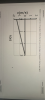 QUESTIONS 3 points Save Below is a vt graph for a 15 kg object. What's the net force on the object, in Newtons? (Get the sign right) 2 1 اسی لیا -2 t(s) 2 points QUESTION 6 2 points Save Anger Bumper car 1 of mass my 10 kg is initially moving to the right. Bumper car 2 of mass m2 - 2.0 kg is initially moving to the left. The two cars have an elastic collision only conservative forces...
1-4 using Work-Energy Theorem/KE and PE thank you! not 1. An object of mass 0.5kg is...
 1-4
using Work-Energy Theorem/KE and PE
thank you!
not 1. An object of mass 0.5kg is projected from ground at 40m/s. Find the work done by gravity on the object, when it is at (a) 10m above the ground -49 Joules (b) 15m above the ground.- 73.5 Joules (c) Find the potential energy of the object in (a) and (b) relative to the ground. PE-mgh 49 J/73.55 2. A block of is sliding down a slope as shown in the...
1-4
using Work-Energy Theorem/KE and PE
thank you!
not 1. An object of mass 0.5kg is projected from ground at 40m/s. Find the work done by gravity on the object, when it is at (a) 10m above the ground -49 Joules (b) 15m above the ground.- 73.5 Joules (c) Find the potential energy of the object in (a) and (b) relative to the ground. PE-mgh 49 J/73.55 2. A block of is sliding down a slope as shown in the...
 8 When an object experienices unicem cinsular motion, the direction of the net fonce is b. in the opposite direction of the motion of the objoct d. is directed sway from the center of the ciculr path 9. Compared to its mass on the Farth, the mass of an object on the Moon is less b. more c the same d half as moch 10. Can work be done on a system if there is no motion? b. yes, since...
 Work Done by Normal Force Consider an object sliding along the surface shown below. Choose and show a direction of motion for the object and show the direction of the normal force. Use this figure to do the scalar product given below. oM bns av W, n-s Is the work done by the normal force exerted between two colliding objects also zero? Explain. Work Done by Weight Unlike the normal and kinetic friction forces, the direction of an object's motion...
 Work Done by the Govtational Force bute the gravitational force G m./r into the integral equation on the previous genith Y replacing and find the work done by this force df w is the work done by the gravitational for moves away from t he gravitational force positive, negative, or zero when an object in the Earth? When it moves toward the Earth? When it orbits the Earth in a circle? Part B: Conservative and Non-conservative Forces welop and understorence...
 Calculate the work WAB done by the electrostatic force on a
particle of charge q as it moves from A to B. Express your answer
in terms of some or all the variables E, q, L, and ?.
Constants Learning Goal: To review the concept of conservative forces and to understand that electrostatic forces are, in fact, conservative. Calculate the work WAB done by the electrostatic force on a particle of charge q as it moves from A to B....
Calculate the work WAB done by the electrostatic force on a
particle of charge q as it moves from A to B. Express your answer
in terms of some or all the variables E, q, L, and ?.
Constants Learning Goal: To review the concept of conservative forces and to understand that electrostatic forces are, in fact, conservative. Calculate the work WAB done by the electrostatic force on a particle of charge q as it moves from A to B....
 Coefficient of Restitution = 0 Objectives: Partially elastic collisions are defined by the coefficient of restitution between the two objects. In this experiment you will a. Propose a procedure to measure the coefficient of restitution b. Determine the coefficient of restitution for a racquet ball c. Determine whether the coefficient of restitution depends on velocity Introduction An elastic collision is one in which mechanical energy is conserved. A perfectly inelastic collision is one in which some of the mechanical energy...
 Due Date: 11-21-19 Name: Jcninct pour Activity 7.3 Work Done by Common Forces, Conservative and Non-conservative Forces, Potential and Internal Energy, and the Conservation of Energy 20 Points Text Reference: Ch.7.4-7.7.8.1-8.4.13.6 Part A: Work Done by Common Forces Discussion In this section, the goal is not to find numerical values for the work done by common forces, but to obtain simplified expressions for this work. Often, the magnitudes and directions or components of these common forces are known and unvarying...
 Q 2. The work done on an object is equal to the force times the distance moved in the direction of the force. The velocity of au objected in the direction of a force is given by 4cos(t1). 0SIS1 r(t) 20+(5-) 1<t52 1 where e(t) is in m/s. Determine the work done with Simpson's one-third rule if a constant required to use a mesh grid size of 0.2 (i.c. h=0.2). force of 200 N is applied for all t.You are...
 ms H: 10 42 11 Two equal and opposite forces of 3 N have a netforce of A9N B6N c3N DON Which of the following is NOT a constant for an object in uniform circular motion! A distance with time speed e velocity D acceleration magnitude Work is A energy times distance, B force times distance. c force times time. D momentum times distance. You push against Plymouth Rock with a force of 100 newtons for 20.0 seconds. If the...
 QUESTIONS 3 points Save Below is a vt graph for a 15 kg object. What's the net force on the object, in Newtons? (Get the sign right) 2 1 اسی لیا -2 t(s) 2 points QUESTION 6 2 points Save Anger Bumper car 1 of mass my 10 kg is initially moving to the right. Bumper car 2 of mass m2 - 2.0 kg is initially moving to the left. The two cars have an elastic collision only conservative forces...
 1-4
using Work-Energy Theorem/KE and PE
thank you!
not 1. An object of mass 0.5kg is projected from ground at 40m/s. Find the work done by gravity on the object, when it is at (a) 10m above the ground -49 Joules (b) 15m above the ground.- 73.5 Joules (c) Find the potential energy of the object in (a) and (b) relative to the ground. PE-mgh 49 J/73.55 2. A block of is sliding down a slope as shown in the...
1-4
using Work-Energy Theorem/KE and PE
thank you!
not 1. An object of mass 0.5kg is projected from ground at 40m/s. Find the work done by gravity on the object, when it is at (a) 10m above the ground -49 Joules (b) 15m above the ground.- 73.5 Joules (c) Find the potential energy of the object in (a) and (b) relative to the ground. PE-mgh 49 J/73.55 2. A block of is sliding down a slope as shown in the...
Most questions answered within 3 hours.
-
Where is the error in this code sequence?
String s1 = "Hello";
String s2 = "ello";...
asked 10 months ago -
Financial data for Joel de Paris, Inc., for last year
follow:
Joel de Paris, Inc.
Balance...
asked 10 months ago -
Consider this reaction:
Al2(SO4)3 (aq)+ BaCl3
(aq) Al2Cl6 (aq)- +
3BaSO4(s) . What is the...
asked 10 months ago -
Suppose that Savneet is considering increasing her
recent random sample from 20 car rentals to 40...
asked 10 months ago -
Trucks arrive at an unloading terminal at an average rate of 120
per hour.
Trucks arrive...
asked 10 months ago -
Why are methanol and ethanol completely soluble in water while
octanol is not very little soluble....
asked 10 months ago -
A facilities manager at a university reads in a research report
that the mean amount of...
asked 10 months ago -
When the CuSO4 is rehydrated by adding water to the anhydrous
compound, is this an endothermic...
asked 10 months ago -
A ray of sunlight is passing from diamond into crown glass; the
angle of incidence is...
asked 10 months ago -
A block of mass 0.249 kg is placed on top of a light, vertical
spring of...
asked 10 months ago -
how do the kidneys compensate in the presences of acidosis
a) trigger hyperventilate
b) reserve acid...
asked 10 months ago -
Question 501 pts
The rental rate of capital to the firm increases. Which of the
following...
asked 10 months ago