Show that the cross correlation of f(t) with δ(t – t0) is equal to f(t –...
Show that the cross correlation of f(t) with δ(t – t0) is equal to f(t – t0). Where δ(t–t0) is delayed unit impulse function
Homework Answers
Let '*' represent cross-sorrelation


By shifting property, the above function is zero everywhere
except  .
Therefore, putting , we
get:
.
Therefore, putting , we
get:


Add Answer to:
Show that the cross correlation of f(t) with δ(t –
t0) is equal to f(t –...
Problem 1: Consider the followingtime-invariant channel impulse response c(t)-6(t-td) + (1/2) δ(t...
 Problem 1: Consider the followingtime-invariant channel impulse response c(t)-6(t-td) + (1/2) δ(t-(t0+T)) + (1/2) δ(t(td-T)), td and Tare constants. a Plot this impulse response and show the delay of each path. b- Find the power delay profile for this given channel c Find the rms delay spread by using the power delay profile you find in (b) d- Find the coherence bandwidth°fthis channel (assume 90% correlation). Note that it may be a function oftd and e Find the frequency response...
What is the Laplace transform? Show all steps 0O (e) g(1-Σ e-)κιδ(t-kT) where δ(r) unit-impulse function
 What is the Laplace transform? Show all steps
0O (e) g(1-Σ e-)κιδ(t-kT) where δ(r) unit-impulse function
What is the Laplace transform? Show all steps
0O (e) g(1-Σ e-)κιδ(t-kT) where δ(r) unit-impulse function
2) Let the cross-correlation function of two processes X(t) and Y(t) be where A, B, and ω are con...
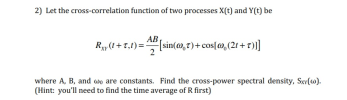 2) Let the cross-correlation function of two processes X(t) and Y(t) be where A, B, and ω are constants. Find the cross-power spectral density, SXY(ω). (Hint: you'll need to find the time average of R first)
2) Let the cross-correlation function of two processes X(t) and Y(t) be where A, B, and ω are constants. Find the cross-power spectral density, SXY(ω). (Hint: you'll need to find the time average of R first)
2) Let the cross-correlation function of two processes X(t) and Y(t) be where A, B, and ω are constants. Find the cross-power spectral density, SXY(ω). (Hint: you'll need to find the time average of R first)
(b) (5 pts) Unit Impulse. Suppose we have an impulse train signal h(t)-Σ δ(t-nT). Given an arbitrary signal r(t), find r(t)h(t) and (t) h(t) in terms of r(t) Show that r(t)h(t)-Σ r(nT)δ(t-nT) and r(...
 (b) (5 pts) Unit Impulse. Suppose we have an impulse train signal h(t)-Σ δ(t-nT). Given an arbitrary signal r(t), find r(t)h(t) and (t) h(t) in terms of r(t) Show that r(t)h(t)-Σ r(nT)δ(t-nT) and r(t) * h(t)-Σ r(t-nT) (b) (5 pts) Find the Fourier Transform of r(t) (t 2n). Hint: Find wo and the Fourier series coefjicients then use the Fourier Transform property for periodic signals.
(b) (5 pts) Unit Impulse. Suppose we have an impulse train signal h(t)-Σ δ(t-nT). Given...
(b) (5 pts) Unit Impulse. Suppose we have an impulse train signal h(t)-Σ δ(t-nT). Given an arbitrary signal r(t), find r(t)h(t) and (t) h(t) in terms of r(t) Show that r(t)h(t)-Σ r(nT)δ(t-nT) and r(t) * h(t)-Σ r(t-nT) (b) (5 pts) Find the Fourier Transform of r(t) (t 2n). Hint: Find wo and the Fourier series coefjicients then use the Fourier Transform property for periodic signals.
(b) (5 pts) Unit Impulse. Suppose we have an impulse train signal h(t)-Σ δ(t-nT). Given...
1. Auto- and Cross-Correlation. For each of the following, compute the cross correlation T/2 Rry(,) = E[drpd, + n-linx...
 1. Auto- and Cross-Correlation. For each of the following, compute the cross correlation T/2 Rry(,) = E[drpd, + n-linx t-Tax(ry(, + rdr . Hint: Use trigonometric identities (see HW 1), 27T such as sin a sin b-2 [cos(a-b)-cos(a + b)] . Also use the fact that j cos(ont-б unless co-0 x(t) = sin(2n/r), y(t)-sin(2nft) (here x and y are the same, so Rry-Rrr is the a. autocorrelation of x). x(t) = sin(2nft), y(t) = sin(2nf(t-to)) c. x(t)-n(), y()2x(t) +n2(t) where...
1. Auto- and Cross-Correlation. For each of the following, compute the cross correlation T/2 Rry(,) = E[drpd, + n-linx...
 1. Auto- and Cross-Correlation. For each of the following, compute the cross correlation T/2 Rry(,) = E[drpd, + n-linx t-Tax(ry(, + rdr . Hint: Use trigonometric identities (see HW 1), 27T such as sin a sin b-2 [cos(a-b)-cos(a + b)] . Also use the fact that j cos(ont-б unless co-0 x(t) = sin(2n/r), y(t)-sin(2nft) (here x and y are the same, so Rry-Rrr is the a. autocorrelation of x). x(t) = sin(2nft), y(t) = sin(2nf(t-to)) c. x(t)-n(), y()2x(t) +n2(t) where...
1 if t>0 Consider the unit step function u(t) if t0 0 if t< The Fourier transform of the unit ste...
 1 if t>0 Consider the unit step function u(t) if t0 0 if t< The Fourier transform of the unit step function is: U(ω)-Flu (t)]- πδ(w) + 1 , and the graph of the unit step function is shown below: u(t) 1/2 Relate intuitively each term of the Fourier transform U() given above to the corresponding parts f you find it helpful). Explain briefly below.
1 if t>0 Consider the unit step function u(t) if t0 0 if t
1 if t>0 Consider the unit step function u(t) if t0 0 if t< The Fourier transform of the unit step function is: U(ω)-Flu (t)]- πδ(w) + 1 , and the graph of the unit step function is shown below: u(t) 1/2 Relate intuitively each term of the Fourier transform U() given above to the corresponding parts f you find it helpful). Explain briefly below.
1 if t>0 Consider the unit step function u(t) if t0 0 if t
Problem 4: Evaluation of the convolution integral too y(t) = (f * h)(t) = f(t)h(t –...
 Problem 4: Evaluation of the convolution integral too y(t) = (f * h)(t) = f(t)h(t – 7)dt is greatly simplified when either the input f(t) or impulse response h(t) is the sum of weighted impulse functions. This fact will be used later in the semester when we study the operation of communication systems using Fourier analysis methods. a) Use the convolution integral to prove that f(t) *8(t – T) = f(t – T) and 8(t – T) *h(t) = h(t...
Consider the periodic function defined by 1<t0, 0<t<1, f(t)= f(t+2) f(), and its Fourier series F(t): Σ A,...
 Consider the periodic function defined by 1<t0, 0<t<1, f(t)= f(t+2) f(), and its Fourier series F(t): Σ A, cos(nmi) +ΣB, sin (nπί), F(t)= Ao+ n1 n=1 (a) Sketch the function f(t) the function is even, odd or neither even nor odd. over the range -3<t< 3 and hence state whether (b) Calculate the constant term Ao
Consider the periodic function defined by 1
Consider the periodic function defined by 1<t0, 0<t<1, f(t)= f(t+2) f(), and its Fourier series F(t): Σ A, cos(nmi) +ΣB, sin (nπί), F(t)= Ao+ n1 n=1 (a) Sketch the function f(t) the function is even, odd or neither even nor odd. over the range -3<t< 3 and hence state whether (b) Calculate the constant term Ao
Consider the periodic function defined by 1
3. An infinite bar has initial temperature distribution: T(x,0)-T0 [s(x-l) +δ(x + 1)] Find T(x,t) for...
 3. An infinite bar has initial temperature distribution: T(x,0)-T0 [s(x-l) +δ(x + 1)] Find T(x,t) for >0. The free space Green's function for the 1-D diffusion equation is G(x -x)- e 4DI 4TDt
 Problem 1: Consider the followingtime-invariant channel impulse response c(t)-6(t-td) + (1/2) δ(t-(t0+T)) + (1/2) δ(t(td-T)), td and Tare constants. a Plot this impulse response and show the delay of each path. b- Find the power delay profile for this given channel c Find the rms delay spread by using the power delay profile you find in (b) d- Find the coherence bandwidth°fthis channel (assume 90% correlation). Note that it may be a function oftd and e Find the frequency response...
 What is the Laplace transform? Show all steps
0O (e) g(1-Σ e-)κιδ(t-kT) where δ(r) unit-impulse function
What is the Laplace transform? Show all steps
0O (e) g(1-Σ e-)κιδ(t-kT) where δ(r) unit-impulse function
 2) Let the cross-correlation function of two processes X(t) and Y(t) be where A, B, and ω are constants. Find the cross-power spectral density, SXY(ω). (Hint: you'll need to find the time average of R first)
2) Let the cross-correlation function of two processes X(t) and Y(t) be where A, B, and ω are constants. Find the cross-power spectral density, SXY(ω). (Hint: you'll need to find the time average of R first)
2) Let the cross-correlation function of two processes X(t) and Y(t) be where A, B, and ω are constants. Find the cross-power spectral density, SXY(ω). (Hint: you'll need to find the time average of R first)
 (b) (5 pts) Unit Impulse. Suppose we have an impulse train signal h(t)-Σ δ(t-nT). Given an arbitrary signal r(t), find r(t)h(t) and (t) h(t) in terms of r(t) Show that r(t)h(t)-Σ r(nT)δ(t-nT) and r(t) * h(t)-Σ r(t-nT) (b) (5 pts) Find the Fourier Transform of r(t) (t 2n). Hint: Find wo and the Fourier series coefjicients then use the Fourier Transform property for periodic signals.
(b) (5 pts) Unit Impulse. Suppose we have an impulse train signal h(t)-Σ δ(t-nT). Given...
(b) (5 pts) Unit Impulse. Suppose we have an impulse train signal h(t)-Σ δ(t-nT). Given an arbitrary signal r(t), find r(t)h(t) and (t) h(t) in terms of r(t) Show that r(t)h(t)-Σ r(nT)δ(t-nT) and r(t) * h(t)-Σ r(t-nT) (b) (5 pts) Find the Fourier Transform of r(t) (t 2n). Hint: Find wo and the Fourier series coefjicients then use the Fourier Transform property for periodic signals.
(b) (5 pts) Unit Impulse. Suppose we have an impulse train signal h(t)-Σ δ(t-nT). Given...
 1. Auto- and Cross-Correlation. For each of the following, compute the cross correlation T/2 Rry(,) = E[drpd, + n-linx t-Tax(ry(, + rdr . Hint: Use trigonometric identities (see HW 1), 27T such as sin a sin b-2 [cos(a-b)-cos(a + b)] . Also use the fact that j cos(ont-б unless co-0 x(t) = sin(2n/r), y(t)-sin(2nft) (here x and y are the same, so Rry-Rrr is the a. autocorrelation of x). x(t) = sin(2nft), y(t) = sin(2nf(t-to)) c. x(t)-n(), y()2x(t) +n2(t) where...
 1. Auto- and Cross-Correlation. For each of the following, compute the cross correlation T/2 Rry(,) = E[drpd, + n-linx t-Tax(ry(, + rdr . Hint: Use trigonometric identities (see HW 1), 27T such as sin a sin b-2 [cos(a-b)-cos(a + b)] . Also use the fact that j cos(ont-б unless co-0 x(t) = sin(2n/r), y(t)-sin(2nft) (here x and y are the same, so Rry-Rrr is the a. autocorrelation of x). x(t) = sin(2nft), y(t) = sin(2nf(t-to)) c. x(t)-n(), y()2x(t) +n2(t) where...
 1 if t>0 Consider the unit step function u(t) if t0 0 if t< The Fourier transform of the unit step function is: U(ω)-Flu (t)]- πδ(w) + 1 , and the graph of the unit step function is shown below: u(t) 1/2 Relate intuitively each term of the Fourier transform U() given above to the corresponding parts f you find it helpful). Explain briefly below.
1 if t>0 Consider the unit step function u(t) if t0 0 if t
1 if t>0 Consider the unit step function u(t) if t0 0 if t< The Fourier transform of the unit step function is: U(ω)-Flu (t)]- πδ(w) + 1 , and the graph of the unit step function is shown below: u(t) 1/2 Relate intuitively each term of the Fourier transform U() given above to the corresponding parts f you find it helpful). Explain briefly below.
1 if t>0 Consider the unit step function u(t) if t0 0 if t
 Problem 4: Evaluation of the convolution integral too y(t) = (f * h)(t) = f(t)h(t – 7)dt is greatly simplified when either the input f(t) or impulse response h(t) is the sum of weighted impulse functions. This fact will be used later in the semester when we study the operation of communication systems using Fourier analysis methods. a) Use the convolution integral to prove that f(t) *8(t – T) = f(t – T) and 8(t – T) *h(t) = h(t...
 Consider the periodic function defined by 1<t0, 0<t<1, f(t)= f(t+2) f(), and its Fourier series F(t): Σ A, cos(nmi) +ΣB, sin (nπί), F(t)= Ao+ n1 n=1 (a) Sketch the function f(t) the function is even, odd or neither even nor odd. over the range -3<t< 3 and hence state whether (b) Calculate the constant term Ao
Consider the periodic function defined by 1
Consider the periodic function defined by 1<t0, 0<t<1, f(t)= f(t+2) f(), and its Fourier series F(t): Σ A, cos(nmi) +ΣB, sin (nπί), F(t)= Ao+ n1 n=1 (a) Sketch the function f(t) the function is even, odd or neither even nor odd. over the range -3<t< 3 and hence state whether (b) Calculate the constant term Ao
Consider the periodic function defined by 1
 3. An infinite bar has initial temperature distribution: T(x,0)-T0 [s(x-l) +δ(x + 1)] Find T(x,t) for >0. The free space Green's function for the 1-D diffusion equation is G(x -x)- e 4DI 4TDt
Most questions answered within 3 hours.
-
Where is the error in this code sequence?
String s1 = "Hello";
String s2 = "ello";...
asked 11 months ago -
Financial data for Joel de Paris, Inc., for last year
follow:
Joel de Paris, Inc.
Balance...
asked 11 months ago -
Consider this reaction:
Al2(SO4)3 (aq)+ BaCl3
(aq) Al2Cl6 (aq)- +
3BaSO4(s) . What is the...
asked 11 months ago -
Suppose that Savneet is considering increasing her
recent random sample from 20 car rentals to 40...
asked 11 months ago -
Trucks arrive at an unloading terminal at an average rate of 120
per hour.
Trucks arrive...
asked 11 months ago -
Why are methanol and ethanol completely soluble in water while
octanol is not very little soluble....
asked 11 months ago -
A facilities manager at a university reads in a research report
that the mean amount of...
asked 11 months ago -
When the CuSO4 is rehydrated by adding water to the anhydrous
compound, is this an endothermic...
asked 11 months ago -
A ray of sunlight is passing from diamond into crown glass; the
angle of incidence is...
asked 11 months ago -
A block of mass 0.249 kg is placed on top of a light, vertical
spring of...
asked 11 months ago -
how do the kidneys compensate in the presences of acidosis
a) trigger hyperventilate
b) reserve acid...
asked 11 months ago -
Question 501 pts
The rental rate of capital to the firm increases. Which of the
following...
asked 11 months ago