We just need one more solution with a glucose concentration of 1.052 M, twice as concentrated...
We just need one more solution with a glucose concentration of 1.052 M, twice as concentrated as what we just made. Use the 0.526 M glucose solution, the solid glucose and/or water to create a 500.0 mL of IV solution for the final patient.
Homework Answers

Add Answer to:
We just need one more solution with a glucose concentration of
1.052 M, twice as concentrated...
We just need one more solution with a glucose concentration of 1.052 M, twice as concentrated as what we just made. Use...
We just need one more solution with a glucose concentration of 1.052 M, twice as concentrated as what we just made. Use the 0.526 M glucose solution, the solid glucose and/or water to create a 500.0 mL of IV solution for the final patient
What would the concentration of the resulting glucose solution be if 333 ml of a 30...
 What would the concentration of the resulting glucose solution be if 333 ml of a 30 % (m/v) glucose solution were diluted to a final volume of 1 L with distilled water? Express your answer using one significant figure. IV AED ?
A medication B is available as a concentrated paste (of unknown concentration – see later). 0.1406...
A medication B is available as a concentrated paste (of unknown concentration – see later). 0.1406 g of the paste was made up to 100 mL with water. This “original” solution was diluted serially twice further, each time a hundred-fold (i.e. 1 mL to 100 mL). The final dilute solution was analyzed and found to contain 36.68 ng of B per mL. What was the concentration of the paste in terms of %B by weight of paste?
The concentration of a solution after dilution can be found by: where M1 is the concentrated...
 The concentration of a solution after dilution can be found
by:
where M1 is the concentrated solution (in
this lab, 0.400 M), and V1 is the volume of the
concentrated solution placed in the test tube. The
V2 is the total volume of
concentrated solution plus water added, and M2
is the concentration of the solution after diluting.
Tube 1 has 2.00 mL of the 0.400 M Ni2+ solution and
8.00 mL of water added. What is the concentration of...
The concentration of a solution after dilution can be found
by:
where M1 is the concentrated solution (in
this lab, 0.400 M), and V1 is the volume of the
concentrated solution placed in the test tube. The
V2 is the total volume of
concentrated solution plus water added, and M2
is the concentration of the solution after diluting.
Tube 1 has 2.00 mL of the 0.400 M Ni2+ solution and
8.00 mL of water added. What is the concentration of...
The total concentration of dissolved particles in blood is 0.30 M. An intravenous (IV) solution must...
The total concentration of dissolved particles in blood is 0.30 M. An intravenous (IV) solution must be isotonic with blood, which means it must have the same concentration. (a) To relieve dehydration, a patient is given 190. mL/h of IV glucose (C6H12O6) for 2.0 h. What mass (g) of glucose did she receive? (b) If isotonic saline (NaCl) is used, what is the molarity of the solution? (c) If the patient is given 160. mL/h of IV saline for 3.0...
Solve the following 1) A solution is made by adding 24.8 mL of concentrated nitric acid...
Solve the following 1) A solution is made by adding 24.8 mL of concentrated nitric acid (70.4 wt%, density 1.42 g/mL) to some water in a volumetric flask, and then adding water to the mark to make exactly 200 mL of solution. Calculate the concentration of this solution in molarity. 2) A 72.0 mL aliquot of a 1.50 M solution is diluted to a total volume of 288 mL. A 144 mL portion of that solution is diluted by adding...
The total concentration of dissolved particles in blood is 0.30 M. An intravenous (IV) solution must...
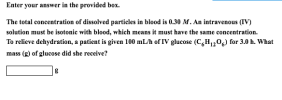 The total concentration of dissolved particles in blood is 0.30 M. An intravenous (IV) solution must be isotonic with blood, which means it must have the same concentration. To relieve dehydration, a patient is given 100 mL/h of IV glucose (C_6H_12O_6) for 3.0 h. What mass (g) of glucose did she receive? g
Chemistry 2A Lab 13: Solution Calculations Introduction This lab involves sample calculations using various concentration units....
 Chemistry 2A Lab 13: Solution Calculations Introduction This lab involves sample calculations using various concentration units. This lab will work with the following types of concentration units: % mass, % volume, % mass/volume, and molarity. A solution is the sum total of the solute and solvent. % mass= mass solute mass solution -100 volumesolute .100 % volume- volume solution % mass/volume mass solute volumesolution -100 Molarity moles solute liters solution The dilution of a liquid requires the addition of more...
A solution of a theoretical triprotic acid was prepared by dissolving 5.981 g of solid in...
A solution of a theoretical triprotic acid was prepared by dissolving 5.981 g of solid in enough DI water to make 500.0 mL of solution. 13.87 mL of a 0.446 M solution was required to titrate 20.00 mL of this acid's solution. What is the concentration of the acid solution? What is the molar mass of the acid? Hint: You need to calculate the total moles in the 500.0 mL solution (the full 500.0 mL was NOT titrated).
Chemistry 2A Lab 13: Solution Calculations Introduction This lab involves sample calculations using various concentration units....
 Chemistry 2A Lab 13: Solution Calculations Introduction This lab involves sample calculations using various concentration units. This lab will work with the following types of concentration units: % mass, % volume, % mass/volume, and molarity. A solution is the sum total of the solute and solvent. mass solute 100 mass solution % mass- volumesolute -100 volume solution % volume mass solute 100 volumesolution % mass/ volume moles solute Molarity liters solution The dilution of a liquid requires the addition of...
 What would the concentration of the resulting glucose solution be if 333 ml of a 30 % (m/v) glucose solution were diluted to a final volume of 1 L with distilled water? Express your answer using one significant figure. IV AED ?
 The concentration of a solution after dilution can be found
by:
where M1 is the concentrated solution (in
this lab, 0.400 M), and V1 is the volume of the
concentrated solution placed in the test tube. The
V2 is the total volume of
concentrated solution plus water added, and M2
is the concentration of the solution after diluting.
Tube 1 has 2.00 mL of the 0.400 M Ni2+ solution and
8.00 mL of water added. What is the concentration of...
The concentration of a solution after dilution can be found
by:
where M1 is the concentrated solution (in
this lab, 0.400 M), and V1 is the volume of the
concentrated solution placed in the test tube. The
V2 is the total volume of
concentrated solution plus water added, and M2
is the concentration of the solution after diluting.
Tube 1 has 2.00 mL of the 0.400 M Ni2+ solution and
8.00 mL of water added. What is the concentration of...
 The total concentration of dissolved particles in blood is 0.30 M. An intravenous (IV) solution must be isotonic with blood, which means it must have the same concentration. To relieve dehydration, a patient is given 100 mL/h of IV glucose (C_6H_12O_6) for 3.0 h. What mass (g) of glucose did she receive? g
 Chemistry 2A Lab 13: Solution Calculations Introduction This lab involves sample calculations using various concentration units. This lab will work with the following types of concentration units: % mass, % volume, % mass/volume, and molarity. A solution is the sum total of the solute and solvent. % mass= mass solute mass solution -100 volumesolute .100 % volume- volume solution % mass/volume mass solute volumesolution -100 Molarity moles solute liters solution The dilution of a liquid requires the addition of more...
 Chemistry 2A Lab 13: Solution Calculations Introduction This lab involves sample calculations using various concentration units. This lab will work with the following types of concentration units: % mass, % volume, % mass/volume, and molarity. A solution is the sum total of the solute and solvent. mass solute 100 mass solution % mass- volumesolute -100 volume solution % volume mass solute 100 volumesolution % mass/ volume moles solute Molarity liters solution The dilution of a liquid requires the addition of...
Most questions answered within 3 hours.
-
Where is the error in this code sequence?
String s1 = "Hello";
String s2 = "ello";...
asked 10 months ago -
Financial data for Joel de Paris, Inc., for last year
follow:
Joel de Paris, Inc.
Balance...
asked 10 months ago -
Consider this reaction:
Al2(SO4)3 (aq)+ BaCl3
(aq) Al2Cl6 (aq)- +
3BaSO4(s) . What is the...
asked 10 months ago -
Suppose that Savneet is considering increasing her
recent random sample from 20 car rentals to 40...
asked 10 months ago -
Trucks arrive at an unloading terminal at an average rate of 120
per hour.
Trucks arrive...
asked 10 months ago -
Why are methanol and ethanol completely soluble in water while
octanol is not very little soluble....
asked 10 months ago -
A facilities manager at a university reads in a research report
that the mean amount of...
asked 10 months ago -
When the CuSO4 is rehydrated by adding water to the anhydrous
compound, is this an endothermic...
asked 10 months ago -
A ray of sunlight is passing from diamond into crown glass; the
angle of incidence is...
asked 10 months ago -
A block of mass 0.249 kg is placed on top of a light, vertical
spring of...
asked 10 months ago -
how do the kidneys compensate in the presences of acidosis
a) trigger hyperventilate
b) reserve acid...
asked 10 months ago -
Question 501 pts
The rental rate of capital to the firm increases. Which of the
following...
asked 10 months ago