A 28.91-mC charge is placed 32.15 cm to the left of a 68.23-mC charge, as shown...
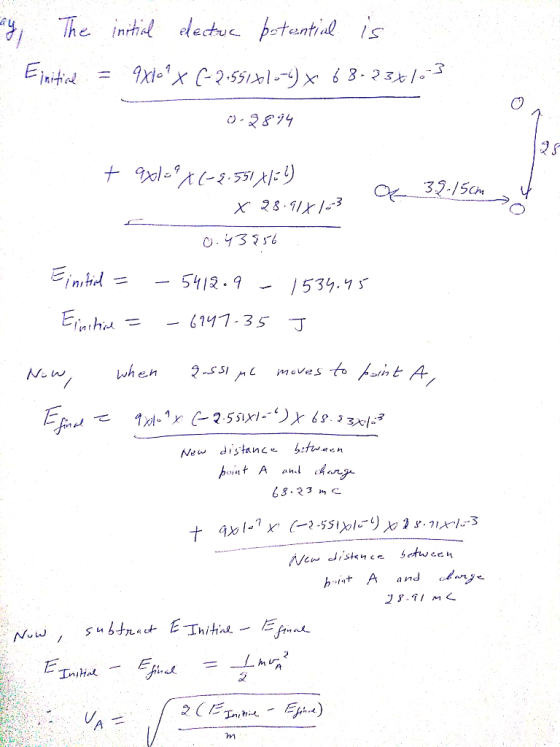
A 28.91-mC charge is placed 32.15 cm to the left of a 68.23-mC charge, as shown in the figure, and both charges are held stationary. A particle with a charge of -2.551 μC and a mass of 39.81 g (depicted as a blue sphere) is placed at rest at a distance 28.94 cm above the right-most charge. If the particle were to be released from rest, it would follow some complicated path around the two stationary charges. Calculating the exact path of the particle would be a challenging problem, but even without performing such a calculation it is possible to make some definite predictions about the future motion of the particle. If the path of the particle were to pass through the gray point labeled A, what would be its speed vA at that point?
Homework Answers
Hello, you forgot to upload the figure. Without figure, I didn't know the distance between charges when the charge has moved to point .
However I have solved it and you just need to put values of distance which is pretty easy and straightforward. Let me know if you have any difficulty or get stuck anywhere.....I have written which distance to put where.
Add Answer to:
A 28.91-mC charge is placed 32.15 cm to the left of a 68.23-mC
charge, as shown...
A 18.91-mC charge is placed 37.15 cm to the left of a 72.73-mC charge, as shown...
 A 18.91-mC charge is placed 37.15 cm to the left of a 72.73-mC charge, as shown in the figure, and both charges are held stationary. A particle with a charge of -8.051 pC and a mass of 21.31 g (depicted as a blue sphere) is placed at rest at a distance 33.44 cm above the right-most charge. If the particle were to be released from rest, it would follow some complicated path around the two stationary charges. Calculating the exact...
13 and 14 please (answer with significant figures as well) 10. A +2.3 mC charge is...
 13 and 14 please (answer with significant figures as well)
10. A +2.3 mC charge is placed 35 cm away from a stationary -3.4 mC charge. What is the electrical potential? 11. In a 15 Volt potential, a particle has a potential energy of -0.45 J. What is the particle's charge? 12. A 1.5 mC charge is moving towards a stationary +6.8 mC charge. What is the change in potential energy as the particle moves from 75 cm away from...
13 and 14 please (answer with significant figures as well)
10. A +2.3 mC charge is placed 35 cm away from a stationary -3.4 mC charge. What is the electrical potential? 11. In a 15 Volt potential, a particle has a potential energy of -0.45 J. What is the particle's charge? 12. A 1.5 mC charge is moving towards a stationary +6.8 mC charge. What is the change in potential energy as the particle moves from 75 cm away from...
A +25 μC point charge is placed 48 cm from an identical +25 μC charge. How...
A +25 μC point charge is placed 48 cm from an identical +25 μC charge. How much work would be required for an external force to move a +0.70 μC test charge from a point midway between them to a point 13 cm closer to either of the charges
A +45 μC point charge is placed 32 cm from an identical +45 μC charge. How...
A +45 μC point charge is placed 32 cm from an identical +45 μC charge. How much work would be required for an external force to move a +0.70 μC test charge from a point midway between them to a point 11 cm closer to either of the charges?
A +45 μC point charge is placed 48 cm from an identical +45 μC charge. How...
A +45 μC point charge is placed 48 cm from an identical +45 μC charge. How much work would be required for an external force to move a +0.60 μC test charge from a point midway between them to a point 10 cm closer to either of the charges?
A +40 μC point charge is placed 32 cm from an identical +40 μC charge. How...
A +40 μC point charge is placed 32 cm from an identical +40 μC charge. How much work would be required for an external force to move a +0.70 μC test charge from a point midway between them to a point 13 cm closer to either of the charges?
A +40 μC point charge is placed 38 cm from an identical +40 μC charge. How...
A +40 μC point charge is placed 38 cm from an identical +40 μC charge. How much work would be required for an external force to move a +0.70 μC test charge from a point midway between them to a point 13 cm closer to either of the charges?
A +40 μC point charge is placed 54 cm from an identical +40 μC charge. How...
A +40 μC point charge is placed 54 cm from an identical +40 μC charge. How much work would be required for an external force to move a +0.40 μC test charge from a point midway between them to a point 11 cm closer to either of the charges?
A +40 μC point charge is placed 60 cm from an identical +40 μC charge. How...
A +40 μC point charge is placed 60 cm from an identical +40 μC charge. How much work would be required for an external force to move a +0.50 μC test charge from a point midway between them to a point 12 cm closer to either of the charges?
A +50 μC point charge is placed 48 cm from an identical +50 μC charge. Part...
A +50 μC point charge is placed 48 cm from an identical +50 μC charge. Part A How much work would be required for an external force to move a +0.70 μC test charge from a point midway between them to a point 13 cm closer to either of the charges? Express your answer using two significant figure
 A 18.91-mC charge is placed 37.15 cm to the left of a 72.73-mC charge, as shown in the figure, and both charges are held stationary. A particle with a charge of -8.051 pC and a mass of 21.31 g (depicted as a blue sphere) is placed at rest at a distance 33.44 cm above the right-most charge. If the particle were to be released from rest, it would follow some complicated path around the two stationary charges. Calculating the exact...
 13 and 14 please (answer with significant figures as well)
10. A +2.3 mC charge is placed 35 cm away from a stationary -3.4 mC charge. What is the electrical potential? 11. In a 15 Volt potential, a particle has a potential energy of -0.45 J. What is the particle's charge? 12. A 1.5 mC charge is moving towards a stationary +6.8 mC charge. What is the change in potential energy as the particle moves from 75 cm away from...
13 and 14 please (answer with significant figures as well)
10. A +2.3 mC charge is placed 35 cm away from a stationary -3.4 mC charge. What is the electrical potential? 11. In a 15 Volt potential, a particle has a potential energy of -0.45 J. What is the particle's charge? 12. A 1.5 mC charge is moving towards a stationary +6.8 mC charge. What is the change in potential energy as the particle moves from 75 cm away from...
Most questions answered within 3 hours.
-
Where is the error in this code sequence?
String s1 = "Hello";
String s2 = "ello";...
asked 11 months ago -
Financial data for Joel de Paris, Inc., for last year
follow:
Joel de Paris, Inc.
Balance...
asked 11 months ago -
Consider this reaction:
Al2(SO4)3 (aq)+ BaCl3
(aq) Al2Cl6 (aq)- +
3BaSO4(s) . What is the...
asked 11 months ago -
Suppose that Savneet is considering increasing her
recent random sample from 20 car rentals to 40...
asked 11 months ago -
Trucks arrive at an unloading terminal at an average rate of 120
per hour.
Trucks arrive...
asked 11 months ago -
Why are methanol and ethanol completely soluble in water while
octanol is not very little soluble....
asked 11 months ago -
A facilities manager at a university reads in a research report
that the mean amount of...
asked 11 months ago -
When the CuSO4 is rehydrated by adding water to the anhydrous
compound, is this an endothermic...
asked 11 months ago -
A ray of sunlight is passing from diamond into crown glass; the
angle of incidence is...
asked 11 months ago -
A block of mass 0.249 kg is placed on top of a light, vertical
spring of...
asked 11 months ago -
how do the kidneys compensate in the presences of acidosis
a) trigger hyperventilate
b) reserve acid...
asked 11 months ago -
Question 501 pts
The rental rate of capital to the firm increases. Which of the
following...
asked 11 months ago