Draw the mechanism (with arrows) of the reaction of acetic acid with phenylmagnesium bromide after being...
Draw the mechanism (with arrows) of the reaction of acetic acid with phenylmagnesium bromide after being treated with LiOH.
Homework Answers

Add Answer to:
Draw the mechanism (with arrows) of the reaction of acetic acid
with phenylmagnesium bromide after being...
Draw the mechanism of the reaction between a Phenylmagnesium bromide and formaldehyde
Draw the mechanism of the reaction between a Phenylmagnesium bromide and formaldehyde
Draw the mechanism of phenylmagnesium bromide, a gringard reagent, reacting with an alpha, beta u...
Draw the mechanism of phenylmagnesium bromide, a gringard reagent, reacting with an alpha, beta unsaturated ketone, R-(-)-Carvone. Show both the 1,2 and 1,4 products and label their stereogenic centers.
a) Draw the mechanism (including electron-movement arrows) of the acid-catalyzed esterification + H2O Sulfuric Acetic acid...
 a) Draw the mechanism (including electron-movement arrows) of the acid-catalyzed esterification + H2O Sulfuric Acetic acid Isoamyl alcohol acid isoamyl acetatewater (concn.) (glacial)
help please 2. Draw the products from the reaction of phenylmagnesium bromide both with water and...
 help please
2. Draw the products from the reaction of phenylmagnesium bromide both with water and with acetone.
help please
2. Draw the products from the reaction of phenylmagnesium bromide both with water and with acetone.
7. The reaction of acetic acid with ammonia is very rapid (it is an acid-reaction, after...
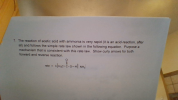 7. The reaction of acetic acid with ammonia is very rapid (it is an acid-reaction, after all) and follows the simple rate law shown in the following equation. Purpose a mechanism that is consistent with this rate law. Show curly arrows for both forward and reverse reaction. rate = k/H,C-C-0-H) NHS
Draw the product obtained if the dry Et2O used in the formation of the phenylmagnesium bromide...
 Draw the product obtained if the dry Et2O used in the formation
of the phenylmagnesium bromide would have been contaminated with
acetone.
Draw the product obtained if the dry Et2O used in the formation of the phenylmagnesium bromide would have been contaminated with acetone.
Draw the product obtained if the dry Et2O used in the formation
of the phenylmagnesium bromide would have been contaminated with
acetone.
Draw the product obtained if the dry Et2O used in the formation of the phenylmagnesium bromide would have been contaminated with acetone.
What reagent might be added to phenylmagnesium bromide to produce methyl phenyl ketone? (Hint: ethyl acetate...
What reagent might be added to phenylmagnesium bromide to produce methyl phenyl ketone? (Hint: ethyl acetate is not a good choice.) Draw the mechanism for this reaction
1-Butanol reaction with sodium bromide and sulfuric acid. Draw the reaction mechanism. Explain why the reaction would pr...
1-Butanol reaction with sodium bromide and sulfuric acid. Draw the reaction mechanism. Explain why the reaction would prefer a polar protic solvent.
3. Why did the acetic acid odor disappear after the addition of NaOH? Draw a reaction...
 3. Why did the acetic acid odor disappear after the addition of NaOH? Draw a reaction as part of your answer. 4. Why did the acetic acid odor reappear after the addition of HCI? Draw a reaction as part of your answer. 5. Write the reaction for the interaction between acetic acid and sodium bicarbonate. 6. Compute the average percent acetic acid in your vinegar sample. Average % acetic acid Value on label of bottle
1. Write a detailed mechanism for the reactions of phenylmagnesium bromide with methyl benzoate which produced...
1. Write a detailed mechanism for the reactions of phenylmagnesium bromide with methyl benzoate which produced the conjugate base of triphenylmethanol. 2. Assume that we ran this reaction with 1.0 g Mg, 4.5 mL bromobenzene, and 2.3 mL methylbenzoate. If you got 2.15 g of product calculate your percent yield for this reaction. (just do number 2 please)
 a) Draw the mechanism (including electron-movement arrows) of the acid-catalyzed esterification + H2O Sulfuric Acetic acid Isoamyl alcohol acid isoamyl acetatewater (concn.) (glacial)
 help please
2. Draw the products from the reaction of phenylmagnesium bromide both with water and with acetone.
help please
2. Draw the products from the reaction of phenylmagnesium bromide both with water and with acetone.
 7. The reaction of acetic acid with ammonia is very rapid (it is an acid-reaction, after all) and follows the simple rate law shown in the following equation. Purpose a mechanism that is consistent with this rate law. Show curly arrows for both forward and reverse reaction. rate = k/H,C-C-0-H) NHS
 Draw the product obtained if the dry Et2O used in the formation
of the phenylmagnesium bromide would have been contaminated with
acetone.
Draw the product obtained if the dry Et2O used in the formation of the phenylmagnesium bromide would have been contaminated with acetone.
Draw the product obtained if the dry Et2O used in the formation
of the phenylmagnesium bromide would have been contaminated with
acetone.
Draw the product obtained if the dry Et2O used in the formation of the phenylmagnesium bromide would have been contaminated with acetone.
 3. Why did the acetic acid odor disappear after the addition of NaOH? Draw a reaction as part of your answer. 4. Why did the acetic acid odor reappear after the addition of HCI? Draw a reaction as part of your answer. 5. Write the reaction for the interaction between acetic acid and sodium bicarbonate. 6. Compute the average percent acetic acid in your vinegar sample. Average % acetic acid Value on label of bottle
Most questions answered within 3 hours.
-
Where is the error in this code sequence?
String s1 = "Hello";
String s2 = "ello";...
asked 11 months ago -
Financial data for Joel de Paris, Inc., for last year
follow:
Joel de Paris, Inc.
Balance...
asked 11 months ago -
Consider this reaction:
Al2(SO4)3 (aq)+ BaCl3
(aq) Al2Cl6 (aq)- +
3BaSO4(s) . What is the...
asked 11 months ago -
Suppose that Savneet is considering increasing her
recent random sample from 20 car rentals to 40...
asked 11 months ago -
Trucks arrive at an unloading terminal at an average rate of 120
per hour.
Trucks arrive...
asked 11 months ago -
Why are methanol and ethanol completely soluble in water while
octanol is not very little soluble....
asked 11 months ago -
A facilities manager at a university reads in a research report
that the mean amount of...
asked 11 months ago -
When the CuSO4 is rehydrated by adding water to the anhydrous
compound, is this an endothermic...
asked 11 months ago -
A ray of sunlight is passing from diamond into crown glass; the
angle of incidence is...
asked 11 months ago -
A block of mass 0.249 kg is placed on top of a light, vertical
spring of...
asked 11 months ago -
how do the kidneys compensate in the presences of acidosis
a) trigger hyperventilate
b) reserve acid...
asked 11 months ago -
Question 501 pts
The rental rate of capital to the firm increases. Which of the
following...
asked 11 months ago