The time between two ordering opportunities for an order-up-to product is called a ________ and it...
The time between two ordering opportunities for an order-up-to product is called a ________ and it has a ________ duration.
| lead time, fixed |
| period, variable |
| period, fixed |
| lead time, variable |
Homework Answers
period, fixed
The time between two ordering opportunities for an order-up-to product is called a period time. This period time has a fixed duration of occurence. This is a fixed time interval.
Add Answer to:
The time between two ordering opportunities for an order-up-to
product is called a ________ and it...
5. The purchase-order lead-time is a. The difference between the times an order is placed and...
 5. The purchase-order lead-time is a. The difference between the times an order is placed and delivered. b. The difference between the products ordered and the products received. C. The discrepancies in purchase orders. d. The time required to correct errors in the products received. 6. If the purchase price per unit is constant, the carrying cost per unit is constant, and the ordering cost per order is constant, then the annual relevant total costs of having to have an...
Presentation subject FIT Lesson 9 - Fixed Time Period Order Model • A company has 200...
 Presentation subject FIT Lesson 9 - Fixed Time Period Order Model • A company has 200 units of a product on-hand that it orders every two weeks when the salesperson visits the premises. Demand for the product averages 20 units per day with a standard deviation of 3 units. Lead time for the product to arrive is seven days. Management has a goal of a 90% percent probability of not stocking out for this product. (Round your answer up to...
A company wishes to determine the optimal order quantity for its products. The product is sold...
 A company wishes to determine the optimal order quantity for its products. The product is sold at a rate of 800 per week. Each order costs $500. On average, the cost of each product is $8 and the holding cost is based on an annual percentage rate of 10% per product. The lead time for order arrival is 1.5 weeks. Respond to parts (a) Suppose that annual percentage rate may vary up to 14% per product. How much will the...
Consider the following information about an end-product item: Ordering cost =$45/order Average usage =12 units/week Inventory...
Consider the following information about an end-product item: Ordering cost =$45/order Average usage =12 units/week Inventory carrying cost =$1/unit/week (a) How many orders should we place per year (52 weeks) to replenish inventory of the item based on average weekly demand? (b) Given the following time-phased net requirements from an MRP record for this item, determine the sequence of planned orders using economic order quantity (EOQ) and periodic order quantity (POQ) procedures. Assume lead time equals zero and current on-hand...
Question 12 The time needed to respond to a customer order is called: Order response metric...
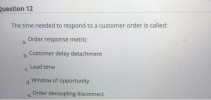 Question 12 The time needed to respond to a customer order is called: Order response metric b. Customer delay detachment c. Lead time d. Window of opportunity e. Order decoupling disconnect
Suppose that a distributor would like to design an optimal ordering quantity at an optimal time. Their demand is at a constant rate of 1000 units per week. In addition, any time they place an order, t...
Suppose that a distributor would like to design an optimal ordering quantity at an optimal time. Their demand is at a constant rate of 1000 units per week. In addition, any time they place an order, their supplier charges them a fixed fee of $500 and $20 per unit. It also costs them $5 per unit per week to store the product in inventory. Use this information to answer the questions 1-3. 1. What is the approximate amount of products...
A lower inventory order quantity _____________ annual ordering costs but _____________ carrying costs, assuming both are...
A lower inventory order quantity _____________ annual ordering costs but _____________ carrying costs, assuming both are measured over a specific period of time. increases, decreases has no effect on, increases has no effect on, decreases decreases, increases
Using gross requirements schedule below, prepare an alternative ordering system that always orders 100 units the...
 Using gross requirements schedule below, prepare an alternative ordering system that always orders 100 units the week prior to a shortage (a fixed order quantity of 100) as a Lot Sizing technique. What is the cost of this ordering system? Period Gross requirements 25 20 50 0 10 40 30 0 30 65 1 2 3 45 6 7 8 9 10 Holding cost $1/unitweek; setup cost $200; lead time 1 week beginning inventory 25 units. Prepare a net requirements...
Given the following information, constant demand, and a fixed quantity ordering policy, the expected time interval...
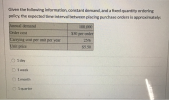 Given the following information, constant demand, and a fixed quantity ordering policy, the expected time interval between placing purchase orders is approximately: Annual demand Order cost Carrying cost per unit per year Unit price 100,000 $30 per order 25% $5.50 1 day 1 week 1 month 1 quarter
. Which of the following is the set of all cost components that make up the...
. Which of the following is the set of all cost components that make up the fixed-order quantity total annual cost (TC) function? A. Annual lead time cost, annual holding cost, annual purchase cost B. Annual holding cost, annual ordering cost, annual purchase cost C. Annual holding cost, annual ordering cost, unit cost D. Annual unit cost, annual set up cost, annual purchase cost E. None of the above
 5. The purchase-order lead-time is a. The difference between the times an order is placed and delivered. b. The difference between the products ordered and the products received. C. The discrepancies in purchase orders. d. The time required to correct errors in the products received. 6. If the purchase price per unit is constant, the carrying cost per unit is constant, and the ordering cost per order is constant, then the annual relevant total costs of having to have an...
 Presentation subject FIT Lesson 9 - Fixed Time Period Order Model • A company has 200 units of a product on-hand that it orders every two weeks when the salesperson visits the premises. Demand for the product averages 20 units per day with a standard deviation of 3 units. Lead time for the product to arrive is seven days. Management has a goal of a 90% percent probability of not stocking out for this product. (Round your answer up to...
 A company wishes to determine the optimal order quantity for its products. The product is sold at a rate of 800 per week. Each order costs $500. On average, the cost of each product is $8 and the holding cost is based on an annual percentage rate of 10% per product. The lead time for order arrival is 1.5 weeks. Respond to parts (a) Suppose that annual percentage rate may vary up to 14% per product. How much will the...
 Question 12 The time needed to respond to a customer order is called: Order response metric b. Customer delay detachment c. Lead time d. Window of opportunity e. Order decoupling disconnect
 Using gross requirements schedule below, prepare an alternative ordering system that always orders 100 units the week prior to a shortage (a fixed order quantity of 100) as a Lot Sizing technique. What is the cost of this ordering system? Period Gross requirements 25 20 50 0 10 40 30 0 30 65 1 2 3 45 6 7 8 9 10 Holding cost $1/unitweek; setup cost $200; lead time 1 week beginning inventory 25 units. Prepare a net requirements...
 Given the following information, constant demand, and a fixed quantity ordering policy, the expected time interval between placing purchase orders is approximately: Annual demand Order cost Carrying cost per unit per year Unit price 100,000 $30 per order 25% $5.50 1 day 1 week 1 month 1 quarter
Most questions answered within 3 hours.
-
Where is the error in this code sequence?
String s1 = "Hello";
String s2 = "ello";...
asked 11 months ago -
Financial data for Joel de Paris, Inc., for last year
follow:
Joel de Paris, Inc.
Balance...
asked 11 months ago -
Consider this reaction:
Al2(SO4)3 (aq)+ BaCl3
(aq) Al2Cl6 (aq)- +
3BaSO4(s) . What is the...
asked 11 months ago -
Suppose that Savneet is considering increasing her
recent random sample from 20 car rentals to 40...
asked 11 months ago -
Trucks arrive at an unloading terminal at an average rate of 120
per hour.
Trucks arrive...
asked 11 months ago -
Why are methanol and ethanol completely soluble in water while
octanol is not very little soluble....
asked 11 months ago -
A facilities manager at a university reads in a research report
that the mean amount of...
asked 11 months ago -
When the CuSO4 is rehydrated by adding water to the anhydrous
compound, is this an endothermic...
asked 11 months ago -
A ray of sunlight is passing from diamond into crown glass; the
angle of incidence is...
asked 11 months ago -
A block of mass 0.249 kg is placed on top of a light, vertical
spring of...
asked 11 months ago -
how do the kidneys compensate in the presences of acidosis
a) trigger hyperventilate
b) reserve acid...
asked 11 months ago -
Question 501 pts
The rental rate of capital to the firm increases. Which of the
following...
asked 11 months ago