Please find the following in Matlab 1.The sequence x [ n ] = 1/(2^n) , 0...
Please find the following in Matlab
1.The sequence x [ n ] = 1/(2^n) , 0 ≤ n ≤ 5. Calculate the z-transform of it.
Homework Answers
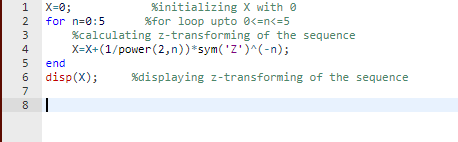
SOURCE CODE:
X=0; %initializing X with 0
for n=0:5 %for loop upto 0<=n<=5
%calculating z-transforming of the sequence
X=X+(1/power(2,n))*sym('Z')^(-n);
end
disp(X); %displaying z-transforming of the sequence
CODE SCREENSHOT:
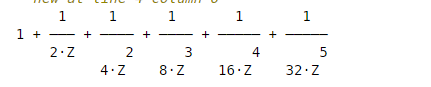
OUTPUT:
Add Answer to:
Please find the following in Matlab
1.The sequence x [ n ] = 1/(2^n) , 0...
Let the sequence: x[n]= { (a^n)*sin(nw), a>0 known constant, n ∈ N0 else x[n]=0 Find with...
Let the sequence: x[n]= { (a^n)*sin(nw), a>0 known constant, n ∈ N0 else x[n]=0 Find with a direct calculation (without using the transformation matrix Z) the transform Z of x [n], its convergence pass, the roots (zeroes) and its poles.
1. Consider the following sequence (The bold large size element is at n = 0) x(n)...
 1. Consider the following sequence (The bold large size element is at n = 0) x(n) = { ----- 0,0,01, 1, 1, 1, 1, 0, 0, 0------}. It has the period of N=8. a. Find (in closed form) and sketch the complex exponential Fourier series coefficients (Magnitude and Phase). Verify using Matlab. Include code and graphics. b. Find the energy in this sequence first using the sequence in the time domain, and then using the DTFS coefficients. Verify using Matlab....
x[n] = { Consider the discrete sequence S (0.5)" 0<n<N-1 otherwise a) Determine the z-transform X(2)!...
 x[n] = { Consider the discrete sequence S (0.5)" 0<n<N-1 otherwise a) Determine the z-transform X(2)! b) Determine and plot the poles and zeros of X(2) when N = 8!
Q1. Let x(n) be a complex values sequence with real part xr(n) and the imaginary part...
 Q1. Let x(n) be a complex values sequence with real part xr(n) and the imaginary part xi(n). Prove the following z-transform two relations: XR(2) 4 Z [ZR(n)] = _X(z) + X* (z*) 2 and X (2) - X* (*) X1() = Z XI(n) = - 2 Must you use only MATLAB in your proof, and for x(n), use two random sequences for real and the imaginary parts.
Consider the system:y[n]-0.5y[n-1]-0.25y[n-2]=x[n]+2x[n-1]+x[n-2] • Plot, using MATLAB, the impulse and step responses of the system. Highlight...
Consider the system:y[n]-0.5y[n-1]-0.25y[n-2]=x[n]+2x[n-1]+x[n-2] • Plot, using MATLAB, the impulse and step responses of the system. Highlight the response characteristics in your plots • Assume initial conditions y(-1) = 1, y(-2) = 0 and that the input signal to the system is a discrete-time unit step. Determine the formula for the Z-transform of the solution, Y(z). Subsequently, determine the formula for the solution, y[n], itself.
PLEASE ANSWER ASAP a- Evaluate fft , X(k), of the sequence x(n) defined as x(0)=0.8,...
PLEASE ANSWER ASAP a- Evaluate fft , X(k), of the sequence x(n) defined as x(0)=0.8, x(1)=0.4, x(2) = -0.4 and x(3) = -0.2. b- Verify your calculation using Matlab.
3. (20%) The Z-Transform of x[n] is X(2), 72(152 – 3) WA(Z-0.25) (7z – 1) Find...
 3. (20%) The Z-Transform of x[n] is X(2), 72(152 – 3) WA(Z-0.25) (7z – 1) Find a. the signal x[n]. b. If y[n] = x[n], n=1..-5, y[n] = 0 elsewhere. Find the Z-transform Y(2).
please answer them indetail. thanks 4. Let x(n) be a causal sequence. a) b) what conclusion...
 please answer them indetail. thanks
4. Let x(n) be a causal sequence. a) b) what conclusion can you draw about the value of its z-transform x(z) at z 00, Use the result in part (a) to check which of the following transforms cannot be associated with a causal sequence (z-1* (z (1-^2-1)- i, x(z) = 321) iii, x(z) = A causal pole-zero system is BIBO stable if its poles are inside the unit circle. Consider now a pole- zero system...
please answer them indetail. thanks
4. Let x(n) be a causal sequence. a) b) what conclusion can you draw about the value of its z-transform x(z) at z 00, Use the result in part (a) to check which of the following transforms cannot be associated with a causal sequence (z-1* (z (1-^2-1)- i, x(z) = 321) iii, x(z) = A causal pole-zero system is BIBO stable if its poles are inside the unit circle. Consider now a pole- zero system...
ASSIGNMENT 2 (C4,_CO2, PO1) 1. Calculate DFT of the following discrete-time sequence, x(n) using DFT technique...
 ASSIGNMENT 2 (C4,_CO2, PO1) 1. Calculate DFT of the following discrete-time sequence, x(n) using DFT technique x(n) = {72,-56, 159) (C4, CO2,PO1) 2. Calculate the 8-point DFT of the following discrete-time sequence, x(n) using Decimation In Time Fast Fourier transform (DIT-FFT) algorithm. Show the sketch and label all parameters on a signal flow graph/butterfly diagram structure in your answer. (1-3<ns3 x(n) = 0 elsewhere
************PLEASE INCLUDE MATLAB CODES*********** Find y(n) by Performing graphical convolution of the following sequences and confirm...
************PLEASE INCLUDE MATLAB CODES*********** Find y(n) by Performing graphical convolution of the following sequences and confirm your results via Matlab (Include Matlab code and graphics). Bold sample represent the sample value at n = 0 a. x(n) = {1, 2, 1, 1}, h(n) = {1, -1, 0, 0, 1, 1} b. x(n) = {1, 1, 0, 1, 1}, h(n) = {1, 2, 3, 2, 1}
 1. Consider the following sequence (The bold large size element is at n = 0) x(n) = { ----- 0,0,01, 1, 1, 1, 1, 0, 0, 0------}. It has the period of N=8. a. Find (in closed form) and sketch the complex exponential Fourier series coefficients (Magnitude and Phase). Verify using Matlab. Include code and graphics. b. Find the energy in this sequence first using the sequence in the time domain, and then using the DTFS coefficients. Verify using Matlab....
 x[n] = { Consider the discrete sequence S (0.5)" 0<n<N-1 otherwise a) Determine the z-transform X(2)! b) Determine and plot the poles and zeros of X(2) when N = 8!
 Q1. Let x(n) be a complex values sequence with real part xr(n) and the imaginary part xi(n). Prove the following z-transform two relations: XR(2) 4 Z [ZR(n)] = _X(z) + X* (z*) 2 and X (2) - X* (*) X1() = Z XI(n) = - 2 Must you use only MATLAB in your proof, and for x(n), use two random sequences for real and the imaginary parts.
 3. (20%) The Z-Transform of x[n] is X(2), 72(152 – 3) WA(Z-0.25) (7z – 1) Find a. the signal x[n]. b. If y[n] = x[n], n=1..-5, y[n] = 0 elsewhere. Find the Z-transform Y(2).
 please answer them indetail. thanks
4. Let x(n) be a causal sequence. a) b) what conclusion can you draw about the value of its z-transform x(z) at z 00, Use the result in part (a) to check which of the following transforms cannot be associated with a causal sequence (z-1* (z (1-^2-1)- i, x(z) = 321) iii, x(z) = A causal pole-zero system is BIBO stable if its poles are inside the unit circle. Consider now a pole- zero system...
please answer them indetail. thanks
4. Let x(n) be a causal sequence. a) b) what conclusion can you draw about the value of its z-transform x(z) at z 00, Use the result in part (a) to check which of the following transforms cannot be associated with a causal sequence (z-1* (z (1-^2-1)- i, x(z) = 321) iii, x(z) = A causal pole-zero system is BIBO stable if its poles are inside the unit circle. Consider now a pole- zero system...
 ASSIGNMENT 2 (C4,_CO2, PO1) 1. Calculate DFT of the following discrete-time sequence, x(n) using DFT technique x(n) = {72,-56, 159) (C4, CO2,PO1) 2. Calculate the 8-point DFT of the following discrete-time sequence, x(n) using Decimation In Time Fast Fourier transform (DIT-FFT) algorithm. Show the sketch and label all parameters on a signal flow graph/butterfly diagram structure in your answer. (1-3<ns3 x(n) = 0 elsewhere
Most questions answered within 3 hours.
-
Where is the error in this code sequence?
String s1 = "Hello";
String s2 = "ello";...
asked 10 months ago -
Financial data for Joel de Paris, Inc., for last year
follow:
Joel de Paris, Inc.
Balance...
asked 10 months ago -
Consider this reaction:
Al2(SO4)3 (aq)+ BaCl3
(aq) Al2Cl6 (aq)- +
3BaSO4(s) . What is the...
asked 10 months ago -
Suppose that Savneet is considering increasing her
recent random sample from 20 car rentals to 40...
asked 10 months ago -
Trucks arrive at an unloading terminal at an average rate of 120
per hour.
Trucks arrive...
asked 10 months ago -
Why are methanol and ethanol completely soluble in water while
octanol is not very little soluble....
asked 10 months ago -
A facilities manager at a university reads in a research report
that the mean amount of...
asked 10 months ago -
When the CuSO4 is rehydrated by adding water to the anhydrous
compound, is this an endothermic...
asked 10 months ago -
A ray of sunlight is passing from diamond into crown glass; the
angle of incidence is...
asked 10 months ago -
A block of mass 0.249 kg is placed on top of a light, vertical
spring of...
asked 10 months ago -
how do the kidneys compensate in the presences of acidosis
a) trigger hyperventilate
b) reserve acid...
asked 10 months ago -
Question 501 pts
The rental rate of capital to the firm increases. Which of the
following...
asked 10 months ago