Which of the three available on-board clock frequencies of the Basys board do we use in...
Which of the three available on-board clock frequencies of the Basys board do we use in this class? Select one: a. 50 MHz b. 25 MHz c. 100 MHz d. 400 kHz
Homework Answers
Here, in Basys board, it has only one oscillator and it is 100 MHz.
So The answer is C.100 MHz
In Basys Board, it has a single oscillator of 100MHz and which is connected to pin W5. W5 is a MRCC input on bank 34. The input can drive MMCM or PLL and hence generate various frequencies specified by the user.
Hope I answered your doubt and All the best.
Add Answer to:
Which of the three available on-board clock frequencies of the
Basys board do we use in...
(3 points) The clock on the Basys-3 board is 100 MHz, so it has a 10...
 (3 points) The clock on the Basys-3 board is 100 MHz, so it has a 10 ns period (the time from the rising edge of one clock cycle to the next is 10 ns). For a 3-bit counter there are 8 clock cycles from the rising edge of one roll signal to the next. Therefore, the period of the roll signal is 80 ns and the frequency is 12.5 MHz. Complete the following table for various sizes of counters. Be...
Consider two different implementations, M1 and M2, of the same instruction set. There are three classes...
 Consider two different implementations, M1 and M2, of the same
instruction set. There are three classes of instructions (A, B, and
C) in the instruction set. M1 has a clock rate of 80 MHz and M2 has
a clock rate of 100 MHz. The average number of cycles for each
instruction class and their frequencies (for a typical program) are
as follows:
(a) Calculate the average CPI for each machine, M1, and M2.
(b) Calculate the average MIPS ratings for...
Consider two different implementations, M1 and M2, of the same
instruction set. There are three classes of instructions (A, B, and
C) in the instruction set. M1 has a clock rate of 80 MHz and M2 has
a clock rate of 100 MHz. The average number of cycles for each
instruction class and their frequencies (for a typical program) are
as follows:
(a) Calculate the average CPI for each machine, M1, and M2.
(b) Calculate the average MIPS ratings for...
The shortwave AM radio bands are above the normal AM commercial station frequencies and are separated...
The shortwave AM radio bands are above the normal AM commercial station frequencies and are separated into bands associated with the approximate wavelength of that band. The radio receiver designs are similar to commercial AM radio in that they use an IF of 455 kHz in a Superheterodyne receiver. For a station broadcasting in the 49 m band (5.8 to 6.2 MHz), select the required minimum to maximum LO frequency range. Question 4 options: A) 5.745 to 6.255 MHz B)...
Two sound waves have frequencies of 1.00 kHz and 1.05kHz. How many beats do you hear...
Two sound waves have frequencies of 1.00 kHz and 1.05kHz. How many beats do you hear in 5 seconds. A) 1000 B) 50 C) 250 D) 10 E) None of the above
A processor is designed such that the clock of the processor runs at 1 GHz. The following table gives the instruction frequencies for the benchmark and how many cycles each instruction takes. Inst...
A processor is designed such that the clock of the processor runs at 1 GHz. The following table gives the instruction frequencies for the benchmark and how many cycles each instruction takes. Instruction Type Frequency Cycles Load & Stores 25% 10 cycles Arithmetic Instructions 65% 6 cycles Branch instructions 10% 4 cycles (a) Calculate the CPI for the above benchmark. (b) Suppose the amount of registers are doubled, such that clock cycle time increases by 40%. What is the new...
(1 pt) In each question below, we have given the relative frequencies for the null hypothesis...
 (1 pt) In each question below, we have given the relative frequencies for the null hypothesis of a chi-square goodness-of-fit test and the sample size. In each case, decide whether the two assumptions for using that test are satisfied Assumption 1: All expected frequencies are 1 or greater Assumption 2: At most 20 percent of the expected frequencies are less than 5 Sample size: n 100, Relative frequencies: 0.65, 0.30, 0.05 A. Only assumption 1 is satisfied B. Both assumptions...
(Q21-25) We have the following three sets of mouse breeding experiments. The table summarizes the number...
(Q21-25) We have the following three sets of mouse breeding experiments. The table summarizes the number of each category of the F2 progeny. These breeding results were obtained in a similar fashion as shown in the lecture, starting from two pure-bred homozygous lines as the Parental stage, which were followed by the heterozygous F1. The subsequent F1 was testcrossed with the breeding partners with homozygous recessive alleles. Wild-type alleles are indicated with +, and the mutant alleles without + are...
I need help with the following Computer Architecture question: Consider two different implementations, M1 and M2,...
I need help with the following Computer Architecture question: Consider two different implementations, M1 and M2, of the same instruction set. There are three classes of instructions (A, B, and C) in the instruction set. M1 has a clock rate of 90 MHz and M2 has a clock rate of 80 MHz. The average number of cycles for each instruction class and their frequencies (for a typical program) are as follows: Instruction Class Machine M1 – Cycles/Instruction Class Machine M2...
please answer question 4 (all parts of question4 please) will rate! 3. (30 pts) Design a 2-bit Gray code generator that ropetitively delivers the sequence 00301911-10-00when the input signal UP-...
 please answer question 4 (all parts of question4 please) will
rate!
3. (30 pts) Design a 2-bit Gray code generator that ropetitively delivers the sequence 00301911-10-00when the input signal UP- 1,or in reverse order 009 10기け01 →00→ when UP-0. Your design should include an asynchronous low. active reset operation: the FSM goes to 00 state when a reset signal is applied In addition to the state output z[1). 2[0]. there is a carry/borrow output bit e which is I when...
please answer question 4 (all parts of question4 please) will
rate!
3. (30 pts) Design a 2-bit Gray code generator that ropetitively delivers the sequence 00301911-10-00when the input signal UP- 1,or in reverse order 009 10기け01 →00→ when UP-0. Your design should include an asynchronous low. active reset operation: the FSM goes to 00 state when a reset signal is applied In addition to the state output z[1). 2[0]. there is a carry/borrow output bit e which is I when...
1k luF 10nF VIN(t) C r(t) oUr Figure 1. Bandpass circuit Only for this assignment, you will do a ...
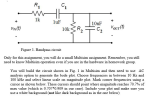 1k luF 10nF VIN(t) C r(t) oUr Figure 1. Bandpass circuit Only for this assignment, you will do a small Multisim assignment. Remember, you still need to know Multisim operation even if you are in the hardware in homework group You will build the circuit shown in Fig. 1 in Multisim and then need to use AC analysis option to generate the bode plot. Choose frequencies in between 10 Hz and 100 kHz and select linear scale on magnitude plot....
 (3 points) The clock on the Basys-3 board is 100 MHz, so it has a 10 ns period (the time from the rising edge of one clock cycle to the next is 10 ns). For a 3-bit counter there are 8 clock cycles from the rising edge of one roll signal to the next. Therefore, the period of the roll signal is 80 ns and the frequency is 12.5 MHz. Complete the following table for various sizes of counters. Be...
 Consider two different implementations, M1 and M2, of the same
instruction set. There are three classes of instructions (A, B, and
C) in the instruction set. M1 has a clock rate of 80 MHz and M2 has
a clock rate of 100 MHz. The average number of cycles for each
instruction class and their frequencies (for a typical program) are
as follows:
(a) Calculate the average CPI for each machine, M1, and M2.
(b) Calculate the average MIPS ratings for...
Consider two different implementations, M1 and M2, of the same
instruction set. There are three classes of instructions (A, B, and
C) in the instruction set. M1 has a clock rate of 80 MHz and M2 has
a clock rate of 100 MHz. The average number of cycles for each
instruction class and their frequencies (for a typical program) are
as follows:
(a) Calculate the average CPI for each machine, M1, and M2.
(b) Calculate the average MIPS ratings for...
 (1 pt) In each question below, we have given the relative frequencies for the null hypothesis of a chi-square goodness-of-fit test and the sample size. In each case, decide whether the two assumptions for using that test are satisfied Assumption 1: All expected frequencies are 1 or greater Assumption 2: At most 20 percent of the expected frequencies are less than 5 Sample size: n 100, Relative frequencies: 0.65, 0.30, 0.05 A. Only assumption 1 is satisfied B. Both assumptions...
 please answer question 4 (all parts of question4 please) will
rate!
3. (30 pts) Design a 2-bit Gray code generator that ropetitively delivers the sequence 00301911-10-00when the input signal UP- 1,or in reverse order 009 10기け01 →00→ when UP-0. Your design should include an asynchronous low. active reset operation: the FSM goes to 00 state when a reset signal is applied In addition to the state output z[1). 2[0]. there is a carry/borrow output bit e which is I when...
please answer question 4 (all parts of question4 please) will
rate!
3. (30 pts) Design a 2-bit Gray code generator that ropetitively delivers the sequence 00301911-10-00when the input signal UP- 1,or in reverse order 009 10기け01 →00→ when UP-0. Your design should include an asynchronous low. active reset operation: the FSM goes to 00 state when a reset signal is applied In addition to the state output z[1). 2[0]. there is a carry/borrow output bit e which is I when...
 1k luF 10nF VIN(t) C r(t) oUr Figure 1. Bandpass circuit Only for this assignment, you will do a small Multisim assignment. Remember, you still need to know Multisim operation even if you are in the hardware in homework group You will build the circuit shown in Fig. 1 in Multisim and then need to use AC analysis option to generate the bode plot. Choose frequencies in between 10 Hz and 100 kHz and select linear scale on magnitude plot....
Most questions answered within 3 hours.
-
Where is the error in this code sequence?
String s1 = "Hello";
String s2 = "ello";...
asked 10 months ago -
Financial data for Joel de Paris, Inc., for last year
follow:
Joel de Paris, Inc.
Balance...
asked 10 months ago -
Consider this reaction:
Al2(SO4)3 (aq)+ BaCl3
(aq) Al2Cl6 (aq)- +
3BaSO4(s) . What is the...
asked 10 months ago -
Suppose that Savneet is considering increasing her
recent random sample from 20 car rentals to 40...
asked 10 months ago -
Trucks arrive at an unloading terminal at an average rate of 120
per hour.
Trucks arrive...
asked 10 months ago -
Why are methanol and ethanol completely soluble in water while
octanol is not very little soluble....
asked 10 months ago -
A facilities manager at a university reads in a research report
that the mean amount of...
asked 10 months ago -
When the CuSO4 is rehydrated by adding water to the anhydrous
compound, is this an endothermic...
asked 10 months ago -
A ray of sunlight is passing from diamond into crown glass; the
angle of incidence is...
asked 10 months ago -
A block of mass 0.249 kg is placed on top of a light, vertical
spring of...
asked 10 months ago -
how do the kidneys compensate in the presences of acidosis
a) trigger hyperventilate
b) reserve acid...
asked 10 months ago -
Question 501 pts
The rental rate of capital to the firm increases. Which of the
following...
asked 10 months ago