Problem 5: Let X be a uniform random variable over (0, 1). Compute Cov(X2 , X5...
Problem 5: Let X be a uniform random variable over (0, 1). Compute Cov(X2 , X5 )
Homework Answers

Add Answer to:
Problem 5: Let X be a uniform random variable over (0, 1).
Compute Cov(X2 , X5...
Problem 4 Let X be the following discrete random variable: Let Y = X2. Show that...
 Problem 4 Let X be the following discrete random variable: Let Y = X2. Show that cov(X·Y) = 0, but X and Y are not independent random variable.
Problem 4 Let X be the following discrete random variable: P(X-1) = P(X = 0) =...
 Problem 4 Let X be the following discrete random variable: P(X-1) = P(X = 0) = P(x-1) Let Y-X2. Show that cov(X, Y) 0, but X and Y are not independent random variable.
Problem 1. Let X be a normal random variable with mean 0 and variance 1 and...
 Problem 1. Let X be a normal random variable with mean 0 and variance 1 and let Y be uniform(0.1) with X and Y being independent. Let U-X + Y and V = X-Y. For this problem recall the density for a normal random variable is 2πσ2 (a) Find the joint distribution of U and V (b) Find the marginal distributions of U and V (c) Find Cov(U, V).
1) Let X and Y be random variables. Show that Cov( X + Y, X-Y) Var(X)--Var(Y)...
 1) Let X and Y be random variables. Show that Cov( X + Y, X-Y) Var(X)--Var(Y) without appealing to the general formulas for the covariance of the linear combinations of sets of random variables; use the basic identity Cov(Z1,22)-E[Z1Z2]- E[Z1 E[Z2, valid for any two random variables, and the properties of the expected value 2) Let X be the normal random variable with zero mean and standard deviation Let ?(t) be the distribution function of the standard normal random variable....
Q6 (4pt) Let X be a discrete uniform random variable over {1,2,...,6} and let Y be...
 Q6 (4pt) Let X be a discrete uniform random variable over {1,2,...,6} and let Y be a Bernoulli random variable with parameter 1/2 such that X, Y are independent. (1) Find the PMF of the random variable Z, where Z XY. (2) Compute the third moment of Z, that is, E[z2
5. Let X1,X2, . , Xn be a random sample from a distribution with finite variance. Show that (i) COV(Xi-X, X )-0 f ) ρ (Xi-XX,-X)--n-1, 1 # J, 1,,-1, , n. OV&.for any two random variables X and Y)...
 5. Let X1,X2, . , Xn be a random sample from a distribution with finite variance. Show that (i) COV(Xi-X, X )-0 f ) ρ (Xi-XX,-X)--n-1, 1 # J, 1,,-1, , n. OV&.for any two random variables X and Y) or each 1, and (11 CoV(X,Y) var(x)var(y) (Recall that p vararo
5. Let X1,X2, . , Xn be a random sample from a distribution with finite variance. Show that (i) COV(Xi-X, X )-0 f ) ρ (Xi-XX,-X)--n-1, 1 # J,...
5. Let X1,X2, . , Xn be a random sample from a distribution with finite variance. Show that (i) COV(Xi-X, X )-0 f ) ρ (Xi-XX,-X)--n-1, 1 # J, 1,,-1, , n. OV&.for any two random variables X and Y) or each 1, and (11 CoV(X,Y) var(x)var(y) (Recall that p vararo
5. Let X1,X2, . , Xn be a random sample from a distribution with finite variance. Show that (i) COV(Xi-X, X )-0 f ) ρ (Xi-XX,-X)--n-1, 1 # J,...
4. Let Xi, X2,... be uncorrelated random variables, such that Xn has a uniform distribution over...
 4. Let Xi, X2,... be uncorrelated random variables, such that Xn has a uniform distribution over -1/n, 1/n]. Does the sequence converge in probability? 5. Let Xi,X2 be independent random variables, such that P(X) PX--) Does the sequence X1 +X2+...+X satisfy the WLLN? Converge in probability to 0?
Let X be a uniform(0, 1) random variable and let Y be uniform(1,2) with X and...
Let X be a uniform(0, 1) random variable and let Y be uniform(1,2) with X and Y being independent. Let U = X/Y and V = X. (a) Find the joint distribution of U and V . (b) Find the marginal distributions of U.
Problem 3. Let Y be uniform on 0,, 10 and Z be uniform on 0, 10...
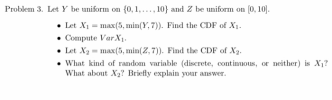 Problem 3. Let Y be uniform on 0,, 10 and Z be uniform on 0, 10 . Let Xi = max(5, min(Y, 7)). Find the CDF of Xi. . Compute VarX . Let X2 = max(5, min(Z, 7)). Find the CDF of X2. What kind of random variable discrete, continuous, or neither) is X1? What about X2? Briefly explain your answer.
Let the random variable X and Y have joint pdf f(x,y)=4/7(x2 +3y2), 0<x<1, 0<y<1 a. find...
Let the random variable X and Y have joint pdf f(x,y)=4/7(x2 +3y2), 0<x<1, 0<y<1 a. find E(X) and E(Y) b. find Var(X) and Var(Y) c. find Cov (X,Y)
 Problem 4 Let X be the following discrete random variable: Let Y = X2. Show that cov(X·Y) = 0, but X and Y are not independent random variable.
 Problem 4 Let X be the following discrete random variable: P(X-1) = P(X = 0) = P(x-1) Let Y-X2. Show that cov(X, Y) 0, but X and Y are not independent random variable.
 Problem 1. Let X be a normal random variable with mean 0 and variance 1 and let Y be uniform(0.1) with X and Y being independent. Let U-X + Y and V = X-Y. For this problem recall the density for a normal random variable is 2πσ2 (a) Find the joint distribution of U and V (b) Find the marginal distributions of U and V (c) Find Cov(U, V).
 1) Let X and Y be random variables. Show that Cov( X + Y, X-Y) Var(X)--Var(Y) without appealing to the general formulas for the covariance of the linear combinations of sets of random variables; use the basic identity Cov(Z1,22)-E[Z1Z2]- E[Z1 E[Z2, valid for any two random variables, and the properties of the expected value 2) Let X be the normal random variable with zero mean and standard deviation Let ?(t) be the distribution function of the standard normal random variable....
 Q6 (4pt) Let X be a discrete uniform random variable over {1,2,...,6} and let Y be a Bernoulli random variable with parameter 1/2 such that X, Y are independent. (1) Find the PMF of the random variable Z, where Z XY. (2) Compute the third moment of Z, that is, E[z2
 5. Let X1,X2, . , Xn be a random sample from a distribution with finite variance. Show that (i) COV(Xi-X, X )-0 f ) ρ (Xi-XX,-X)--n-1, 1 # J, 1,,-1, , n. OV&.for any two random variables X and Y) or each 1, and (11 CoV(X,Y) var(x)var(y) (Recall that p vararo
5. Let X1,X2, . , Xn be a random sample from a distribution with finite variance. Show that (i) COV(Xi-X, X )-0 f ) ρ (Xi-XX,-X)--n-1, 1 # J,...
5. Let X1,X2, . , Xn be a random sample from a distribution with finite variance. Show that (i) COV(Xi-X, X )-0 f ) ρ (Xi-XX,-X)--n-1, 1 # J, 1,,-1, , n. OV&.for any two random variables X and Y) or each 1, and (11 CoV(X,Y) var(x)var(y) (Recall that p vararo
5. Let X1,X2, . , Xn be a random sample from a distribution with finite variance. Show that (i) COV(Xi-X, X )-0 f ) ρ (Xi-XX,-X)--n-1, 1 # J,...
 4. Let Xi, X2,... be uncorrelated random variables, such that Xn has a uniform distribution over -1/n, 1/n]. Does the sequence converge in probability? 5. Let Xi,X2 be independent random variables, such that P(X) PX--) Does the sequence X1 +X2+...+X satisfy the WLLN? Converge in probability to 0?
 Problem 3. Let Y be uniform on 0,, 10 and Z be uniform on 0, 10 . Let Xi = max(5, min(Y, 7)). Find the CDF of Xi. . Compute VarX . Let X2 = max(5, min(Z, 7)). Find the CDF of X2. What kind of random variable discrete, continuous, or neither) is X1? What about X2? Briefly explain your answer.
Most questions answered within 3 hours.
-
Where is the error in this code sequence?
String s1 = "Hello";
String s2 = "ello";...
asked 10 months ago -
Financial data for Joel de Paris, Inc., for last year
follow:
Joel de Paris, Inc.
Balance...
asked 10 months ago -
Consider this reaction:
Al2(SO4)3 (aq)+ BaCl3
(aq) Al2Cl6 (aq)- +
3BaSO4(s) . What is the...
asked 10 months ago -
Suppose that Savneet is considering increasing her
recent random sample from 20 car rentals to 40...
asked 10 months ago -
Trucks arrive at an unloading terminal at an average rate of 120
per hour.
Trucks arrive...
asked 10 months ago -
Why are methanol and ethanol completely soluble in water while
octanol is not very little soluble....
asked 10 months ago -
A facilities manager at a university reads in a research report
that the mean amount of...
asked 10 months ago -
When the CuSO4 is rehydrated by adding water to the anhydrous
compound, is this an endothermic...
asked 10 months ago -
A ray of sunlight is passing from diamond into crown glass; the
angle of incidence is...
asked 10 months ago -
A block of mass 0.249 kg is placed on top of a light, vertical
spring of...
asked 10 months ago -
how do the kidneys compensate in the presences of acidosis
a) trigger hyperventilate
b) reserve acid...
asked 10 months ago -
Question 501 pts
The rental rate of capital to the firm increases. Which of the
following...
asked 10 months ago