Suppliers produce two goods, cheese and butter. Assume that there is no cost to switch resources...
Suppliers produce two goods, cheese and butter. Assume
that there is no cost to switch resources from cheese production to
butter production and vice versa. Suppose the demand for butter
increases. What do we expect to happen to the equilibrium in the
market for cheese?
Homework Answers
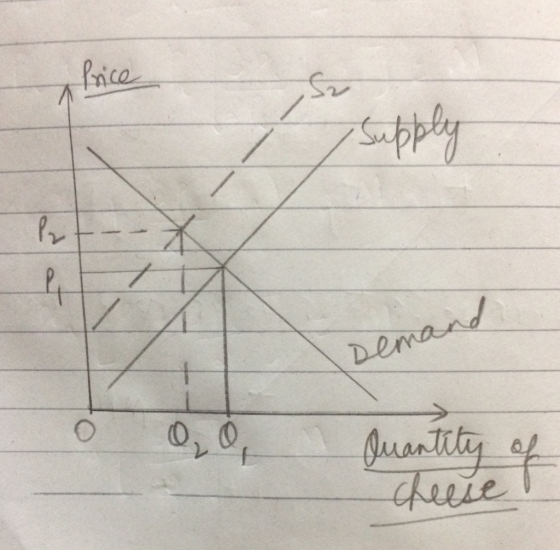
Suppliers produce two goods. So, if the price of butter increases , then suppliers shift their resources from cheese production to butter production . And therefore, the supply of cheese will decline. Therefore supply curve for cheese shifts leftward . As a result, equilibrium price of cheese rises and equilibrium quantity of cheese will decrease.
This is shown in the below figure:
Add Answer to:
Suppliers produce two goods, cheese and butter. Assume
that there is no cost to switch resources...
Consider a two countries, Portugal and England, that produce two goods, wine and cheese, with only...
Consider a two countries, Portugal and England, that produce two goods, wine and cheese, with only one factor of production, Labor. In England, one unit of labor can produce 2 units of wine or 1 unit of cheese. In Portugal, one unit of labor can produce 3 units of wine or 1/2 of cheese. There are 100 units of labor in Portugal, and 100 in England. Countries share the same tastes, and there is perfect competition. 1) Fill in the...
Bananas and peanut butter are considered complementary goods because, as everyone knows, the combination of these...
Bananas and peanut butter are considered complementary goods because, as everyone knows, the combination of these two items is truly a delight for the senses. If this is true, what would you expect to happen to the equilibrium quantity of bananas bought and sold in the market as the price of peanut butter decreases? a. It would decrease because of a shift in supply b. It would decrease because of a shift in demand c. It would increase because of...
1a. Suppose that each worker in Home can produce 2 pound of cheese or 3 gallons...
1a. Suppose that each worker in Home can produce 2 pound of cheese or 3 gallons of wine. Assume that Home has 40 workers. a. Graph the production possibilities frontier (PPF) for Home? What is the no-trade relative price of cheese in Home? Why? b. Suppose that each worker in Foreign can produce 1 pounds of cheese or 2 gallons of wine. Assume that Foreign also has 40 workers. Graph the PPF for Foreign? What is the no-trade relative price...
QUESTION 3 (CHAPTER 4 - SUPPLY AND DEMAND) a. What is the law of demand? What...
 QUESTION 3 (CHAPTER 4 - SUPPLY AND DEMAND) a. What is the law of demand? What factors are taken as constant when plotting a demand curve? b. What happens to a demand curve if the income of the consumers increases? c. What happens to a demand curve for a product if the price of a substitute product increases? (Hint: Margarine and butter are substitute good. What would happen to the demand curve for margarine if the price of butter increases?)...
1525 11. Discuss the most significant factors that affect demand for goods and services. 12. What...
 1525 11. Discuss the most significant factors that affect demand for goods and services. 12. What causes for a demand curve to shift to right or to left? When do we move from one point to another on a demand curve, what causes it? 13. Demonstrate graphically how a horizontal summation of individual demand curves provides a "market demand curve." 14. Discuss the most important factors/variables that affect supply of goods and services. 15. Explain the difference between moving on...
D Question 32 2 pts Wine and cheese are complement goods because they are consumed together....
 D Question 32 2 pts Wine and cheese are complement goods because they are consumed together. What would we pect to happen to the equilibrium quantity of cheeseif the price of wine increased and allese is d constant? O It would increase because of a supply shift it would decrease because of a demand shitt O It would stay the same because of both a demand and a supply shift. O it would increase because of a demand shift. D...
2. Consider a Cournot competition model with two firms, 1 and 2. They produce identical goods...
 2. Consider a Cournot competition model with two firms, 1 and 2. They produce identical goods in the same market with demand function P= 100-5Q with Q=91 +92. Furthermore, their production process generates pollution to the environment, which increases their cost of production. Their cost functions are given by C1(91,92) = 109,- +5Q and C291,92) = 15922 +45Q. a (10pts) Calculate their equilibrium quantities, price, and profits for both firms. b. (5pts) Consider they collude and form a cartel. That...
Suppose that Greece and Germany both produce oil and cheese. Greece's opportunity cost of producing a...
 Suppose that Greece and Germany both produce oil and cheese. Greece's opportunity cost of producing a pound of cheese is 3 barrels of oil while Germany's opportunity cost of producing a pound of cheese is 11 barrels of oil. By comparing the opportunity cost of producing cheese in the two countries, you can tell that has a comparative advantage in the has a comparative advantage in the production of oil. production of cheese and Suppose that Greece and Germany consider...
production possibilities frontier from Abbreviale in graphs C for cheese and F for furnitur North Carolina...
 production possibilities frontier
from Abbreviale in graphs C for cheese and F for furnitur North Carolina is famous for its furniture, if necessary. and if it produced only e sets. Show your work! while Wisconsin for its cheese. Both NC and WI can produce both, If NC devoted all of its resources to the production of furniture, it could produce 20 furniture sets, cheese it could make 10 wheels of cheese. If WI devoted all of its resources to the...
production possibilities frontier
from Abbreviale in graphs C for cheese and F for furnitur North Carolina is famous for its furniture, if necessary. and if it produced only e sets. Show your work! while Wisconsin for its cheese. Both NC and WI can produce both, If NC devoted all of its resources to the production of furniture, it could produce 20 furniture sets, cheese it could make 10 wheels of cheese. If WI devoted all of its resources to the...
Suppose that Greece and Austria both produce fish and cheese. Greece's opportunity cost of producing a pound of cheese is 4 pounds of fish while
3. Terms of trade Suppose that Greece and Austria both produce fish and cheese. Greece's opportunity cost of producing a pound of cheese is 4 pounds of fish while Austria's opportunity cost of producing a pound of cheese is 10 pounds of fish. By comparing the opportunity cost of producing cheese in the two countries, you can tell that _______ has a comparative advantage in the production of cheese and _______ has a comparative advantage in the production of fish. Suppose that Greece and Austria...
 QUESTION 3 (CHAPTER 4 - SUPPLY AND DEMAND) a. What is the law of demand? What factors are taken as constant when plotting a demand curve? b. What happens to a demand curve if the income of the consumers increases? c. What happens to a demand curve for a product if the price of a substitute product increases? (Hint: Margarine and butter are substitute good. What would happen to the demand curve for margarine if the price of butter increases?)...
 1525 11. Discuss the most significant factors that affect demand for goods and services. 12. What causes for a demand curve to shift to right or to left? When do we move from one point to another on a demand curve, what causes it? 13. Demonstrate graphically how a horizontal summation of individual demand curves provides a "market demand curve." 14. Discuss the most important factors/variables that affect supply of goods and services. 15. Explain the difference between moving on...
 D Question 32 2 pts Wine and cheese are complement goods because they are consumed together. What would we pect to happen to the equilibrium quantity of cheeseif the price of wine increased and allese is d constant? O It would increase because of a supply shift it would decrease because of a demand shitt O It would stay the same because of both a demand and a supply shift. O it would increase because of a demand shift. D...
 2. Consider a Cournot competition model with two firms, 1 and 2. They produce identical goods in the same market with demand function P= 100-5Q with Q=91 +92. Furthermore, their production process generates pollution to the environment, which increases their cost of production. Their cost functions are given by C1(91,92) = 109,- +5Q and C291,92) = 15922 +45Q. a (10pts) Calculate their equilibrium quantities, price, and profits for both firms. b. (5pts) Consider they collude and form a cartel. That...
 Suppose that Greece and Germany both produce oil and cheese. Greece's opportunity cost of producing a pound of cheese is 3 barrels of oil while Germany's opportunity cost of producing a pound of cheese is 11 barrels of oil. By comparing the opportunity cost of producing cheese in the two countries, you can tell that has a comparative advantage in the has a comparative advantage in the production of oil. production of cheese and Suppose that Greece and Germany consider...
 production possibilities frontier
from Abbreviale in graphs C for cheese and F for furnitur North Carolina is famous for its furniture, if necessary. and if it produced only e sets. Show your work! while Wisconsin for its cheese. Both NC and WI can produce both, If NC devoted all of its resources to the production of furniture, it could produce 20 furniture sets, cheese it could make 10 wheels of cheese. If WI devoted all of its resources to the...
production possibilities frontier
from Abbreviale in graphs C for cheese and F for furnitur North Carolina is famous for its furniture, if necessary. and if it produced only e sets. Show your work! while Wisconsin for its cheese. Both NC and WI can produce both, If NC devoted all of its resources to the production of furniture, it could produce 20 furniture sets, cheese it could make 10 wheels of cheese. If WI devoted all of its resources to the...
Most questions answered within 3 hours.
-
Where is the error in this code sequence?
String s1 = "Hello";
String s2 = "ello";...
asked 11 months ago -
Financial data for Joel de Paris, Inc., for last year
follow:
Joel de Paris, Inc.
Balance...
asked 11 months ago -
Consider this reaction:
Al2(SO4)3 (aq)+ BaCl3
(aq) Al2Cl6 (aq)- +
3BaSO4(s) . What is the...
asked 11 months ago -
Suppose that Savneet is considering increasing her
recent random sample from 20 car rentals to 40...
asked 11 months ago -
Trucks arrive at an unloading terminal at an average rate of 120
per hour.
Trucks arrive...
asked 11 months ago -
Why are methanol and ethanol completely soluble in water while
octanol is not very little soluble....
asked 11 months ago -
A facilities manager at a university reads in a research report
that the mean amount of...
asked 11 months ago -
When the CuSO4 is rehydrated by adding water to the anhydrous
compound, is this an endothermic...
asked 11 months ago -
A ray of sunlight is passing from diamond into crown glass; the
angle of incidence is...
asked 11 months ago -
A block of mass 0.249 kg is placed on top of a light, vertical
spring of...
asked 11 months ago -
how do the kidneys compensate in the presences of acidosis
a) trigger hyperventilate
b) reserve acid...
asked 11 months ago -
Question 501 pts
The rental rate of capital to the firm increases. Which of the
following...
asked 11 months ago