Prove that the number of nodes in a binary decision tree will be full with k...
Prove that the number of nodes in a binary decision tree will be full with k levels if and only if the number of nodes available is 2k - 1.
Note that to conduct this proof, you will need to prove the statement both ways.
Homework Answers
As we know, the maximum number of a child of a tree can have is either 2 or 0.
The maximum number of nodes in a binary Decision tree or we can say (BST) of depth K is 2 ^ K -1, where, K >=1. Consider only this case.
This can easily be proved by PMI (Principle Mathematical Induction).
Suppose, we are at level 1. Now put the value of K = 1 in Equation (2 ^ K- 1), the answer is coming out be 1 for Level 1. At level 1 no further child is present.
Suppose, we are at level 3, Number of possible child Level 3 can have is (2 ^ 3 - 1 ) which is nothing but 7.
Add Answer to:
Prove that the number of nodes in a binary decision tree will be
full with k...
Refer to the definition of Full Binary Tree from the notes. For a Full Binary Tree...
 Refer to the definition of Full Binary Tree from the notes. For a Full Binary Tree T, we use n(T), h(T), i(T) and l(T) to refer to number of nodes, height, number of internal nodes (non-leaf nodes) and number of leaves respectively. Note that the height of a tree with single node is 1 (not zero). Using structural induction, prove the following: (a) For every Full Binary Tree T, n(T) greaterthanorequalto h(T). (b) For every Full Binary Tree T, i(T)...
A binary tree node is called full if the node contains 2 children. Use a proof...
 A binary tree node is called full if the node contains 2 children. Use a proof by induction to prove that in any binary tree, the number of leaves in the tree is equal to the number of full nodes plus one. (Hint: your inductive step should consider two cases: the k+1 node becomes the only child of a node that was previously a leaf; and the k+1 node becomes the second child of a node that previously only had...
Trees and Heaps 1. Show that the maximum number of nodes in a binary tree of...
Trees and Heaps 1. Show that the maximum number of nodes in a binary tree of height h is 2h+1 − 1. 2. A full node is a node with two children. Prove that the number of full nodes plus one is equal to the number of leaves in a nonempty binary tree. 3. What is the minimum number of nodes in an AVL tree of height 15? 4. Show the result of inserting 14, 12, 18, 20, 27, 16,...
(2 points) A full binary tree has a start node, internal nodes, and leaf nodes. The...
 (2 points) A full binary tree has a start node, internal nodes, and leaf nodes. The number of leaf nodes of this binary tree is 256. a) What is the height of the tree? b) How many internal nodes are in this tree?
C++ Write a function, singleParent, that returns the number of nodes in a binary tree that...
C++ Write a function, singleParent, that returns the number of nodes in a binary tree that have only one child. Add this function to the class binaryTreeType and create a program to test this function. (Note: First create a binary search tree.)
A full binary tree is a binary tree with the leaves on the same level. Add...
A full binary tree is a binary tree with the leaves on the same level. Add a method in the BinaryTree class to return True if the tree is full. (Hint: The number of nodes in a full binary tree is 2depth -1.) answer must be in python.
Problem 2 (8 pts): Structural Induction In a binary tree, a full node is a node...
 Problem 2 (8 pts): Structural Induction In a binary tree, a full node is a node with two children. Using structural induction, prove that the number of full nodes plus one is equal to the number of leaves in a binary tree (even if the tree itself is not necessarily full, i.e. some nodes may not be full)
6) Which nodes would you remove from this binary tree to make it into a "full"...
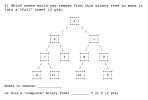 6) Which nodes would you remove from this binary tree to make it into a "full" tree? (2 pts) 2 10 Nodes to remove: Is this a "complete" Binary Tree? T or F (2 pts)
Give an equation to calculate the minimum number of nodes in a complete binary tree of...
Give an equation to calculate the minimum number of nodes in a complete binary tree of height h. This means that every height 1,..,h-1 is completely full.
2. A regular binary tree is a binary tree whose internal nodes all have two subtrees...
 2. A regular binary tree is a binary tree whose internal nodes all have two subtrees (left and right). In other words, all their nodes have either zero subtrees (in which case they are leaves) or two subtrees (in which case they are internal nodes). Suppose that you have a boolean function that tells you, for each node of the tree, whether it is a leaf or not (call it: leaf(n), for node n). a) Write a recursive function that...
 Refer to the definition of Full Binary Tree from the notes. For a Full Binary Tree T, we use n(T), h(T), i(T) and l(T) to refer to number of nodes, height, number of internal nodes (non-leaf nodes) and number of leaves respectively. Note that the height of a tree with single node is 1 (not zero). Using structural induction, prove the following: (a) For every Full Binary Tree T, n(T) greaterthanorequalto h(T). (b) For every Full Binary Tree T, i(T)...
 A binary tree node is called full if the node contains 2 children. Use a proof by induction to prove that in any binary tree, the number of leaves in the tree is equal to the number of full nodes plus one. (Hint: your inductive step should consider two cases: the k+1 node becomes the only child of a node that was previously a leaf; and the k+1 node becomes the second child of a node that previously only had...
 (2 points) A full binary tree has a start node, internal nodes, and leaf nodes. The number of leaf nodes of this binary tree is 256. a) What is the height of the tree? b) How many internal nodes are in this tree?
 Problem 2 (8 pts): Structural Induction In a binary tree, a full node is a node with two children. Using structural induction, prove that the number of full nodes plus one is equal to the number of leaves in a binary tree (even if the tree itself is not necessarily full, i.e. some nodes may not be full)
 6) Which nodes would you remove from this binary tree to make it into a "full" tree? (2 pts) 2 10 Nodes to remove: Is this a "complete" Binary Tree? T or F (2 pts)
 2. A regular binary tree is a binary tree whose internal nodes all have two subtrees (left and right). In other words, all their nodes have either zero subtrees (in which case they are leaves) or two subtrees (in which case they are internal nodes). Suppose that you have a boolean function that tells you, for each node of the tree, whether it is a leaf or not (call it: leaf(n), for node n). a) Write a recursive function that...
Most questions answered within 3 hours.
-
Where is the error in this code sequence?
String s1 = "Hello";
String s2 = "ello";...
asked 10 months ago -
Financial data for Joel de Paris, Inc., for last year
follow:
Joel de Paris, Inc.
Balance...
asked 10 months ago -
Consider this reaction:
Al2(SO4)3 (aq)+ BaCl3
(aq) Al2Cl6 (aq)- +
3BaSO4(s) . What is the...
asked 10 months ago -
Suppose that Savneet is considering increasing her
recent random sample from 20 car rentals to 40...
asked 10 months ago -
Trucks arrive at an unloading terminal at an average rate of 120
per hour.
Trucks arrive...
asked 10 months ago -
Why are methanol and ethanol completely soluble in water while
octanol is not very little soluble....
asked 10 months ago -
A facilities manager at a university reads in a research report
that the mean amount of...
asked 10 months ago -
When the CuSO4 is rehydrated by adding water to the anhydrous
compound, is this an endothermic...
asked 10 months ago -
A ray of sunlight is passing from diamond into crown glass; the
angle of incidence is...
asked 10 months ago -
A block of mass 0.249 kg is placed on top of a light, vertical
spring of...
asked 10 months ago -
how do the kidneys compensate in the presences of acidosis
a) trigger hyperventilate
b) reserve acid...
asked 10 months ago -
Question 501 pts
The rental rate of capital to the firm increases. Which of the
following...
asked 10 months ago