1. John (who is 95 kg) drives his car over an absurdly large half-circle speedbump with...
1. John (who is 95 kg) drives his car over an absurdly large half-circle speedbump with a radius of 5 meters. Given that his normal weight is 930 N and his apparent weight at the top of the speed-bump was 246 N, how fast did he drive over the speed bump?
2. When working in circular motion problems, what do we define as always being the positive direction?
3. When in circular motion, the net force points in what direction? What does this mean for the relationship between the weight & weight apparent at the top of a circular track? What does it mean when at the bottom?
4. John spins a sling around in a circle, preparing to release a projectile with a mass of 28 grams. If his sling is 60 cm long, and he is spinning it at a steady speed - so that the edge of the sling is moving at 30 m/s, what is the centripetal acceleration experienced by the projectile? What is the centripetal force acting on the projectile?
5. What is the best way to angularly accelerate a door? What is the worst way? Why?
6. What is the sign of a torque which would cause a clockwise rotation?
7. John (95 kg) sprints at the incredible speed of 11 m/s and tackles a black bear (220 kg) from behind, holding onto the bear as they travel. If the bear was travelling in the same direction as John, at a slow speed of 1 m/s prior to the tackle, what is the final velocity of both the bear and John after the tackle?
8. John, being an awakened bodhisattva who remains in this realm of suffering only to guide others to awakening, is perfectly balanced atop his sick ride – a unicycle – at rest. If a student throws him a marker, and he wants to maximize the velocity he gets from the marker, should he deflect it or catch it? Why?
9. A black bear is charging toward John at 10 m/s. John stops the bear by pushing against it for 2 seconds. If the bear has a mass of 220 kg, what was the average force John applied to stop the bear?
10. A meterstick is attached to the edge of a table by a pivot. A mass of 7 kg hangs at the 40 cm mark on the meterstick. If one were to apply an upward force at the 20 cm mark, what would the force need to be to put the system into equilibrium?
11. A spring is pulled with a force of 12 Newtons causing the spring to extend 6 cm. What is the spring constant?
12. Explain what the center of mass/gravity is. Can it move? Why does its location matter?
13. What makes something easier to tip over? What makes something harder to tip over? Explain why.
14. Define angular velocity, angular acceleration, period, frequency, moment of inertia, centripetal acceleration, and angular momentum.
15. How does angular velocity relate to linear velocity? How does angular acceleration relate to liner acceleration?
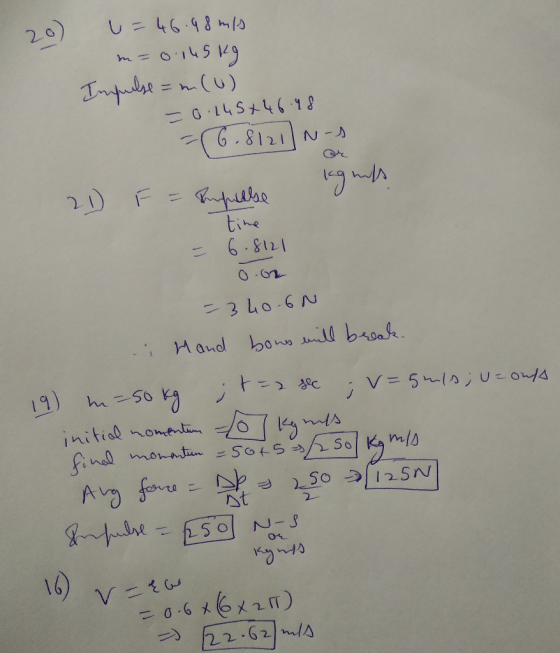
16. A sling with a length of 60 cm does 6 rotations per second. What is the speed that the stone at the end of the sling is travelling?
17. Compare and contrast ‘uniform circular motion’ with ‘nonuniform circular motion’.
18. Explain the conservation of momentum – what is conserved? In which cases does it apply?
19. A 50 kg mass is resting on a frictionless surface. An unknown force pushes the mass for 2 seconds until the mass reaches as velocity of 5 m/s. What is the initial momentum? What is the final momentum? What was the average force acting on the mass? What was the impulse acting on the mass?
20. The fastest pitch recorded in baseball was 105.1 MPH (46.98 m/s) by Aroldis Chapman. Assuming the baseball had a mass of 0.145 kg, what was the impulse he imparted on the baseball?
21. If one was to catch a baseball moving at such a speed with their barehand (assume the catch takes place over a time interval of 0.020 seconds), what force would the baseball impart onto the hand? If hand bones can break when under ~110 Newtons of force, can one safely catch such a ball?
Homework Answers
Please rate the work if you are satisfied with the solution or else kindly ask your doubts or queries in the comment section below
Add Answer to:
1. John (who is 95 kg) drives his car over an absurdly large
half-circle speedbump with...
John spins a sling around in a circle, preparing to release a projectile with a mass...
John spins a sling around in a circle, preparing to release a projectile with a mass of 28 grams. If his sling is 60 cm long, and he is spinning it at a steady speed - so that the edge of the sling is moving at 30 m/s, what is the centripetal acceleration experienced by the projectile? What is the centripetal force acting on the projectile? What is the best way to angularly accelerate a door? What is the worst...
Question: Part A) A mass of 0.134 ± 0.005 kg, set at the radius 9.5 ±...
Question: Part A) A mass of 0.134 ± 0.005 kg, set at the radius 9.5 ± 0.1 cm, undergoes uniform circular motion with the angular velocity 8.6 ± 0.2 rad/s. What is the centripetal force acting on the mass? Part B) A mass of 0.133 ± 0.005 kg, set at the radius 7.9 ± 0.3 cm, undergoes uniform circular motion with the angular velocity 14 ± 0.4 rad/s. What is the uncertainty in the centripetal force acting on the mass?
1- Explain what the center of mass/gravity is. Can it move? Why does its location matter?...
1- Explain what the center of mass/gravity is. Can it move? Why does its location matter? 2- Define angular velocity, angular acceleration, period, frequency, moment of inertia, centripetal acceleration, and angular momentum. 3- . How does angular velocity relate to linear velocity? How does angular acceleration relate to liner acceleration? 4- Compare and contrast ‘uniform circular motion’ with ‘nonuniform circular motion
A 25 kg weight is swung in a horizontal circle with a tension of 1250 N in the cord holding it.
1 A 25 kg weight is swung in a horizontal circle with a tension of 1250 N in the cord holding it. A) What is the centripetal acceleration? B) What is the linear velocity if the radius is 135 cm? C) What is the linear displacement traveled after 32 revolutions? 2 A thin spherical shell with a weight of 76 N and radius 0.8 m rotates for 14 minutes, starting at 60 rad/s. If it has an angular displacement of 88200 radians: A) What is...
1). In a uniform circular motion, instantaneous velocity is tangent to the circle a) True b)...
 1). In a uniform circular motion, instantaneous velocity is tangent to the circle a) True b) False c) Can's say 2).In a uniform circular motion, acceleration is normal to the velocity and directed toward the center a) True b) False c) Unknown 3). For a particle of mass 'm' moving with a uniform velocity 'v'in a circle of radius 'r', write the expression for centripetal force (Fc)? 4). If a particle rotates in a circle of radius r = 10...
1).In a uniform circular motion, instantaneous velocity is tangent to the circle a) True b) False...
 1).In a uniform circular motion, instantaneous velocity is tangent to the circle a) True b) False c) Can's say 2).In a uniform circular motion, acceleration is normal to the velocity and directed toward the center a) True b) False c) Unknown 3). For a particle of mass 'm' moving with a uniform velocity 'v' in a circle of radius 'r', write the expression for centripetal force (Fc)? 4). If a particle rotates in a circle of radius r= 10 cm...
QUESTION 1 : Uniform circular motion Question 1 (uniform circular motion) A 1500 kg car is...
 QUESTION 1 : Uniform circular motion
Question 1 (uniform circular motion) A 1500 kg car is taking a left turn at a constant speed of 10 m/s. The radius of the turn is 12 meters a. What is the centripetal acceleration on the car? b. How much force is require to hold the car in that turn'? c. What force(s) is responsible for the centripetal force on the car?
QUESTION 1 : Uniform circular motion
Question 1 (uniform circular motion) A 1500 kg car is taking a left turn at a constant speed of 10 m/s. The radius of the turn is 12 meters a. What is the centripetal acceleration on the car? b. How much force is require to hold the car in that turn'? c. What force(s) is responsible for the centripetal force on the car?
A hammer thrower accelerates the hammer (mass = 7.30 kg) from rest within four full turns...
A hammer thrower accelerates the hammer (mass = 7.30 kg) from rest within four full turns (revolutions) and releases it at a speed of 27.7 m/s A.) Assuming a uniform rate of increase in angular velocity and a horizontal circular path of radius 1.30 m , calculate the angular acceleration. B.) Calculate the (linear) tangential acceleration. C.) Calculate the centripetal acceleration just before release. D.) Calculate the net force being exerted on the hammer by the athlete just before release....
1.) You whirl a stone in a horizontal circle in such a way that the stone...
1.) You whirl a stone in a horizontal circle in such a way that the stone is in uniform circular motion. Which of the following is true for this situation? (Select all that apply.) The change in direction of the stone's motion is due to the centripetal force acting on the stone. The direction of the stone's velocity changes as it moves around the circle. The stone is moving with constant velocity. The stone's speed is constant. The magnitude of...
1. An 800 kg car travels around the edge of a circular track of radius 400...
 1. An 800 kg car travels around the edge of a circular track of radius 400 m. At one point, the car accelerates around the track, increasing its speed from 40 m/s to 60 m/s over the course of 5 s. At the instant that the car reaches 50 m/s find (a) its angular velocity (b) its radial acceleration, (c) the centripetal force acting on the car, (d) the tangential acceleration of the car, and (e) the magnitude of the...
 1). In a uniform circular motion, instantaneous velocity is tangent to the circle a) True b) False c) Can's say 2).In a uniform circular motion, acceleration is normal to the velocity and directed toward the center a) True b) False c) Unknown 3). For a particle of mass 'm' moving with a uniform velocity 'v'in a circle of radius 'r', write the expression for centripetal force (Fc)? 4). If a particle rotates in a circle of radius r = 10...
 1).In a uniform circular motion, instantaneous velocity is tangent to the circle a) True b) False c) Can's say 2).In a uniform circular motion, acceleration is normal to the velocity and directed toward the center a) True b) False c) Unknown 3). For a particle of mass 'm' moving with a uniform velocity 'v' in a circle of radius 'r', write the expression for centripetal force (Fc)? 4). If a particle rotates in a circle of radius r= 10 cm...
 QUESTION 1 : Uniform circular motion
Question 1 (uniform circular motion) A 1500 kg car is taking a left turn at a constant speed of 10 m/s. The radius of the turn is 12 meters a. What is the centripetal acceleration on the car? b. How much force is require to hold the car in that turn'? c. What force(s) is responsible for the centripetal force on the car?
QUESTION 1 : Uniform circular motion
Question 1 (uniform circular motion) A 1500 kg car is taking a left turn at a constant speed of 10 m/s. The radius of the turn is 12 meters a. What is the centripetal acceleration on the car? b. How much force is require to hold the car in that turn'? c. What force(s) is responsible for the centripetal force on the car?
 1. An 800 kg car travels around the edge of a circular track of radius 400 m. At one point, the car accelerates around the track, increasing its speed from 40 m/s to 60 m/s over the course of 5 s. At the instant that the car reaches 50 m/s find (a) its angular velocity (b) its radial acceleration, (c) the centripetal force acting on the car, (d) the tangential acceleration of the car, and (e) the magnitude of the...
Most questions answered within 3 hours.
-
Where is the error in this code sequence?
String s1 = "Hello";
String s2 = "ello";...
asked 11 months ago -
Financial data for Joel de Paris, Inc., for last year
follow:
Joel de Paris, Inc.
Balance...
asked 11 months ago -
Consider this reaction:
Al2(SO4)3 (aq)+ BaCl3
(aq) Al2Cl6 (aq)- +
3BaSO4(s) . What is the...
asked 11 months ago -
Suppose that Savneet is considering increasing her
recent random sample from 20 car rentals to 40...
asked 11 months ago -
Trucks arrive at an unloading terminal at an average rate of 120
per hour.
Trucks arrive...
asked 11 months ago -
Why are methanol and ethanol completely soluble in water while
octanol is not very little soluble....
asked 11 months ago -
A facilities manager at a university reads in a research report
that the mean amount of...
asked 11 months ago -
When the CuSO4 is rehydrated by adding water to the anhydrous
compound, is this an endothermic...
asked 11 months ago -
A ray of sunlight is passing from diamond into crown glass; the
angle of incidence is...
asked 11 months ago -
A block of mass 0.249 kg is placed on top of a light, vertical
spring of...
asked 11 months ago -
how do the kidneys compensate in the presences of acidosis
a) trigger hyperventilate
b) reserve acid...
asked 11 months ago -
Question 501 pts
The rental rate of capital to the firm increases. Which of the
following...
asked 11 months ago