Use an AD and AS graph (and words) to explain the short-run and long-run effects on...
Use an AD and AS graph (and words) to explain the short-run and long-run effects on real GDP and price level of a decrease in net exports. Assume the economy begins at full employment. Be sure to state what happens to price level and Real GDP in both the short-run and long-run and how the economy transitions from short to long-run. (YOU MUST DRAW A GRAPH)
Homework Answers
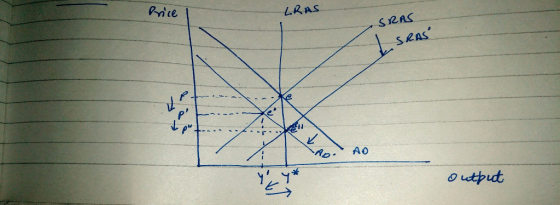
Net exports is one of the components of aggregate demand, so decrease in net exports leads to decrease in aggregate demand that shifts the AD curve leftward to AD'. Short run equilibrium reaches at e' where price level and output both decrease.
Over time nominal wages will fall because less than full employment level of output is produced. This decreases the cost of production that leads to increase aggregate supply. So SRAS curve shifts rightward to SRAS'. Long run equilibrium reaches at e'' where price level falls further and output returns to initial potential level.
Add Answer to:
Use an AD and AS graph (and words) to explain
the short-run and long-run effects on...
Assume the U.S. economy is in both short-run and long-run equilibrium, as shown in the graph...
 Assume the U.S. economy is in both short-run and long-run equilibrium, as shown in the graph below. Suppose the federal government increases the amount of spending on the military. either the new a. Show the effect on the short-run equilibrium as a result of increased government spending. Using the graph, dra AD curve or new AS curve resulting from this change in spending. Instructions: Use the tool provided 'New Curve' to plot the appropriate line. After placing the curve, click...
Unit 3: Aggregate Demand, Aggregate Supply, and Fiscal Policy AD, AS, and LRAS Short Run vs....
 Unit 3: Aggregate Demand, Aggregate Supply, and Fiscal Policy AD, AS, and LRAS Short Run vs. Long Run Aggregate Supply Draw the economy at full employment 1. In the short run, wages and resource prices will as price levels increase 2. In the long run, wages and resource prices will as price levels increase Shifters of AD and AS Shifters of Aggregate Demand Shifters of Aggregate Supply imi Recessionary Gap Draw an economy in a recession Inflationary Gap Draw an...
The graph shows the economy in long-run equilibrium Then the world economy expands and the demand...
 The graph shows the economy in long-run equilibrium Then the world economy expands and the demand for U.S.-produced goods increases Price level (GDP deflator, 2009-100) 14 Draw a curve that shows 1) the effect of increased demand for U.S.-produced goods. Label it 1 2) the effect of a rising money wage rate that returns the economy to full employment. Label it 2. Draw a point at the new long-run equilibrium 13 SAS 12 An economy is in a long-run equilibrium....
The graphs illustrate an initial equilibrium for the economy. Suppose that oil prices temporarily decrease Use...
 The graphs illustrate an initial equilibrium for the economy. Suppose that oil prices temporarily decrease Use the graphs to show the new positions of aggregate demand (AD), short-run aggregate supply (SRAS), and long-run aggregate supply (LRAS) in both the short run and the long run, as well as the short-run and long-run equilibriums resulting from this change. Then, indicate what happens to the price level and GDP in the short run and in the long run. Short-run graph Long-run graph...
Suppose real output is initially at its full employment level. Using Aggregate Demand (AD)—Aggregate Supply (AS) framework, discuss the short-run and long-run effects of a decrease in government expe...
Suppose real output is initially at its full employment level. Using Aggregate Demand (AD)—Aggregate Supply (AS) framework, discuss the short-run and long-run effects of a decrease in government expenditure on the price level, real output, nominal wage rate and real wage rate under the following three alternative assumptions: nominal wages are fully flexible nominal wages are relatively slow to adjust nominal wages are completely rigid.
drawing the graph of AD (Aggregate Demand), SRAS (Short- run aggregate supply curve) and LRAS (...
drawing the graph of AD (Aggregate Demand), SRAS (Short- run aggregate supply curve) and LRAS ( long run aggregate supply curve) and writing down what would happen under the two conditions "increase personal income taxes" and "decrease personal income taxes". You need to write down everything happens by following the seven steps: 1. What would happen under the condition? (Whether AD, SRAS, or LRAS would change? And in which direction the curve would shift?) 2. Where is the new short-run...
Suppose that the economy is at long-run equilibrium. a. Draw a diagram to illustrate the state of the economy. Be su...
 Suppose that the economy is at long-run equilibrium. a. Draw a diagram to illustrate the state of the economy. Be sure to show aggregate demand, short-run aggregate supply, and long-run aggregate supply. b. Now suppose that a severe decline in the value of homes has affected the entire economy. Use your diagram to show what happens to output, employment, and the price level in the short run. Explain how households and businesses will adjust to this unanticipated shock to the...
AD-AS and Phillip Curve Model, Money Market and Banking System Graphically illustrate an economy in the...
AD-AS and Phillip Curve Model, Money Market and Banking System Graphically illustrate an economy in the long run equilibrium, producing at the full employment level of production. Indicate the equilibrium Price level (P*) and the level of real GDP (Y*) Graphically illustrate an economy in the short run equilibrium producing at a below full employment level of production. Indicate the equilibrium Price level (P*) and the level of real GDP (Y*) and show the amount of the recessionary gap. Graphically...
1. What is on the horizontal axis and the vertical axis of the AD-AS graph? Or...
 1. What is on the horizontal axis and the vertical axis of the AD-AS graph? Or explain what Y and P are, and how they are measured. 2. What is the major difference between the AE model and the AD-AS model? 3. Suppose a recession is characterized by a decrease in real GDP and a decrease in the price level. What could be the cause of the recession? 4. Suppose a recession is characterized by a decrease in real GDP...
Assume an economy operating below full employment. Draw a correctly labeled AD/AS graph showing: the problem...
Assume an economy operating below full employment. Draw a correctly labeled AD/AS graph showing: the problem in the economy current price level and output full employment output Identify an open market operation that the Fed could implement to resolve the problem. Using a correctly labeled money market graph with a side-by-side investment demand graph, show the effect of the policy you identified in part B on each of the following: nominal interest rates quantity of investment demanded On your graph...
 Assume the U.S. economy is in both short-run and long-run equilibrium, as shown in the graph below. Suppose the federal government increases the amount of spending on the military. either the new a. Show the effect on the short-run equilibrium as a result of increased government spending. Using the graph, dra AD curve or new AS curve resulting from this change in spending. Instructions: Use the tool provided 'New Curve' to plot the appropriate line. After placing the curve, click...
 Unit 3: Aggregate Demand, Aggregate Supply, and Fiscal Policy AD, AS, and LRAS Short Run vs. Long Run Aggregate Supply Draw the economy at full employment 1. In the short run, wages and resource prices will as price levels increase 2. In the long run, wages and resource prices will as price levels increase Shifters of AD and AS Shifters of Aggregate Demand Shifters of Aggregate Supply imi Recessionary Gap Draw an economy in a recession Inflationary Gap Draw an...
 The graph shows the economy in long-run equilibrium Then the world economy expands and the demand for U.S.-produced goods increases Price level (GDP deflator, 2009-100) 14 Draw a curve that shows 1) the effect of increased demand for U.S.-produced goods. Label it 1 2) the effect of a rising money wage rate that returns the economy to full employment. Label it 2. Draw a point at the new long-run equilibrium 13 SAS 12 An economy is in a long-run equilibrium....
 The graphs illustrate an initial equilibrium for the economy. Suppose that oil prices temporarily decrease Use the graphs to show the new positions of aggregate demand (AD), short-run aggregate supply (SRAS), and long-run aggregate supply (LRAS) in both the short run and the long run, as well as the short-run and long-run equilibriums resulting from this change. Then, indicate what happens to the price level and GDP in the short run and in the long run. Short-run graph Long-run graph...
 Suppose that the economy is at long-run equilibrium. a. Draw a diagram to illustrate the state of the economy. Be sure to show aggregate demand, short-run aggregate supply, and long-run aggregate supply. b. Now suppose that a severe decline in the value of homes has affected the entire economy. Use your diagram to show what happens to output, employment, and the price level in the short run. Explain how households and businesses will adjust to this unanticipated shock to the...
 1. What is on the horizontal axis and the vertical axis of the AD-AS graph? Or explain what Y and P are, and how they are measured. 2. What is the major difference between the AE model and the AD-AS model? 3. Suppose a recession is characterized by a decrease in real GDP and a decrease in the price level. What could be the cause of the recession? 4. Suppose a recession is characterized by a decrease in real GDP...
Most questions answered within 3 hours.
-
Where is the error in this code sequence?
String s1 = "Hello";
String s2 = "ello";...
asked 10 months ago -
Financial data for Joel de Paris, Inc., for last year
follow:
Joel de Paris, Inc.
Balance...
asked 10 months ago -
Consider this reaction:
Al2(SO4)3 (aq)+ BaCl3
(aq) Al2Cl6 (aq)- +
3BaSO4(s) . What is the...
asked 10 months ago -
Suppose that Savneet is considering increasing her
recent random sample from 20 car rentals to 40...
asked 10 months ago -
Trucks arrive at an unloading terminal at an average rate of 120
per hour.
Trucks arrive...
asked 10 months ago -
Why are methanol and ethanol completely soluble in water while
octanol is not very little soluble....
asked 10 months ago -
A facilities manager at a university reads in a research report
that the mean amount of...
asked 10 months ago -
When the CuSO4 is rehydrated by adding water to the anhydrous
compound, is this an endothermic...
asked 10 months ago -
A ray of sunlight is passing from diamond into crown glass; the
angle of incidence is...
asked 10 months ago -
A block of mass 0.249 kg is placed on top of a light, vertical
spring of...
asked 10 months ago -
how do the kidneys compensate in the presences of acidosis
a) trigger hyperventilate
b) reserve acid...
asked 10 months ago -
Question 501 pts
The rental rate of capital to the firm increases. Which of the
following...
asked 10 months ago