(biochem question) If the pH of a solution decreased from 6.0 to 5.0, by what factor...
(biochem question) If the pH of a solution decreased from 6.0 to 5.0, by what factor did the [H+] change? (Trying to remind you of the relationship between the log scale and concentration.)
Homework Answers
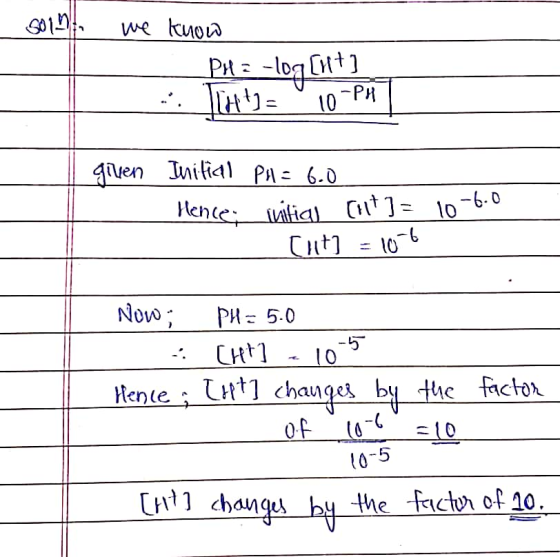
Please like this answer. THANK YOU
Please comment if YOU have any doubts about this answer.
All the best for your future.
Add Answer to:
(biochem question) If the pH of a solution decreased from 6.0 to
5.0, by what factor...
The pH value is an expression of the molarity of H3O+ ions in solution. This concentration...
The pH value is an expression of the molarity of H3O+ ions in solution. This concentration has strong impact on chemical reactions. The molarity is very small value, and therefore awkward to use. The pH scale simplifies this concentration making communication easier and faster. Demonstrate the relationship between pH and H3O+ molarity, using the formula, pH = -log(H3O+) where () indicates concentration in molarity of a substance. What is the pH of a solution, having the H3O+ concentration of 0.00038...
hi can someone help thank u Micro pH Scale Soda pop solution pH 0.1L solution 2.50...
 hi can someone help thank u
Micro pH Scale Soda pop solution pH 0.1L solution 2.50 3:48 [H30*] (M) [OH-](M) 3.2x10³ 3.2x10⁻¹² 3.3610-4 3.0x10" 1.0L solution Report Sheet Find the product of the [H3O] and the [OH-] for the 0.1 L solution. Find the product of the [H3O+] and the [OH-] for the 1.0 L solution. What is the relationship between [H3O'] and [OH-] for the solutions? A. The product of [H,O") and the [OH] is greater for a solution...
hi can someone help thank u
Micro pH Scale Soda pop solution pH 0.1L solution 2.50 3:48 [H30*] (M) [OH-](M) 3.2x10³ 3.2x10⁻¹² 3.3610-4 3.0x10" 1.0L solution Report Sheet Find the product of the [H3O] and the [OH-] for the 0.1 L solution. Find the product of the [H3O+] and the [OH-] for the 1.0 L solution. What is the relationship between [H3O'] and [OH-] for the solutions? A. The product of [H,O") and the [OH] is greater for a solution...
) The acidity or alkalinity of a solution is described using the pH scale. Basically, pH...
 ) The acidity or alkalinity of a solution is described using the pH scale. Basically, pH (which stands for "potential of hydrogen") is a measure of how many H+ ions there are in a solution. As we saw in the previous question, the more H*s there are in a solution, the more acidic it is. The formula for calculating pH is given below: In words, pH equals the negative log base ten of the hydrogen ion concentration. Solution X has...
Question two A buffer solution is able to maintain a constant pH when small amounts of...
 Question two
A buffer solution is able to maintain a constant pH when small amounts of acid or base are added to the buffer. Consider what happens when 1 mL of a 5 M solution is added or 0.005 mol of HCl are added to a 100.0 ml solution acetic acid buffer that contains 0.0100 mol of Acetic acid, HC,H,O,, and 0.0100 mol of sodium acetate, NaC,H,O2. The initial concentration of both the acid and the base are 0.0100 mol/0.1000...
Question two
A buffer solution is able to maintain a constant pH when small amounts of acid or base are added to the buffer. Consider what happens when 1 mL of a 5 M solution is added or 0.005 mol of HCl are added to a 100.0 ml solution acetic acid buffer that contains 0.0100 mol of Acetic acid, HC,H,O,, and 0.0100 mol of sodium acetate, NaC,H,O2. The initial concentration of both the acid and the base are 0.0100 mol/0.1000...
The acidity of a solution can be measured by pH=-log([H+] =-log([H3O+]. What is the pH of...
The acidity of a solution can be measured by pH=-log([H+] =-log([H3O+]. What is the pH of a solution if the concentration of H3O+ ions is 1.0X10^-5 M
pH operates off of a ___________ scale. The autoionization constant of water is abbreviated ________....
pH operates off of a ___________ scale. The autoionization constant of water is abbreviated ________. The molar concentration of hydronium in pure water at 25ºC has been measured to be ________. The relationship between hydronium and hydroxide in any dilute aqueous solution is represented by _________. The p in pH stands for _________. The relationship between pH and pOH is ___________. The pH value of a 1 M solution of strong acid would be...
9. Consider the equation pH = -log[4], where (H+) is the concentration of hydrogen ions in...
 9. Consider the equation pH = -log[4], where (H+) is the concentration of hydrogen ions in mol/L. What is the difference in pH between a solution with [14] -0.006 mol/L and a solution with (H+) = 0.0001 mol/L? Mark Value: 2 10. What is the relationship between an exponential function and a logarithmic function? What happens to the domain and range between an exponential and logarithmic function? Name two other characteristics between them that change in the same way. Mark...
Question 7 of 11 Determine the concentration of H+ in each solution at 25∘C. A solution with pH = 1.0....
Question 7 of 11 Determine the concentration of H+ in each solution at 25∘C. A solution with pH = 1.0. [H+]= M A solution with pH=5.0. [H+]= M A solution with pOH=11.0. [H+]=
1. (2) At pH 5.0, what is the concentration of OH- in solution? ___________ 2. (2)...
1. (2) At pH 5.0, what is the concentration of OH- in solution? ___________ 2. (2) If the monoprotic acid HAb has a pK of 3 and a solution is adjusted to pH 5: a) what is the concentration of hydrogen ions in that solution? ____________ b) what is the ratio of Ab- to HAb? ________________ 3. (2) Oxalic acid, a di-protic, di-carboxylic acid has pKs of 1.3 and 4.3 and thus can exist as H2Ox, HOx- and Ox= (please...
pH is a logarithmic scale used to indicate the hydrogen ion concentration, [H+], of a solution:...
pH is a logarithmic scale used to indicate the hydrogen ion concentration, [H+], of a solution: pH=−log[H+] Due to the autoionization of water, in any aqueous solution, the hydrogen ion concentration and the hydroxide ion concentration, [OH−], are related to each other by the Kw of water: Kw=[H+][OH−]=1.00×10⁻¹⁴ where 1.00×10⁻¹⁴ is the value at approximately 297 K. Based on this relation, the pH and pOH are also related to each other as 14.00=pH+pOH Part B Part complete 0.25 g of...
 hi can someone help thank u
Micro pH Scale Soda pop solution pH 0.1L solution 2.50 3:48 [H30*] (M) [OH-](M) 3.2x10³ 3.2x10⁻¹² 3.3610-4 3.0x10" 1.0L solution Report Sheet Find the product of the [H3O] and the [OH-] for the 0.1 L solution. Find the product of the [H3O+] and the [OH-] for the 1.0 L solution. What is the relationship between [H3O'] and [OH-] for the solutions? A. The product of [H,O") and the [OH] is greater for a solution...
hi can someone help thank u
Micro pH Scale Soda pop solution pH 0.1L solution 2.50 3:48 [H30*] (M) [OH-](M) 3.2x10³ 3.2x10⁻¹² 3.3610-4 3.0x10" 1.0L solution Report Sheet Find the product of the [H3O] and the [OH-] for the 0.1 L solution. Find the product of the [H3O+] and the [OH-] for the 1.0 L solution. What is the relationship between [H3O'] and [OH-] for the solutions? A. The product of [H,O") and the [OH] is greater for a solution...
 ) The acidity or alkalinity of a solution is described using the pH scale. Basically, pH (which stands for "potential of hydrogen") is a measure of how many H+ ions there are in a solution. As we saw in the previous question, the more H*s there are in a solution, the more acidic it is. The formula for calculating pH is given below: In words, pH equals the negative log base ten of the hydrogen ion concentration. Solution X has...
 Question two
A buffer solution is able to maintain a constant pH when small amounts of acid or base are added to the buffer. Consider what happens when 1 mL of a 5 M solution is added or 0.005 mol of HCl are added to a 100.0 ml solution acetic acid buffer that contains 0.0100 mol of Acetic acid, HC,H,O,, and 0.0100 mol of sodium acetate, NaC,H,O2. The initial concentration of both the acid and the base are 0.0100 mol/0.1000...
Question two
A buffer solution is able to maintain a constant pH when small amounts of acid or base are added to the buffer. Consider what happens when 1 mL of a 5 M solution is added or 0.005 mol of HCl are added to a 100.0 ml solution acetic acid buffer that contains 0.0100 mol of Acetic acid, HC,H,O,, and 0.0100 mol of sodium acetate, NaC,H,O2. The initial concentration of both the acid and the base are 0.0100 mol/0.1000...
 9. Consider the equation pH = -log[4], where (H+) is the concentration of hydrogen ions in mol/L. What is the difference in pH between a solution with [14] -0.006 mol/L and a solution with (H+) = 0.0001 mol/L? Mark Value: 2 10. What is the relationship between an exponential function and a logarithmic function? What happens to the domain and range between an exponential and logarithmic function? Name two other characteristics between them that change in the same way. Mark...
Most questions answered within 3 hours.
-
Where is the error in this code sequence?
String s1 = "Hello";
String s2 = "ello";...
asked 10 months ago -
Financial data for Joel de Paris, Inc., for last year
follow:
Joel de Paris, Inc.
Balance...
asked 10 months ago -
Consider this reaction:
Al2(SO4)3 (aq)+ BaCl3
(aq) Al2Cl6 (aq)- +
3BaSO4(s) . What is the...
asked 10 months ago -
Suppose that Savneet is considering increasing her
recent random sample from 20 car rentals to 40...
asked 10 months ago -
Trucks arrive at an unloading terminal at an average rate of 120
per hour.
Trucks arrive...
asked 10 months ago -
Why are methanol and ethanol completely soluble in water while
octanol is not very little soluble....
asked 10 months ago -
A facilities manager at a university reads in a research report
that the mean amount of...
asked 10 months ago -
When the CuSO4 is rehydrated by adding water to the anhydrous
compound, is this an endothermic...
asked 10 months ago -
A ray of sunlight is passing from diamond into crown glass; the
angle of incidence is...
asked 10 months ago -
A block of mass 0.249 kg is placed on top of a light, vertical
spring of...
asked 10 months ago -
how do the kidneys compensate in the presences of acidosis
a) trigger hyperventilate
b) reserve acid...
asked 10 months ago -
Question 501 pts
The rental rate of capital to the firm increases. Which of the
following...
asked 10 months ago