Human body temperatures are normally distributed with a mean of 98.20°F and a standard deviation of...
Human body temperatures are normally distributed with a mean of 98.20°F and a standard deviation of 0.62°F. Find the temperature such that only 7% of people have a higher body temperature. Round to the nearest hundredth of a degree.
Homework Answers

Add Answer to:
Human body temperatures are normally distributed with a mean of
98.20°F and a standard deviation of...
Healty people have body temperatures that are normally distributed with a mean of 98.20∘F and a...
Healty people have body temperatures that are normally distributed with a mean of 98.20∘F and a standard deviation of 0.62∘F . (a) If a healthy person is randomly selected, what is the probability that he or she has a temperature above 100∘F? (b) A hospital wants to select a minimum temperature for requiring further medical tests. What should that temperature be, if we want only 0.5 % of healty people to exceed it?
Healthy people have body temperatures that are normally distributed with a mean of 98.20∘F and a...
Healthy people have body temperatures that are normally distributed with a mean of 98.20∘F and a standard deviation of 0.62∘F. (a) If a healthy person is randomly selected, what is the probability that he or she has a temperature above 99.1∘F? answer: (b) A hospital wants to select a minimum temperature for requiring further medical tests. What should that temperature be, if we want only 1 % of healthy people to exceed it? answer:
Assume that human body temperatures are normally distributed with a mean of 98.20°F and a standard...
Assume that human body temperatures are normally distributed with a mean of 98.20°F and a standard deviation of 0.63°F. a. A hospital uses 100.6°F as the lowest temperature considered to be a fever. What percentage of normal and healthy persons would be considered to have a fever? Does this percentage suggest that a cutoff of 100.6°F is appropriate? b. Physicians want to select a minimum temperature for requiring further medical tests. What should that temperature be, if we want only...
1 point) Healty people have body temperatures that are normally distributed with a mean of 98.20∘F...
1 point) Healty people have body temperatures that are normally distributed with a mean of 98.20∘F and a standard deviation of 0.62∘F . (a) If a healthy person is randomly selected, what is the probability that he or she has a temperature above 98.3∘F?
Healthy people have body temperatures that are normally distributed with a mean of 98.20∘Fand a standard...
Healthy people have body temperatures that are normally distributed with a mean of 98.20∘Fand a standard deviation of 0.62∘F. (a) If a healthy person is randomly selected, what is the probability that he or she has a temperature above 99.8∘F? answer: (b) A hospital wants to select a minimum temperature for requiring further medical tests. What should that temperature be, if we want only 1 % of healthy people to exceed it? answer:
(1 point) Healty people have body temperatures that are normally distributed with a mean of 98.20°F...
 (1 point) Healty people have body temperatures that are normally distributed with a mean of 98.20°F and a standard deviation of 0.62°F (a) If a healthy person is randomly selected, what is the probability that he or she has a temperature above 99.1°F answer (b) A hospital wants to select a minimum temperature for requiring further medical tests. What should that temperature be, if we want only 0.5 % of healty people to exceed it? answer.
Healthy people have body temperatures that are normally distributed with a mean of 98.20 degrees Fahrenheit...
Healthy people have body temperatures that are normally distributed with a mean of 98.20 degrees Fahrenheit and a standard deviation of 0.62 degrees Fahrenheit. If a healthy person is randomly selected, what is the probability that he or she has a temperature above 98.8 degrees Fahrenheit? A hospital wants to select a minimum temperature for requiring further medical tests. What should the temperature be, if we want only 2.5% of healthy people to exceed it?
Assume that human body temperatures are normally distributed with a mean of 98.20 degrees Upper F...
Assume that human body temperatures are normally distributed with a mean of 98.20 degrees Upper F and a standard deviation of 0.61 degrees Upper F. a. A hospital uses 100.6 degrees Upper F as the lowest temperature considered to be a fever. What percentage of normal and healthy persons would be considered to have a fever? Does this percentage suggest that a cutoff of 100.6 degrees Upper F is appropriate? b. Physicians want to select a minimum temperature for requiring...
Human bo y temperatures have a mean of 98.20 F and a standard deviation of Round...
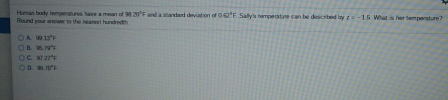 Human bo y temperatures have a mean of 98.20 F and a standard deviation of Round your answer to the nearest hundredth 62 F Sa y's temperature can be descnbed by -Wh s her temperature? O A. 99 13°F O B. 95.79°F O D. 96.70°F
a sample of 106 body temperatures has a mean of 98.20 oF and a standard deviation...
a sample of 106 body temperatures has a mean of 98.20 oF and a standard deviation of 0.62 oF. use a 0.05 significance level to test the claim that the mean body temperature of the population is equal to 98.6 oF, as is commonly believed. Find the following: A. Original claim: B. Opposite claim: C. alternative and Null Hypothesis: D. significance level: E. test statistic: F. P-vaule G. reject or fail to reject: H. final conclusion:
 (1 point) Healty people have body temperatures that are normally distributed with a mean of 98.20°F and a standard deviation of 0.62°F (a) If a healthy person is randomly selected, what is the probability that he or she has a temperature above 99.1°F answer (b) A hospital wants to select a minimum temperature for requiring further medical tests. What should that temperature be, if we want only 0.5 % of healty people to exceed it? answer.
 Human bo y temperatures have a mean of 98.20 F and a standard deviation of Round your answer to the nearest hundredth 62 F Sa y's temperature can be descnbed by -Wh s her temperature? O A. 99 13°F O B. 95.79°F O D. 96.70°F
Most questions answered within 3 hours.
-
Where is the error in this code sequence?
String s1 = "Hello";
String s2 = "ello";...
asked 10 months ago -
Financial data for Joel de Paris, Inc., for last year
follow:
Joel de Paris, Inc.
Balance...
asked 10 months ago -
Consider this reaction:
Al2(SO4)3 (aq)+ BaCl3
(aq) Al2Cl6 (aq)- +
3BaSO4(s) . What is the...
asked 10 months ago -
Suppose that Savneet is considering increasing her
recent random sample from 20 car rentals to 40...
asked 10 months ago -
Trucks arrive at an unloading terminal at an average rate of 120
per hour.
Trucks arrive...
asked 10 months ago -
Why are methanol and ethanol completely soluble in water while
octanol is not very little soluble....
asked 10 months ago -
A facilities manager at a university reads in a research report
that the mean amount of...
asked 10 months ago -
When the CuSO4 is rehydrated by adding water to the anhydrous
compound, is this an endothermic...
asked 10 months ago -
A ray of sunlight is passing from diamond into crown glass; the
angle of incidence is...
asked 10 months ago -
A block of mass 0.249 kg is placed on top of a light, vertical
spring of...
asked 10 months ago -
how do the kidneys compensate in the presences of acidosis
a) trigger hyperventilate
b) reserve acid...
asked 10 months ago -
Question 501 pts
The rental rate of capital to the firm increases. Which of the
following...
asked 10 months ago