The following data are for the decomposition of hydrogen peroxide in dilute sodium hydroxide at 20...
The following data are for the decomposition of hydrogen
peroxide in dilute sodium hydroxide at 20 °C.
H2O2(aq) -->
H2O(l) + ½ O2(g)
| [ H2O2], M | 2.58×10⁻² | 1.29×10⁻² | 6.45×10⁻³ | 3.23×10⁻³ |
| time, min | 0 | 8.68 | 17.4 | 26.0 |
Hint: It is not necessary to graph these
data.
(1)
The half life observed for this reaction is ____
min .
(2)
Based on these data, the rate constant for this
(zero/first/second?) order reaction is
______min -1.
Homework Answers
Half-life is the time required for a quantity to reduce to half of its initial value.
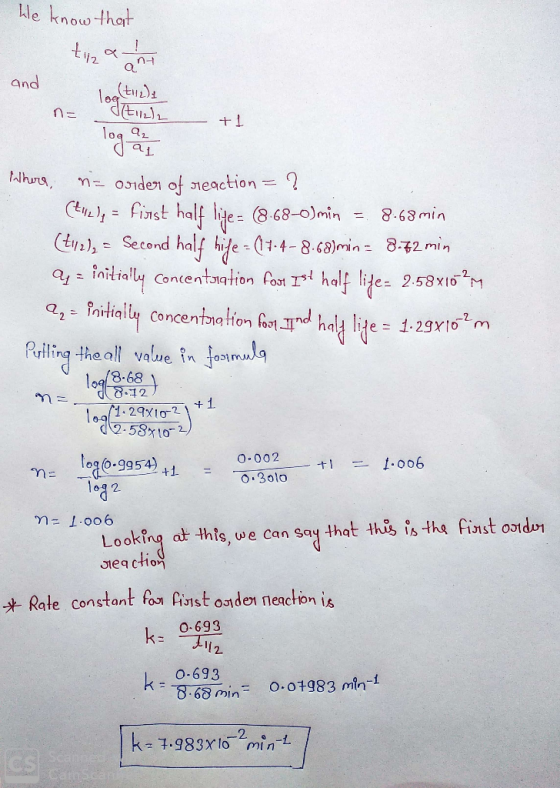
H2O2 takes 8.68min to be half ( i.e.1.29×10-2 M) of its initial concentration (i.e. 2.58×10⁻² M), so its half age will be 8.68min
(1) = 8.68min
(2) first of all we calculate order of reaction
Add Answer to:
The following data are for the decomposition of hydrogen
peroxide in dilute sodium hydroxide at 20...
The decomposition of hydrogen peroxide in dilute sodium hydroxide at 20 °C H2O2(aq) ------> H2O(l) +...
The decomposition of hydrogen peroxide in dilute sodium hydroxide at 20 °C H2O2(aq) ------> H2O(l) + ½ O2(g) is first order in H2O2 with a rate constant of 1.10×10⁻³min-1. If the initial concentration of H2O2 is 5.52×10⁻² M, the concentration of H2O2 will be 1.56×10⁻² M after _____ min have passed.
The decomposition of hydrogen peroxide in dilute sodium hydroxide at 20 °C H2O2(aq)H2O(l) + ½ O2(g)...
The decomposition of hydrogen peroxide in dilute sodium hydroxide at 20 °C H2O2(aq)H2O(l) + ½ O2(g) is first order in H2O2 with a rate constant of 1.10×10⁻³ min-1. If the initial concentration of H2O2 is 5.66×10⁻² M, the concentration of H2O2 will be 9.34×10⁻³ M after _______ min have passed.
For the decomposition of hydrogen peroxide in dilute sodium hydroxide at 20 °C 2 H2O2(aq) 2...
 For the decomposition of hydrogen peroxide in dilute sodium hydroxide at 20 °C 2 H2O2(aq) 2 H2O(l) + O2(g) the following data have been obtained: 6.26x10⁻² 3.39x10⁻² 1.84x10⁻² 9.96x10⁻³ [H202], M time, min 9.28 18.6 27.9 The average rate of disappearance of H2O2 over the time period from t=18.6 min to t = 27.9 min is M min-1
The decomposition of hydrogen peroxide in dilute sodium hydroxide at 20 °C H2O2(aq)->H2O(1) + 12 02(g)...
 The decomposition of hydrogen peroxide in dilute sodium hydroxide at 20 °C H2O2(aq)->H2O(1) + 12 02(g) is first order in H2O2- During one experiment it was found that when the initial concentration of 1,0, was 3.16x10⁻² M, the concentration of H2O2 dropped to 8.09x10⁻³ M after 945 min had passed. Based on this experiment, the rate constant for the reaction is nin-1
The following mechanism, proposed for the decomposition of hydrogen peroxide is composed of 2 elementary steps:...
 The following mechanism, proposed for the decomposition of hydrogen peroxide is composed of 2 elementary steps: H2O2(aq) + I'(aq) > H2O(l) + 10 (aq) 10 (aq) + H2O2(aq) -> H2O(l) + O2(g) + I'(aq) The rate law predicted by the mechanism is slow fast a) rate = k [H2O2) b) rate =k [H202][I] c) rate =k [H2O2][10] d) rate = k [H202) [1]
In a study of the gas phase decomposition of dinitrogen pentoxide at 335 K N2O3(g) 2...
 In a study of the gas phase decomposition of dinitrogen pentoxide at 335 K N2O3(g) 2 NO2(g) + % O2(g) the concentration of N,05 was followed as a function of time. It was found that a graph of In[N203) versus time in seconds gave a straight line with a slope of 6.25x10s and a y-intercept of -1.94 Based on this plot, the reaction is order in N205 and the rate constant for the reaction is In a study of the...
For the decomposition of ammonia on a platinum surface at 856 °C 2 NH3-N2 + 3...
 For the decomposition of ammonia on a platinum surface at 856 °C 2 NH3-N2 + 3 H2 the average rate of disappearance of NH3 over the time period from t=0 s to t = 6293 s is found to be 1.50X100 Ms? The average rate of formation of H, over the same time period is Ms. For the decomposition of hydrogen peroxide in dilute sodium hydroxide at 20 °C 2 H2O2(aq) +2 H2O(1) + O2(g) the average rate of disappearance...
In a study of the decomposition of nitrosyl bromide at 10 °C NOBr—+NO+ Br2 the concentration...
 In a study of the decomposition of nitrosyl bromide at 10 °C NOBr—+NO+ Br2 the concentration of NOBr was followed as a function of time. It was found that a graph of 1/[NOBr] versus time in seconds gave a straight line with a slope of 1.27 m?s and a y-intercept of 3.98 M? Based on this plot, the reaction is order in NOBr and the rate constant for the reaction is M?? In a study of the decomposition of hydrogen...
The decomposition of hydrogen peroxide (H2O2(aq)) is proposed to follow a reaction mechanism of Step 1:...
 The decomposition of hydrogen peroxide (H2O2(aq)) is proposed to follow a reaction mechanism of Step 1: H2O2(aq) + Br(aq)-H2O(l) + BrO (aq) Step 2: Bro (aq) + H2O2(aq),H2O(l) + O2(g) + Br(aq) What is the catalyst, and what is the effect of having a catalyst present? Periodic Table and Datasheet Br is the catalyst, and the reaction follows a faster pathway with Br than without BrO is the catalyst, and the reaction follows a faster pathway with Bro-than without Bro...
3. The decomposition of gaseous hydrogen peroxide to O2(g) and H2O(g) is a first-order reaction. Experimentally,...
 3. The decomposition of gaseous hydrogen peroxide to O2(g) and H2O(g) is a first-order reaction. Experimentally, at a given temperature, the initial concentration of H2O2 was found to decease to one- half in 17.0 minutes. What fraction of the initial H2O2 would remain after 51 minutes?
 For the decomposition of hydrogen peroxide in dilute sodium hydroxide at 20 °C 2 H2O2(aq) 2 H2O(l) + O2(g) the following data have been obtained: 6.26x10⁻² 3.39x10⁻² 1.84x10⁻² 9.96x10⁻³ [H202], M time, min 9.28 18.6 27.9 The average rate of disappearance of H2O2 over the time period from t=18.6 min to t = 27.9 min is M min-1
 The decomposition of hydrogen peroxide in dilute sodium hydroxide at 20 °C H2O2(aq)->H2O(1) + 12 02(g) is first order in H2O2- During one experiment it was found that when the initial concentration of 1,0, was 3.16x10⁻² M, the concentration of H2O2 dropped to 8.09x10⁻³ M after 945 min had passed. Based on this experiment, the rate constant for the reaction is nin-1
 The following mechanism, proposed for the decomposition of hydrogen peroxide is composed of 2 elementary steps: H2O2(aq) + I'(aq) > H2O(l) + 10 (aq) 10 (aq) + H2O2(aq) -> H2O(l) + O2(g) + I'(aq) The rate law predicted by the mechanism is slow fast a) rate = k [H2O2) b) rate =k [H202][I] c) rate =k [H2O2][10] d) rate = k [H202) [1]
 In a study of the gas phase decomposition of dinitrogen pentoxide at 335 K N2O3(g) 2 NO2(g) + % O2(g) the concentration of N,05 was followed as a function of time. It was found that a graph of In[N203) versus time in seconds gave a straight line with a slope of 6.25x10s and a y-intercept of -1.94 Based on this plot, the reaction is order in N205 and the rate constant for the reaction is In a study of the...
 For the decomposition of ammonia on a platinum surface at 856 °C 2 NH3-N2 + 3 H2 the average rate of disappearance of NH3 over the time period from t=0 s to t = 6293 s is found to be 1.50X100 Ms? The average rate of formation of H, over the same time period is Ms. For the decomposition of hydrogen peroxide in dilute sodium hydroxide at 20 °C 2 H2O2(aq) +2 H2O(1) + O2(g) the average rate of disappearance...
 In a study of the decomposition of nitrosyl bromide at 10 °C NOBr—+NO+ Br2 the concentration of NOBr was followed as a function of time. It was found that a graph of 1/[NOBr] versus time in seconds gave a straight line with a slope of 1.27 m?s and a y-intercept of 3.98 M? Based on this plot, the reaction is order in NOBr and the rate constant for the reaction is M?? In a study of the decomposition of hydrogen...
 The decomposition of hydrogen peroxide (H2O2(aq)) is proposed to follow a reaction mechanism of Step 1: H2O2(aq) + Br(aq)-H2O(l) + BrO (aq) Step 2: Bro (aq) + H2O2(aq),H2O(l) + O2(g) + Br(aq) What is the catalyst, and what is the effect of having a catalyst present? Periodic Table and Datasheet Br is the catalyst, and the reaction follows a faster pathway with Br than without BrO is the catalyst, and the reaction follows a faster pathway with Bro-than without Bro...
 3. The decomposition of gaseous hydrogen peroxide to O2(g) and H2O(g) is a first-order reaction. Experimentally, at a given temperature, the initial concentration of H2O2 was found to decease to one- half in 17.0 minutes. What fraction of the initial H2O2 would remain after 51 minutes?
Most questions answered within 3 hours.
-
Where is the error in this code sequence?
String s1 = "Hello";
String s2 = "ello";...
asked 10 months ago -
Financial data for Joel de Paris, Inc., for last year
follow:
Joel de Paris, Inc.
Balance...
asked 10 months ago -
Consider this reaction:
Al2(SO4)3 (aq)+ BaCl3
(aq) Al2Cl6 (aq)- +
3BaSO4(s) . What is the...
asked 10 months ago -
Suppose that Savneet is considering increasing her
recent random sample from 20 car rentals to 40...
asked 10 months ago -
Trucks arrive at an unloading terminal at an average rate of 120
per hour.
Trucks arrive...
asked 10 months ago -
Why are methanol and ethanol completely soluble in water while
octanol is not very little soluble....
asked 10 months ago -
A facilities manager at a university reads in a research report
that the mean amount of...
asked 10 months ago -
When the CuSO4 is rehydrated by adding water to the anhydrous
compound, is this an endothermic...
asked 10 months ago -
A ray of sunlight is passing from diamond into crown glass; the
angle of incidence is...
asked 10 months ago -
A block of mass 0.249 kg is placed on top of a light, vertical
spring of...
asked 10 months ago -
how do the kidneys compensate in the presences of acidosis
a) trigger hyperventilate
b) reserve acid...
asked 10 months ago -
Question 501 pts
The rental rate of capital to the firm increases. Which of the
following...
asked 10 months ago