1) You titrate 345 mL of 0.125 M propionic acid (Ka = 1.35 × 10⁻⁵ )...
1) You titrate 345 mL of 0.125 M propionic acid (Ka = 1.35 × 10⁻⁵ ) with 185 mL of 0.165 M KOH. What is the pH of the final solution?
2) What is the pH of a solution formed by titrating 215 mL of 0.45 M nitrous acid (Ka = 7.2 × 10⁻⁴ ) with 125.5 mL of 0.855 M NaOH?
Homework Answers
1.
Use Henderson Hasselbech equation;
pH = pKa + log [base]/[acid]
pka = -log (ka)
here , pKa = - log(1.35×10^-5) = 4.87
Moles of acid = molarity × volume in litres = 0.125M × 0.345L = 0.0431 moles.
Moles of base (KOH) = 0.165M × 0.185L = 0.0305 moles.
Now put values in initial equation;
pH = 4.87 + log (0.0305)/(0.0431)
pH = 4.87 + log(0.708)
pH = 4.87 + (-0.15) = 4.72
Hence final pH = 4.72
Add Answer to:
1) You titrate 345 mL of 0.125 M propionic acid (Ka = 1.35 ×
10–5 )...
An analytical chemist is titrating 188.5 mL of a 0.9900 M solution of propionic acid (HC,HCO,with...
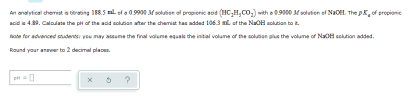 An analytical chemist is titrating 188.5 mL of a 0.9900 M solution of propionic acid (HC,HCO,with a 0.9000 M solution of NaOH. The pK of propionic acid is 4.89. Calculate the pH of the acid solution after the chemist has added 106.3 mL of the NaOH solution to it. Note for advanced students: you may assume the final volume equals the initial volume of the solution plus the volume of NaOH solution added Round your answer to 2 decimal places....
1. You are titrating a 100.0 mL solution of 0.050 M HBrwith a 0.150 M solution of...
1. You are titrating a 100.0 mL solution of 0.050 M HBrwith a 0.150 M solution of KOH. What will be the pH after the addition of 25.0 mL KOH? 2. You titrate 250 mL of 0.250 M acetic acid (Ka= 1.8 x 10⁻⁵) with 50.0 mL of 0.350 M NaOH. What is the pH of this solution? 3. For the titration in question 2, what would be the Kaof an ideal indicator.
Titrate 40.0 mL of 0.0350 M benzoic acid (C6H5COOH, Ka = 6.3 × 10⁻⁵) with 0.0700...
Titrate 40.0 mL of 0.0350 M benzoic acid (C6H5COOH, Ka = 6.3 × 10⁻⁵) with 0.0700 M NaOH Calculate the pH in the solution at equivalent point. a) 5.716 b) 8.284 c) 8.372 d) 5.628 e) 7.546
If you titrate 25 mL of 0.15 M formic acid (HCOOH, Ka = 1.8x10⁻⁴) with 0.060...
If you titrate 25 mL of 0.15 M formic acid (HCOOH, Ka = 1.8x10⁻⁴) with 0.060 M NaOH, what would be the pH after addition of 15 mL of NaOH solution?
How many moles of NaOH must be added to 1.35 L of 0.125 M acetic acid,...
How many moles of NaOH must be added to 1.35 L of 0.125 M acetic acid, CH3COOH, in order to produce a solution with a pH of 5.40? Ka (CH3COOH) = 1.8 x 10⁻⁵
fident you decide to titrate a 0.10s L solution of Malotic ngak diprotic acid. Titrating with...
 fident you decide to titrate a 0.10s L solution of Malotic ngak diprotic acid. Titrating with 045 M NaOH o e after adding 37.2 ml of NaOH Fee H-Mal for with 0.45 M NaOH you was the original concentration of Malonic acid? 1.5 x 10 for Malonic acid what was the original pH of the b IfKa 1.5x 10 for any NaOH? What is pH after adding only 18.6 mL of 0.45 M NaOH? e. d. What is in solution...
A student is titrating 50.00 mL of a 0.100 M weak acid (Ka = 1.8x10⁻⁵) with...
A student is titrating 50.00 mL of a 0.100 M weak acid (Ka = 1.8x10⁻⁵) with 0.100 M KOH. What is the pH after 30.00 mL of the 0.100 M KOH solution has been added?
An analytical chemist is titrating 91.8 mL of a 0.4200 M solution of nitrous acid (HNO2)...
 An analytical chemist is titrating 91.8 mL of a 0.4200 M solution of nitrous acid (HNO2) with a 0.9300 M solution of KOH. The pK, of nitrous acid is 3.35. Calculate the pH of the acid solution after the chemist has added 24.9 mL of the KOH solution to it. Note for advanced students: you may assume the final volume equals the initial volume of the solution plus the volume of KOH solution added. Round your answer to 2 decimal...
An analytical chemist is titrating 118.8 mL of a 0.2500 M solution of nitrous acid (HNO)...
 An analytical chemist is titrating 118.8 mL of a 0.2500 M solution of nitrous acid (HNO) with a 0.6300 M solution of KOH. The pk of nitrous acid is 3.35. Calculate the pH of the acid solution after the chemist has added 21.98 ml of the KOH solution to it. Note for advanced students: you may assume the final volume equals the initial volume of the solution plus the volume of KOH solution added. Round your answer to 2 decimal...
A 50.0 mL sample of 0.25 M formic acid (HCOOH) aqueous solution is titrated with 0.125...
A 50.0 mL sample of 0.25 M formic acid (HCOOH) aqueous solution is titrated with 0.125 M NaOH solution. Ka of HCOOH = 1.7 x 10⁻⁴. a. Calculate the pH of the solution after 50 mL of NaOH solution has been added. b. How many mL of 0.125 M NaOH need to be added to the sample to reach the equivalence point? What is the pH at the equivalence point?
 An analytical chemist is titrating 188.5 mL of a 0.9900 M solution of propionic acid (HC,HCO,with a 0.9000 M solution of NaOH. The pK of propionic acid is 4.89. Calculate the pH of the acid solution after the chemist has added 106.3 mL of the NaOH solution to it. Note for advanced students: you may assume the final volume equals the initial volume of the solution plus the volume of NaOH solution added Round your answer to 2 decimal places....
 fident you decide to titrate a 0.10s L solution of Malotic ngak diprotic acid. Titrating with 045 M NaOH o e after adding 37.2 ml of NaOH Fee H-Mal for with 0.45 M NaOH you was the original concentration of Malonic acid? 1.5 x 10 for Malonic acid what was the original pH of the b IfKa 1.5x 10 for any NaOH? What is pH after adding only 18.6 mL of 0.45 M NaOH? e. d. What is in solution...
 An analytical chemist is titrating 91.8 mL of a 0.4200 M solution of nitrous acid (HNO2) with a 0.9300 M solution of KOH. The pK, of nitrous acid is 3.35. Calculate the pH of the acid solution after the chemist has added 24.9 mL of the KOH solution to it. Note for advanced students: you may assume the final volume equals the initial volume of the solution plus the volume of KOH solution added. Round your answer to 2 decimal...
 An analytical chemist is titrating 118.8 mL of a 0.2500 M solution of nitrous acid (HNO) with a 0.6300 M solution of KOH. The pk of nitrous acid is 3.35. Calculate the pH of the acid solution after the chemist has added 21.98 ml of the KOH solution to it. Note for advanced students: you may assume the final volume equals the initial volume of the solution plus the volume of KOH solution added. Round your answer to 2 decimal...
Most questions answered within 3 hours.
-
Where is the error in this code sequence?
String s1 = "Hello";
String s2 = "ello";...
asked 11 months ago -
Financial data for Joel de Paris, Inc., for last year
follow:
Joel de Paris, Inc.
Balance...
asked 11 months ago -
Consider this reaction:
Al2(SO4)3 (aq)+ BaCl3
(aq) Al2Cl6 (aq)- +
3BaSO4(s) . What is the...
asked 11 months ago -
Suppose that Savneet is considering increasing her
recent random sample from 20 car rentals to 40...
asked 11 months ago -
Trucks arrive at an unloading terminal at an average rate of 120
per hour.
Trucks arrive...
asked 11 months ago -
Why are methanol and ethanol completely soluble in water while
octanol is not very little soluble....
asked 11 months ago -
A facilities manager at a university reads in a research report
that the mean amount of...
asked 11 months ago -
When the CuSO4 is rehydrated by adding water to the anhydrous
compound, is this an endothermic...
asked 11 months ago -
A ray of sunlight is passing from diamond into crown glass; the
angle of incidence is...
asked 11 months ago -
A block of mass 0.249 kg is placed on top of a light, vertical
spring of...
asked 11 months ago -
how do the kidneys compensate in the presences of acidosis
a) trigger hyperventilate
b) reserve acid...
asked 11 months ago -
Question 501 pts
The rental rate of capital to the firm increases. Which of the
following...
asked 11 months ago