Suppose a perfectly competitive market has the following inverse supply and demand curves: Supply: P= 5+2Q...
Suppose a perfectly competitive market has the following inverse supply and demand curves:
Supply: P= 5+2Q Demand: P = 50-Q.
1) Solve for the perfectly competitive Pe and Qe, and calculate consumer+producer surplus at Pe, Qe.
2) Suppose each unit of good produced created a negative externality to society valued at $1 per unit. Calculate the social optimum Pe and Qe for this case and compute consumer+producer surplus.
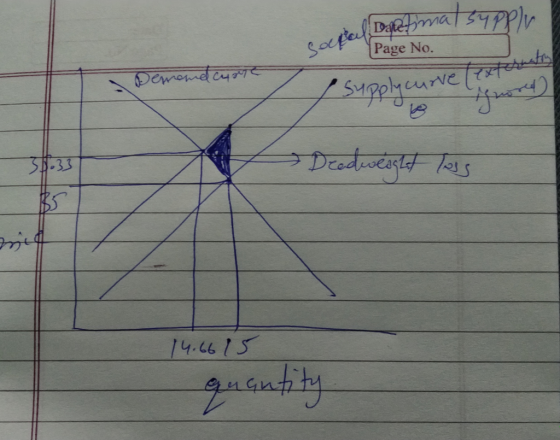
3) Show graphically the welfare loss if the externality is ignored.
Homework Answers
1). Perfect competition EQUILIBRIUM is at where market supply is EQUALS to market demand.
5+2Q=50-Q
3Q=45
Qe=45/3=15
Pe=5+2Q=5+2*15=35
Highest price CONSUMER willing to pay or price at demand Q=0
P=50-0=50
Minimum price at which producer wants to sell or price of supply at Q=0
P=5+2*0=5
CONSUMER surplus=0.5*Qe*(highest price CONSUMER willing to pay - Pe)
=0.5*15*(50-35)=0.5*15*15=112.5
Producer surplus=0.5*Qe*(pe- minimum price at which seller want to sell)
=0.5*15*(35-5)=0.5*15*30=225
CS+PS=112.5+225=337.5
2).social marginal cost =private marginal cost + externalities cost
Supply curve is nothing but producer marginal cost function.
So ,
Social marginal cost=5+2Q+1=6+2Q
Again market demand =social marginal cost or social optimal supply
50-Q=6+2Q
3Q=44
Qe=44/3=14.66
Pe=50-44/3=(150-44)/3=106/3=35.33
CS=0.5*44/3*(50-106/3)=0.5*44/3*44/3=107.5
PS=0.5*44/3*(106/3-5)=0.5*44/3*91/3=222.4
CS+PS=107.5+222.4=329.9
3).
Add Answer to:
Suppose a perfectly competitive market has the following inverse
supply and demand curves:
Supply: P= 5+2Q...
3) Assume that the market for energy efficient window installations in San Diego is perfectly competitive. Quarterly inverse supply and inverse demand are: P 1200 3Q (Private MB) P 440Qs (Private...
 3) Assume that the market for energy efficient window installations in San Diego is perfectly competitive. Quarterly inverse supply and inverse demand are: P 1200 3Q (Private MB) P 440Qs (Private MC) neighbors (lowering the overall price of electricity, reducing pollution, and so on) These external benefits to consumers are estimated to be EMB 2Q (the more windows installed, the more external benefit to installing more windows). a) Find the equilibrium price and quantity that will be produced in a...
The market supply in a competitive industry is p = Q and demand is p =...
The market supply in a competitive industry is p = Q and demand is p = 100 - Q. Production creates pollution with a social cost of $1 per unit of output. In response to environmentalists, the government creates a tax of $2 per unit. (a) (9 points) Calculate the price and quantity for the competitive equilibrium, the social optimum, and the equilibrium with the tax. (b) (9 points) Show these three points in a graph. Calculate the consumer surplus,...
Consider an industry with a linear inverse demand, p = 300 – 2Q, and MC =...
Consider an industry with a linear inverse demand, p = 300 – 2Q, and MC = AC = $60. Solve for industry output (Q), price (p), and profits if the industry is: 1. Perfectly competitive 2. Monopolistic 3. Show graphically (on the next page) the deadweight loss associated with monopoly when costs are constant as in this case. Point out differences in consumer surplus and producer surplus (if any) between the perfectly competitive and monopoly outcomes.
Homework 4 1. Consider the Asia-Pacific LNG market, which is dominated by Japan. Suppose that the...
 Homework 4 1. Consider the Asia-Pacific LNG market, which is dominated by Japan. Suppose that the inverse supply function for this market is given by P 1.Let Japan's marginal factor cost and marginal revenue product functions be as follows: MFC 1 +Q MRP 13- Calculate the quantity of LNG that Japan would purchase (Qm) in this market and the price per unit of LNG (Pm) a. (2 pt) b. Calculate consumer surplus, producer surplus, and social welfare in this market....
Suppose the inverse demand curve for a commodity in a perfectly competitive market takes the functional...
Suppose the inverse demand curve for a commodity in a perfectly competitive market takes the functional form: P (Q) = -.1Q + 10. Additionally, the firm’s marginal cost (MC) takes the following functional form: MC = 4 + 2Q. Recalling that a perfectly competitive firm is a price-taker in the market and its profit-maximizing output level (Qe) is always found by equating its price with its marginal cost: P = MC. Given all this, how much output (Qe) should the...
We are considering a market with marginal cost of P=100+2Q and a demand of P=500-2Q. Use...
We are considering a market with marginal cost of P=100+2Q and a demand of P=500-2Q. Use that information to answer the following questions. a. Find the market equilibrium (price and quantity in the market). b. Find producer and consumer surplus. c. Now imagine production of this good created a negative externality of 1$ per unit of output. Find the socially optimal outcome (price and quantity) taking this externality into account. d. Find consumer and producer surplus at the socially efficient...
Suppose that in a perfectly competitive market, demand is given by Q=58.0-P and supply is given...
Suppose that in a perfectly competitive market, demand is given by Q=58.0-P and supply is given by Q=P-27.0. The government imposes a per-unit excise tax of $1 on the good. What is producer surplus after the tax is imposed? No units, no rounding.
4) Consider the following perfectly competitive market for board games: (Do NOT round values.) (2...
 4) Consider the following perfectly competitive market for board games: (Do NOT round values.) (22 marks) Q-204P Qd-300 - P a) Calculate initial equilibrium supply and demand. b) Calculate consumer and producer surplus. Show graphically c) Realizing that board games are awesome, the government creates a $50 price ceiling. Recalculate new equilibrium quantities. Show graphically d) Calculate consumer surplus, producer surplus, and deadweight loss for the worst case scenario. Show graphically
4) Consider the following perfectly competitive market for board...
4) Consider the following perfectly competitive market for board games: (Do NOT round values.) (22 marks) Q-204P Qd-300 - P a) Calculate initial equilibrium supply and demand. b) Calculate consumer and producer surplus. Show graphically c) Realizing that board games are awesome, the government creates a $50 price ceiling. Recalculate new equilibrium quantities. Show graphically d) Calculate consumer surplus, producer surplus, and deadweight loss for the worst case scenario. Show graphically
4) Consider the following perfectly competitive market for board...
Suppose that in a perfectly competitive market, demand is given by Q=59.0-P and supply is given...
Suppose that in a perfectly competitive market, demand is given by Q=59.0-P and supply is given by Q=P-28.0. The government imposes a per-unit excise tax of $1 on the good. What is consumer surplus after that tax is imposed? No units, no rounding.
Suppose these are the market demand and supply curves for hooded sweatshirts: Supply: P = 10...
Suppose these are the market demand and supply curves for hooded sweatshirts: Supply: P = 10 + 2QS Demand: P = 50−3QD (a) Sketch these two curves (that is, draw them, but don’t worry about numerical accuracy). Calculate equilibrium price and quantity. Calculate equilibrium price and quantity. (b) Show on your graph the areas of consumer and producer surplus. Calculate consumer and producer surplus at the equilibrium from part a. (c) Calculate the price elasticity of demand when price changes...
 3) Assume that the market for energy efficient window installations in San Diego is perfectly competitive. Quarterly inverse supply and inverse demand are: P 1200 3Q (Private MB) P 440Qs (Private MC) neighbors (lowering the overall price of electricity, reducing pollution, and so on) These external benefits to consumers are estimated to be EMB 2Q (the more windows installed, the more external benefit to installing more windows). a) Find the equilibrium price and quantity that will be produced in a...
 Homework 4 1. Consider the Asia-Pacific LNG market, which is dominated by Japan. Suppose that the inverse supply function for this market is given by P 1.Let Japan's marginal factor cost and marginal revenue product functions be as follows: MFC 1 +Q MRP 13- Calculate the quantity of LNG that Japan would purchase (Qm) in this market and the price per unit of LNG (Pm) a. (2 pt) b. Calculate consumer surplus, producer surplus, and social welfare in this market....
 4) Consider the following perfectly competitive market for board games: (Do NOT round values.) (22 marks) Q-204P Qd-300 - P a) Calculate initial equilibrium supply and demand. b) Calculate consumer and producer surplus. Show graphically c) Realizing that board games are awesome, the government creates a $50 price ceiling. Recalculate new equilibrium quantities. Show graphically d) Calculate consumer surplus, producer surplus, and deadweight loss for the worst case scenario. Show graphically
4) Consider the following perfectly competitive market for board...
4) Consider the following perfectly competitive market for board games: (Do NOT round values.) (22 marks) Q-204P Qd-300 - P a) Calculate initial equilibrium supply and demand. b) Calculate consumer and producer surplus. Show graphically c) Realizing that board games are awesome, the government creates a $50 price ceiling. Recalculate new equilibrium quantities. Show graphically d) Calculate consumer surplus, producer surplus, and deadweight loss for the worst case scenario. Show graphically
4) Consider the following perfectly competitive market for board...
Most questions answered within 3 hours.
-
Where is the error in this code sequence?
String s1 = "Hello";
String s2 = "ello";...
asked 10 months ago -
Financial data for Joel de Paris, Inc., for last year
follow:
Joel de Paris, Inc.
Balance...
asked 10 months ago -
Consider this reaction:
Al2(SO4)3 (aq)+ BaCl3
(aq) Al2Cl6 (aq)- +
3BaSO4(s) . What is the...
asked 10 months ago -
Suppose that Savneet is considering increasing her
recent random sample from 20 car rentals to 40...
asked 10 months ago -
Trucks arrive at an unloading terminal at an average rate of 120
per hour.
Trucks arrive...
asked 10 months ago -
Why are methanol and ethanol completely soluble in water while
octanol is not very little soluble....
asked 10 months ago -
A facilities manager at a university reads in a research report
that the mean amount of...
asked 10 months ago -
When the CuSO4 is rehydrated by adding water to the anhydrous
compound, is this an endothermic...
asked 10 months ago -
A ray of sunlight is passing from diamond into crown glass; the
angle of incidence is...
asked 10 months ago -
A block of mass 0.249 kg is placed on top of a light, vertical
spring of...
asked 10 months ago -
how do the kidneys compensate in the presences of acidosis
a) trigger hyperventilate
b) reserve acid...
asked 10 months ago -
Question 501 pts
The rental rate of capital to the firm increases. Which of the
following...
asked 10 months ago