The bright star Rigel in the constellation Orion has a surface temperature about 1.6 times that...
The bright star Rigel in the constellation Orion has a surface temperature about 1.6 times that of the Sun. Its luminosity is about 64,000 times that of the Sun. What is Rigel's radius compared to the radius of the Sun (in units of solar radii, Rø)?
Homework Answers


Add Answer to:
The bright star Rigel in the constellation Orion has a surface
temperature about 1.6 times that...
6. The bright star Arcturus in the constellation Boötes has a surface temperature about 0.74 times...
6. The bright star Arcturus in the constellation Boötes has a surface temperature about 0.74 times that of the Sun. Its luminosity is about 170 times that of the Sun. (a) What is Arcturus’ radius compared to the radius of the Sun (in units of solar radii, ?⊙)? (b) What type of star is Arcturus (a dwarf, a giant, or a supergiant)? Explain your reasoning.
Betelgeuse, a bright red star in the constellation Orion, has a luminosity that is 100,000 times...
 Betelgeuse, a bright red star in the constellation Orion, has a luminosity that is 100,000 times that of the Sun However, the surface temperature of Betelgeuse is only 3000 K. Assuming that the emissivity of stars is 1, find the radius of Betelgeuse.
Find the radius RRigel of the star Rigel, the bright blue star in the constellation Orion...
Find the radius RRigel of the star Rigel, the bright blue star in the constellation Orion that radiates energy at a rate of 2.7×1031W and has a surface temperature of 11,000 K. Assume that the star is spherical. Use σ=5.67×10⁻⁸W/m2⋅K4 for the Stefan-Boltzmann constant and express your answer numerically in meters to two significant figures.
“Bellatrix” (γ Orionis; HD 35468) is a bright star in the constellation Orion and has the...
“Bellatrix” (γ Orionis; HD 35468) is a bright star in the constellation Orion and has the following properties: Surface Temperature = 22,000 K Radius = 6.0 R⊙ Mass = 8.5 M ⊙ (a) Calculate the luminosity of Bellatrix in terms of Solar luminosities ( ). (b) Assuming that Bellatrix is powered by the proton-proton chain in its core, how much hydrogen does Bellatrix consume each second? Express your answer in units of kg. (c) At this rate, how long would...
Question 2. The supergiant star Rigel has a parallax 3.78 mas, apparent magnitude m = 0.1,...
Question 2. The supergiant star Rigel has a parallax 3.78 mas, apparent magnitude m = 0.1, and surface temperature T = 12,100 K. Calculate its: distance [parsec] luminosity [solar units], radius [solar radii]
The brightest star in the northern celestial hemisphere has a surface temperature of about 4300 K...
The brightest star in the northern celestial hemisphere has a surface temperature of about 4300 K and it is 170 times more luminous than the Sun. Calculate the radius of the star in units of the radius of the solar radius (round the result to the nearest integer) In the calculation, you may assume that the Sun has a radius of 7E8 meters and a luminosity of 3.8E26 watts.
The bright star Betelgeuse in the constellation Orion emits the greatest intensity of radiation at a...
The bright star Betelgeuse in the constellation Orion emits the greatest intensity of radiation at a wavelength of 808 nm. Calculate the surface temperature of the star.
the radius of a star that has a surface temperature of 27,000K and is 10000 times...
the radius of a star that has a surface temperature of 27,000K and is 10000 times brighter than the sun radius is ___ RSun?
Useful equations: = 600nm (5000K/T) lambdamax L oCR2 T What is the peak wavelength of an...
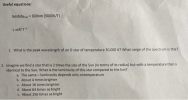 Useful equations: = 600nm (5000K/T) lambdamax L oCR2 T What is the peak wavelength of an O star of temperature 30,000 K? What range of the spectrum is this? 1. 2. Imagine we find a star that is 2 times the size of the Sun (in terms of its radius) but with a temperature that is identical to the Sun. What is the luminosity of this star compared to the Sun? a. The same -luminosity depends only ontemperature b. About...
The star Betelgeuse has a temperature only half that of the Sun but has 100,000 times...
The star Betelgeuse has a temperature only half that of the Sun but has 100,000 times the luminosity of the Sun. Using only this information, calculate the radius of the Betelgeuse in terms of the Sun's.
 Betelgeuse, a bright red star in the constellation Orion, has a luminosity that is 100,000 times that of the Sun However, the surface temperature of Betelgeuse is only 3000 K. Assuming that the emissivity of stars is 1, find the radius of Betelgeuse.
 Useful equations: = 600nm (5000K/T) lambdamax L oCR2 T What is the peak wavelength of an O star of temperature 30,000 K? What range of the spectrum is this? 1. 2. Imagine we find a star that is 2 times the size of the Sun (in terms of its radius) but with a temperature that is identical to the Sun. What is the luminosity of this star compared to the Sun? a. The same -luminosity depends only ontemperature b. About...
Most questions answered within 3 hours.
-
Where is the error in this code sequence?
String s1 = "Hello";
String s2 = "ello";...
asked 10 months ago -
Financial data for Joel de Paris, Inc., for last year
follow:
Joel de Paris, Inc.
Balance...
asked 10 months ago -
Consider this reaction:
Al2(SO4)3 (aq)+ BaCl3
(aq) Al2Cl6 (aq)- +
3BaSO4(s) . What is the...
asked 10 months ago -
Suppose that Savneet is considering increasing her
recent random sample from 20 car rentals to 40...
asked 10 months ago -
Trucks arrive at an unloading terminal at an average rate of 120
per hour.
Trucks arrive...
asked 10 months ago -
Why are methanol and ethanol completely soluble in water while
octanol is not very little soluble....
asked 10 months ago -
A facilities manager at a university reads in a research report
that the mean amount of...
asked 10 months ago -
When the CuSO4 is rehydrated by adding water to the anhydrous
compound, is this an endothermic...
asked 10 months ago -
A ray of sunlight is passing from diamond into crown glass; the
angle of incidence is...
asked 10 months ago -
A block of mass 0.249 kg is placed on top of a light, vertical
spring of...
asked 10 months ago -
how do the kidneys compensate in the presences of acidosis
a) trigger hyperventilate
b) reserve acid...
asked 10 months ago -
Question 501 pts
The rental rate of capital to the firm increases. Which of the
following...
asked 10 months ago