A 3.4-kg sphere is suspended by a cord that passes over a 1.2-kg pulley of radius...
A 3.4-kg sphere is suspended by a cord that passes over a 1.2-kg pulley of radius 3.4 cm. The cord is attached to a spring whose force constant is k = 86 N/m as in the figure below. Assume the pulley is a solid disk. An apparatus is shown with a wall extending upward from the left end of a table and a pulley mounted above the right edge of the table. A horizontal spring labeled k has its left end attached to a horizontal cord, the other end of which is attached to the wall. The center line of the spring is aligned with the top of the pulley. The right end of the spring is attached to a second cord. This cord extends horizontally, over the pulley and 90° around it where it hangs downward. A sphere of mass m hangs from the end of the second cord.
(a) If the sphere is released from rest with the spring
unstretched, what distance does the sphere fall through before
stopping?
_______m
(b) Find the speed of the sphere after it has fallen 25 cm.
________m/s
Homework Answers

Add Answer to:
A 3.4-kg sphere is suspended by a cord that passes over a 1.2-kg
pulley of radius...
A sphere of mass 3.4 × 10⁻⁴ kg is suspended from a cord. A steady horizontal...
A sphere of mass 3.4 × 10⁻⁴ kg is suspended from a cord. A steady horizontal breeze pushes the sphere so that the cord makes a constant angle of 31° with the vertical. Find (a) the magnitude of that push and (b) the tension in the cord.
A mass m hangs on the end of a cord around a pulley of radius a and moment of inertia I, rotating...
 A mass m hangs on the end of a cord around a pulley of radius a
and moment of inertia I, rotating
with an angular velocity w, as shown in the figure below. The rim
of the pulley is attached to a
spring (with constant k). Assume small oscillations so that the
spring remains essentially
horizontal and neglect friction so that the conservation of energy
of the system yields:
1/2mv^2 +1/2Iw^2+1/2kx^2-mgx=C,
where w=v/a, C=const, x+displacement from equilibrium
Find the natural...
A mass m hangs on the end of a cord around a pulley of radius a
and moment of inertia I, rotating
with an angular velocity w, as shown in the figure below. The rim
of the pulley is attached to a
spring (with constant k). Assume small oscillations so that the
spring remains essentially
horizontal and neglect friction so that the conservation of energy
of the system yields:
1/2mv^2 +1/2Iw^2+1/2kx^2-mgx=C,
where w=v/a, C=const, x+displacement from equilibrium
Find the natural...
A 3.00-kg object is fastened to a light spring, with the intervening cord passing over a...
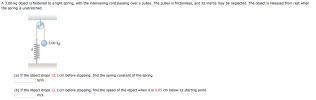 A 3.00-kg object is fastened to a light spring, with the intervening cord passing over a pulley. The pulley isfrictionless, and its inertia may be neglected. The object is released from rest when the spring is unstretched. (a) If the object drops 12.1 cm before stopping, find the spring constant of the spring. N/m (b) If the object drops 12.1 cm before stopping, find the speed of the object when it is 4.95 cm below its starting point. m/s
A block and sphere are connected by a cord that passes over a pulley as shown. Neglect friction and assume the cord is massless. Take m1 = 2.00 kg, m2 = 7.25 kg, and ? = 50.0°.
 A block and sphere are connected by a cord that passes over a pulley as shown. Neglect friction and assume the cord is massless. Take m1 = 2.00 kg, m2 = 7.25 kg, and ? = 50.0°.(a)What are the magnitude of acceleration (in m/s2) of the block and sphere?4.3 m/s2(b)What is the tension (in N) in the cord? (Enter the magnitude.) N(c)What is the speed (in m/s) of each object 1.75 s after being released from rest? m/s(d)What If? If the incline under m2 is rough, what is the minimum value of the coefficient of static friction ?s for which...
4, A uniform solid sphere of mass M 10.0 kg and radius R 0.50 m rotates...
 4, A uniform solid sphere of mass M 10.0 kg and radius R 0.50 m rotates about a vertical axis on frictionless bearings. A massless cord passes around the equator of the sphere, over a pulley of rotational inertia 1-1.60 kg. m2, and radius r = 0.40 m, and is attached to a block of mass m 8.00 kg which is released from rest. The cord does not slip on the sphere or pulley, and the pulley bearings are frictionless....
An green hoop with mass mh = 2.8 kg and radius Rh = 0.17 m hangs...
An green hoop with mass mh = 2.8 kg and radius Rh = 0.17 m hangs from a string that goes over a blue solid disk pulley with mass md = 2.4 kg and radius Rd = 0.08 m. The other end of the string is attached to a massless axel through the center of an orange sphere on a flat horizontal surface that rolls without slipping and has mass ms = 3.4 kg and radius Rs= 0.19 m. The...
Problem 17.78x Two cylinders are attached to the ends of a cord wnich passes over a...
 Problem 17.78x Two cylinders are attached to the ends of a cord wnich passes over a 35 lb pulley (disk) of radius, R 06 ft fixed at the point, O. The inextensible cord does not slip on the pulley. The cylinder on the nght has a weight of 8.5 lb while the cylinder on the left has a weight of 55 lb Neglect the mass of the cord Suggestiori. Analyze he Esyslem consisting of bolh the cylinders and the pulley....
5. Consider the system illustrated in the figure. The pulley with radius R and moment of...
 5. Consider the system illustrated in the figure. The pulley with radius R and moment of inertia I around its fixed axis is mounted on a frictionless axle which is fixed to the table. Th has one end fixed to the table, and the other end is attached to a massless inextensible rope. Th and a mass m hangs at its other end. Initially, the system is at rest e spring with stiffness constant k e rope passes over the...
Suppose you have a system of two masses strung over a pulley. Mass 1 (6.7 kg)...
Suppose you have a system of two masses strung over a pulley. Mass 1 (6.7 kg) hangs on the right side of the pulley suspended over the ground at height 0.8 m. Mass 2 (2.6 kg) hangs over the left side of the pulley and rests on the ground. The pulley is a uniform disk of mass m and radius 13.9 cm. When the system is released, Mass 1 moves down and Mass 2 moves up, such that Mass 1...
1) A rope of negligible mass passes over a uniform cylindrical pulley of 1.50 kg mass...
1) A rope of negligible mass passes over a uniform cylindrical pulley of 1.50 kg mass and 0.090 m radius. The bearings of the pulley have negligible friction, and the rope does not slip on the pulley. On one end of the rope hangs a 3.00 kg bunch of bananas, and on the other end hangs a 4.50 kg monkey. Calculate the downward acceleration of the monkey and the tension in both ends of the rope. 2) A 200 g...
 A mass m hangs on the end of a cord around a pulley of radius a
and moment of inertia I, rotating
with an angular velocity w, as shown in the figure below. The rim
of the pulley is attached to a
spring (with constant k). Assume small oscillations so that the
spring remains essentially
horizontal and neglect friction so that the conservation of energy
of the system yields:
1/2mv^2 +1/2Iw^2+1/2kx^2-mgx=C,
where w=v/a, C=const, x+displacement from equilibrium
Find the natural...
A mass m hangs on the end of a cord around a pulley of radius a
and moment of inertia I, rotating
with an angular velocity w, as shown in the figure below. The rim
of the pulley is attached to a
spring (with constant k). Assume small oscillations so that the
spring remains essentially
horizontal and neglect friction so that the conservation of energy
of the system yields:
1/2mv^2 +1/2Iw^2+1/2kx^2-mgx=C,
where w=v/a, C=const, x+displacement from equilibrium
Find the natural...
 A 3.00-kg object is fastened to a light spring, with the intervening cord passing over a pulley. The pulley isfrictionless, and its inertia may be neglected. The object is released from rest when the spring is unstretched. (a) If the object drops 12.1 cm before stopping, find the spring constant of the spring. N/m (b) If the object drops 12.1 cm before stopping, find the speed of the object when it is 4.95 cm below its starting point. m/s
 4, A uniform solid sphere of mass M 10.0 kg and radius R 0.50 m rotates about a vertical axis on frictionless bearings. A massless cord passes around the equator of the sphere, over a pulley of rotational inertia 1-1.60 kg. m2, and radius r = 0.40 m, and is attached to a block of mass m 8.00 kg which is released from rest. The cord does not slip on the sphere or pulley, and the pulley bearings are frictionless....
 Problem 17.78x Two cylinders are attached to the ends of a cord wnich passes over a 35 lb pulley (disk) of radius, R 06 ft fixed at the point, O. The inextensible cord does not slip on the pulley. The cylinder on the nght has a weight of 8.5 lb while the cylinder on the left has a weight of 55 lb Neglect the mass of the cord Suggestiori. Analyze he Esyslem consisting of bolh the cylinders and the pulley....
 5. Consider the system illustrated in the figure. The pulley with radius R and moment of inertia I around its fixed axis is mounted on a frictionless axle which is fixed to the table. Th has one end fixed to the table, and the other end is attached to a massless inextensible rope. Th and a mass m hangs at its other end. Initially, the system is at rest e spring with stiffness constant k e rope passes over the...
Most questions answered within 3 hours.
-
Where is the error in this code sequence?
String s1 = "Hello";
String s2 = "ello";...
asked 11 months ago -
Financial data for Joel de Paris, Inc., for last year
follow:
Joel de Paris, Inc.
Balance...
asked 11 months ago -
Consider this reaction:
Al2(SO4)3 (aq)+ BaCl3
(aq) Al2Cl6 (aq)- +
3BaSO4(s) . What is the...
asked 11 months ago -
Suppose that Savneet is considering increasing her
recent random sample from 20 car rentals to 40...
asked 11 months ago -
Trucks arrive at an unloading terminal at an average rate of 120
per hour.
Trucks arrive...
asked 11 months ago -
Why are methanol and ethanol completely soluble in water while
octanol is not very little soluble....
asked 11 months ago -
A facilities manager at a university reads in a research report
that the mean amount of...
asked 11 months ago -
When the CuSO4 is rehydrated by adding water to the anhydrous
compound, is this an endothermic...
asked 11 months ago -
A ray of sunlight is passing from diamond into crown glass; the
angle of incidence is...
asked 11 months ago -
A block of mass 0.249 kg is placed on top of a light, vertical
spring of...
asked 11 months ago -
how do the kidneys compensate in the presences of acidosis
a) trigger hyperventilate
b) reserve acid...
asked 11 months ago -
Question 501 pts
The rental rate of capital to the firm increases. Which of the
following...
asked 11 months ago