The kM of lactate dehydrogenase for 2-phenylethanol =0.025 mM and for 2-phenylpropane, kM=0.157 mM. Which is...
The kM of lactate dehydrogenase for 2-phenylethanol =0.025 mM and for 2-phenylpropane, kM=0.157 mM. Which is the preferred substrate?
Homework Answers

Add Answer to:
The kM of lactate dehydrogenase for 2-phenylethanol =0.025 mM
and for 2-phenylpropane, kM=0.157 mM. Which is...
please explain answer Regulation of Lactate dehydrogenase (same enzyme described above). Lactose dehydrogenase (LDH...
 please explain answer
Regulation of Lactate dehydrogenase (same enzyme described above). Lactose dehydrogenase (LDH) is a tetramer that can be regulated in several different ways. The crystal structure of the four subunits of lactate dehydrogenase is shown below. In the heart, lactose has a higher affinity for pyruvate than in the skeletal muscle. Analysis of LDH has identified that it is a substrate of FGFR tyrosine kinase, which results in an increase in the production of lactate. Some types of...
please explain answer
Regulation of Lactate dehydrogenase (same enzyme described above). Lactose dehydrogenase (LDH) is a tetramer that can be regulated in several different ways. The crystal structure of the four subunits of lactate dehydrogenase is shown below. In the heart, lactose has a higher affinity for pyruvate than in the skeletal muscle. Analysis of LDH has identified that it is a substrate of FGFR tyrosine kinase, which results in an increase in the production of lactate. Some types of...
Rate (0.025, 0.03, 0.0325, 0.0550, 0.0725) Substrate(10, 25, 50, 90, 150) it's in mM Enzyem is...
Rate (0.025, 0.03, 0.0325, 0.0550, 0.0725) Substrate(10, 25, 50, 90, 150) it's in mM Enzyem is Invertase, sucrose is substrate, DNS is used as indicator to measure ABS/OD. Professor said Km = 51.5 and Vm = 0.0739. Can you plot the Michaelis Menten and line-weaver burk and calculate the Vm and Km from each method. So far I can't get the data to match up. I can add the regression equation and absorbance for a standard glucose curve if needed.
I1. Mammals lack the enzyme a. Lactate dehydrogenase b. Pyruvate kinase Alcohol Dehydrogenase c. d. Pyruvate...
 I1. Mammals lack the enzyme a. Lactate dehydrogenase b. Pyruvate kinase Alcohol Dehydrogenase c. d. Pyruvate decarboxylase None of the above are correct e. 12. The first reaction of the Krebs cycle combines Oxaloacetate and Acetyl CoA to make Citrate b. a. Malate and NADH to make Citrate a-ketoglutarate and citrate to make CO2 d. c- Succinate and Citrate to make Oxaloacetate 13. The electrons held by NADH and FADH, are donated to the which complexes in the ETC respectively?...
QUESTION 6 Which of the following statements is false? A An enzyme's Km is the concentration...
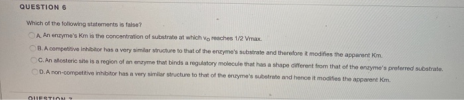 QUESTION 6 Which of the following statements is false? A An enzyme's Km is the concentration of substrate at which Voreaches 1/2 Vmax. B. A competitive inhibitor has a very similar structure to that of the enzyme's substrate and therefore it modifies the apparent Km. C. An Nlosteric site is a region of an enzyme that binds a regulatory molecule that has a shape different from that of the enzyme's preferred substrate. D. A non-competitive inhibitor has a very similar...
Read "Malate dehydrogenase: A model for structure, evolution, and catalysis" 1. Looking at Figure 1, to...
Read "Malate dehydrogenase: A model for structure, evolution, and catalysis" 1. Looking at Figure 1, to which form of MDH is LDH most closely related? Give your reasoning in each case: a. cytoplasmic MDH or archaeal MDH b. mitochondrial MDH or cytoplasmic MDH 2. The sequences of MDH from various organisms aren't very similar, however their structures are very similar. List 3 characteristics of their structures that are conserved: a. b. c. 3. What suggests that MDH and LDH use...
54. What is the catalyze reaction rate? Km=2 mM Kcat= 3 s-1 At the enzyme concentration=10...
54. What is the catalyze reaction rate? Km=2 mM Kcat= 3 s-1 At the enzyme concentration=10 nM and substrate concentration= 3 mM
4. Which of the following enzymes catalyzed reactions in glycolysis require(s) ATP as a substrate? A)...
 4. Which of the following enzymes catalyzed reactions in glycolysis require(s) ATP as a substrate? A) Phosphoglycerate mutase E) Pyruvate kinase B) Aldolase F) Phosphofructokinase-1 C) Phosphoglycerate kinase G) Hexokinase D) Glyceraldehyde-3-phosphate dehydrogenase 5. Blood Lactate Levels during Vigorous Exercise The following graph shows the concentrations of lactate in blood plasma before, during, and after a 400 m sprint. Use your knowledge from chapter 14 to explain the causes of the rapid rise in lactate concentration? --Before-- - After Blood...
CI OD 17) Human alcohol dehydrogenase is capable of oxidizing several substrates besides ethanol. The kinetic...
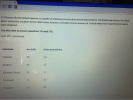 CI OD 17) Human alcohol dehydrogenase is capable of oxidizing several substrates besides ethanol. The kinetic parameters for these other substrates are given in the table below. Assume a constant enzyme amount of 1 mmol when these experimental values were obtained Use this table to answer questions 17a and 17b. note:UM = micromolar Substrate Km (UM) Vmax (mmol/min) Hexanol Butanol Ethylene Glycol Methanol Propanol UTA 17a) Which is the most preferred substrate according to these values? Question 33 4 pts...
2) (5 marks) The enzyme Happyase follows simple Michaelis – Menten Kinetics a. The Km of...
2) (5 marks) The enzyme Happyase follows simple Michaelis – Menten Kinetics a. The Km of Happyase for its substrate ICE is Km^s = 1mM. Happyase also acts on substrate CREAM and its Km^T =10mM. Is ICE or CREAM the preferred substrate for Happyase? Explain b. The rate constant k2 with substrate ICE is 2x10^4sec^ -1; with substrate CREAM, k2=4x10^5sec ^-1. Does Happyase use substrate ICE or substrate CREAM with greater catalytic efficiency? Show calculations and explain your answer
Alcohol dehydrogenase detoxifies ethanol in two steps. First, ethanol is oxidized to acetaldehyde, which is coupled...
 Alcohol dehydrogenase detoxifies ethanol in two steps. First, ethanol is oxidized to acetaldehyde, which is coupled with the reduction of NAD' to NADH. Second, acetaldehyde is oxidized to acetate, which process also produces an NADH molecule. Under anaerobic conditions, muscle cells needing extra energy couple the reduction of pyruvate to lactate with the oxidation of NADH to NAD*. The NAD is then shuttled to the anaerobic glycolysis reactions which produce a small amount of ATP. One common side effect of...
 please explain answer
Regulation of Lactate dehydrogenase (same enzyme described above). Lactose dehydrogenase (LDH) is a tetramer that can be regulated in several different ways. The crystal structure of the four subunits of lactate dehydrogenase is shown below. In the heart, lactose has a higher affinity for pyruvate than in the skeletal muscle. Analysis of LDH has identified that it is a substrate of FGFR tyrosine kinase, which results in an increase in the production of lactate. Some types of...
please explain answer
Regulation of Lactate dehydrogenase (same enzyme described above). Lactose dehydrogenase (LDH) is a tetramer that can be regulated in several different ways. The crystal structure of the four subunits of lactate dehydrogenase is shown below. In the heart, lactose has a higher affinity for pyruvate than in the skeletal muscle. Analysis of LDH has identified that it is a substrate of FGFR tyrosine kinase, which results in an increase in the production of lactate. Some types of...
 I1. Mammals lack the enzyme a. Lactate dehydrogenase b. Pyruvate kinase Alcohol Dehydrogenase c. d. Pyruvate decarboxylase None of the above are correct e. 12. The first reaction of the Krebs cycle combines Oxaloacetate and Acetyl CoA to make Citrate b. a. Malate and NADH to make Citrate a-ketoglutarate and citrate to make CO2 d. c- Succinate and Citrate to make Oxaloacetate 13. The electrons held by NADH and FADH, are donated to the which complexes in the ETC respectively?...
 QUESTION 6 Which of the following statements is false? A An enzyme's Km is the concentration of substrate at which Voreaches 1/2 Vmax. B. A competitive inhibitor has a very similar structure to that of the enzyme's substrate and therefore it modifies the apparent Km. C. An Nlosteric site is a region of an enzyme that binds a regulatory molecule that has a shape different from that of the enzyme's preferred substrate. D. A non-competitive inhibitor has a very similar...
 4. Which of the following enzymes catalyzed reactions in glycolysis require(s) ATP as a substrate? A) Phosphoglycerate mutase E) Pyruvate kinase B) Aldolase F) Phosphofructokinase-1 C) Phosphoglycerate kinase G) Hexokinase D) Glyceraldehyde-3-phosphate dehydrogenase 5. Blood Lactate Levels during Vigorous Exercise The following graph shows the concentrations of lactate in blood plasma before, during, and after a 400 m sprint. Use your knowledge from chapter 14 to explain the causes of the rapid rise in lactate concentration? --Before-- - After Blood...
 CI OD 17) Human alcohol dehydrogenase is capable of oxidizing several substrates besides ethanol. The kinetic parameters for these other substrates are given in the table below. Assume a constant enzyme amount of 1 mmol when these experimental values were obtained Use this table to answer questions 17a and 17b. note:UM = micromolar Substrate Km (UM) Vmax (mmol/min) Hexanol Butanol Ethylene Glycol Methanol Propanol UTA 17a) Which is the most preferred substrate according to these values? Question 33 4 pts...
 Alcohol dehydrogenase detoxifies ethanol in two steps. First, ethanol is oxidized to acetaldehyde, which is coupled with the reduction of NAD' to NADH. Second, acetaldehyde is oxidized to acetate, which process also produces an NADH molecule. Under anaerobic conditions, muscle cells needing extra energy couple the reduction of pyruvate to lactate with the oxidation of NADH to NAD*. The NAD is then shuttled to the anaerobic glycolysis reactions which produce a small amount of ATP. One common side effect of...
Most questions answered within 3 hours.
-
Where is the error in this code sequence?
String s1 = "Hello";
String s2 = "ello";...
asked 11 months ago -
Financial data for Joel de Paris, Inc., for last year
follow:
Joel de Paris, Inc.
Balance...
asked 11 months ago -
Consider this reaction:
Al2(SO4)3 (aq)+ BaCl3
(aq) Al2Cl6 (aq)- +
3BaSO4(s) . What is the...
asked 11 months ago -
Suppose that Savneet is considering increasing her
recent random sample from 20 car rentals to 40...
asked 11 months ago -
Trucks arrive at an unloading terminal at an average rate of 120
per hour.
Trucks arrive...
asked 11 months ago -
Why are methanol and ethanol completely soluble in water while
octanol is not very little soluble....
asked 11 months ago -
A facilities manager at a university reads in a research report
that the mean amount of...
asked 11 months ago -
When the CuSO4 is rehydrated by adding water to the anhydrous
compound, is this an endothermic...
asked 11 months ago -
A ray of sunlight is passing from diamond into crown glass; the
angle of incidence is...
asked 11 months ago -
A block of mass 0.249 kg is placed on top of a light, vertical
spring of...
asked 11 months ago -
how do the kidneys compensate in the presences of acidosis
a) trigger hyperventilate
b) reserve acid...
asked 11 months ago -
Question 501 pts
The rental rate of capital to the firm increases. Which of the
following...
asked 11 months ago