What is the likely results of running the following code fragment? Why? int *ptr = (int...
- What is the likely results of running the following code fragment? Why? int *ptr = (int *) 0xfeedbeef ; *ptr = 0 ;
- Suppose a class uses a dynamically-allocated integer array, pointed to by an int* variable named data. The current capacity of the array is stored in the integer variable capacity. The following code fragment is meant to dyamically resize the array, doubling its capacity. What is the major memory error and how would you detect it? int *tmp = new int[2 * capacity] ; for (int i = 0; i < capacity; i++) { tmp[i] = data[i] ; } data = tmp ; capacity = 2 * capactiy ;
Homework Answers
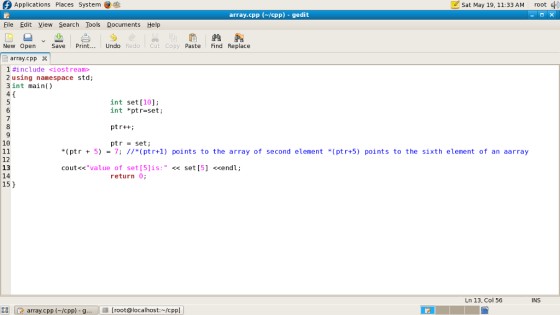
#include <iostream>
using namespace std;
int main()
{
int set[10];
int *ptr=set;
ptr++;
ptr = set;
*(ptr + 5) = 7; //*(ptr+1) points to the array of second element
*(ptr+5) points to the sixth element of an aarray
cout<<"value of set[5]is:" << set[5]
<<endl;
return 0;
}
*****************
ptr = set;
*(ptr + 5) = 7; //*(ptr+1) points to the array of second element
*(ptr+5) points to the sixth element of an aarray
cout<<"value of set[5]is:" << set[5]
<<endl;
this is the statements required to run the code.
*****************
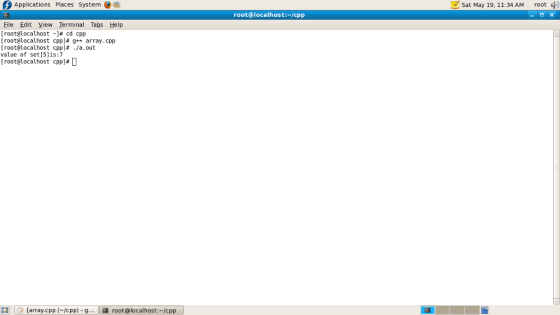
Output::
Add Answer to:
What is the likely results of running the following code
fragment? Why? int *ptr = (int...
Write the code to dynamically allocate ONE integer variable using calloc (contiguous allocation) or malloc (memory...
Write the code to dynamically allocate ONE integer variable using calloc (contiguous allocation) or malloc (memory allocation) and have it pointed to by a pointer (of type int * ) named ptr_1. Use ptr_1 to assign the number 7 to that dynamically allocated integer, and in another line use printf to output the contents of that dynamically allocated integer variable. Write the code to dynamically allocate an integer array of length 5 using calloc or malloc and have it pointed...
Using C programming
Using C, create a data file with the first number being an integer. The value of that integer will be the number of further integers which follow it in the file. Write the code to read the first number into the integer variable how_many.Please help me with the file :((This comes from this question:Write the code to dynamically allocate ONE integer variable using calloc (contiguous allocation) or malloc (memory allocation) and have it pointed to by a pointer (of type int...
5. (10%) Consider the following C code segment: int fun (int a, int b) { static...
 5. (10%) Consider the following C code segment: int fun (int a, int b) { static int count; int x, *p; x= a +b; p-malloc (sizeof (int)); a) What is the lifetime of the variable count? b) What is the scope of the variable count? c) Which part of memory is the storage allocated for x? d) What is the lifetime of the variable x? e) Which part of memory is the storage allocated for the integer pointed to by...
EX 1) Determine the outcome of the following code fragment without writing and running the program....
EX 1) Determine the outcome of the following code fragment without writing and running the program. int num = 0, max = 20; while (num <= max) { System.out.println(num); num += 4; } EX 2) Write a code fragment that reads and prints integer values entered by user until a particular sentinel value (stored in constant SENTINEL) is entered. Do not print the sentinel value. Ex 3) Write a method called averageLargestTwo that accepts three int parameters and returns the average...
TRUE/FALSE 1. If pl is an integer pointer variable, with the value of 1000, pl++ changes...
 TRUE/FALSE 1. If pl is an integer pointer variable, with the value of 1000, pl++ changes P1 to point to the memory location 1001. ANSWER: T 2. When you return a dynamic array to the freestore, you must include the number of elements in the array 3. You can assign an array to a pointer variable. 4. The size of dynamic arrays must be declared at compile time. 5. int *pl; declares a static variable. ANSWER: F ANSWER: F ANSWER:...
Question 31 -Given the following code fragment, what value is contained in myArr[O]? const int ARRAYSIZE...
 Question 31 -Given the following code fragment, what value is contained in myArr[O]? const int ARRAYSIZE 3 double() myArr new double [ARRAYSIZE] myArr [0]1.1 myArr [1]2.2; myArr [2] myArr [0] myArr[1 O3.3 2.2 O 1.1 0 Question 32 - Given the following code fragment, what is displayed in IblResult? const int ARRAYSIZE 3 double(] myArr - new double [ARRAYSIZE] myArr [0] - 1.1 myArr [1] 2.2 lblResult.Text - Convert.Tostring (myArr (01) 3.3 O 2.2 1.1 0 Question 33 - Given...
What does the following code fragment print? Explain the result? int [] a = new int[10];...
What does the following code fragment print? Explain the result? int [] a = new int[10]; for (int i = 0; i < 10; i++) a[i] = 9 - i; for (int i = 0; i < 10; i++) a[i] = a[a[i]]; for (int i = 0; i < 10; i++) System.out.println(a[i]);
What is the purpose of the new operator? Select one: a. It is used to allocate...
What is the purpose of the new operator? Select one: a. It is used to allocate memory for variables at runtime. b. It is used to declare a new function. c. It is used to initialize class member variables. d. It is used to start a new program. e. It allows new operators to be created. Question 2 Not yet answered Scored out of 1.00 Flag question Question text Under what circumstances can you successfully return a pointer from a...
Memory Consider a process running the following program #include estdlib.h> #include #define const char* int int...
 Memory Consider a process running the following program #include estdlib.h> #include #define const char* int int <stdio.h> TO PRINT toPrintCPtr "Good luck!" TO PRINT; main for (i -0; i < sizeof (TO PRINT)-1; i++) printf("%c %c\n", toPrintCPt r [1], toupper(toPrintCPt r [i])); return(EXIT SUCCESS); Please tell where the following objects are stored in memory. Your choices are a. ROM BIOS b. kernal Memory (the OS) c. shared library memory (the glibc library) d. .text segment e. .rodata segment f. .data...
Using MIPS: Consider the following fragment of C code: for i=0: i < = 100: i...
 Using MIPS:
Consider the following fragment of C code: for i=0: i < = 100: i = i + 1) {a[i] = b[i] + c;} Assume that a and bare arrays of words and the base address of a is in $a0 and the base address of b is in $a1. Register $t0 is associated with variable i and register $s0 with c. Write the code for MIPS. How many instructions are executed during the running of this code? How...
Using MIPS:
Consider the following fragment of C code: for i=0: i < = 100: i = i + 1) {a[i] = b[i] + c;} Assume that a and bare arrays of words and the base address of a is in $a0 and the base address of b is in $a1. Register $t0 is associated with variable i and register $s0 with c. Write the code for MIPS. How many instructions are executed during the running of this code? How...
 5. (10%) Consider the following C code segment: int fun (int a, int b) { static int count; int x, *p; x= a +b; p-malloc (sizeof (int)); a) What is the lifetime of the variable count? b) What is the scope of the variable count? c) Which part of memory is the storage allocated for x? d) What is the lifetime of the variable x? e) Which part of memory is the storage allocated for the integer pointed to by...
 TRUE/FALSE 1. If pl is an integer pointer variable, with the value of 1000, pl++ changes P1 to point to the memory location 1001. ANSWER: T 2. When you return a dynamic array to the freestore, you must include the number of elements in the array 3. You can assign an array to a pointer variable. 4. The size of dynamic arrays must be declared at compile time. 5. int *pl; declares a static variable. ANSWER: F ANSWER: F ANSWER:...
 Question 31 -Given the following code fragment, what value is contained in myArr[O]? const int ARRAYSIZE 3 double() myArr new double [ARRAYSIZE] myArr [0]1.1 myArr [1]2.2; myArr [2] myArr [0] myArr[1 O3.3 2.2 O 1.1 0 Question 32 - Given the following code fragment, what is displayed in IblResult? const int ARRAYSIZE 3 double(] myArr - new double [ARRAYSIZE] myArr [0] - 1.1 myArr [1] 2.2 lblResult.Text - Convert.Tostring (myArr (01) 3.3 O 2.2 1.1 0 Question 33 - Given...
 Memory Consider a process running the following program #include estdlib.h> #include #define const char* int int <stdio.h> TO PRINT toPrintCPtr "Good luck!" TO PRINT; main for (i -0; i < sizeof (TO PRINT)-1; i++) printf("%c %c\n", toPrintCPt r [1], toupper(toPrintCPt r [i])); return(EXIT SUCCESS); Please tell where the following objects are stored in memory. Your choices are a. ROM BIOS b. kernal Memory (the OS) c. shared library memory (the glibc library) d. .text segment e. .rodata segment f. .data...
 Using MIPS:
Consider the following fragment of C code: for i=0: i < = 100: i = i + 1) {a[i] = b[i] + c;} Assume that a and bare arrays of words and the base address of a is in $a0 and the base address of b is in $a1. Register $t0 is associated with variable i and register $s0 with c. Write the code for MIPS. How many instructions are executed during the running of this code? How...
Using MIPS:
Consider the following fragment of C code: for i=0: i < = 100: i = i + 1) {a[i] = b[i] + c;} Assume that a and bare arrays of words and the base address of a is in $a0 and the base address of b is in $a1. Register $t0 is associated with variable i and register $s0 with c. Write the code for MIPS. How many instructions are executed during the running of this code? How...
Most questions answered within 3 hours.
-
Where is the error in this code sequence?
String s1 = "Hello";
String s2 = "ello";...
asked 11 months ago -
Financial data for Joel de Paris, Inc., for last year
follow:
Joel de Paris, Inc.
Balance...
asked 11 months ago -
Consider this reaction:
Al2(SO4)3 (aq)+ BaCl3
(aq) Al2Cl6 (aq)- +
3BaSO4(s) . What is the...
asked 11 months ago -
Suppose that Savneet is considering increasing her
recent random sample from 20 car rentals to 40...
asked 11 months ago -
Trucks arrive at an unloading terminal at an average rate of 120
per hour.
Trucks arrive...
asked 11 months ago -
Why are methanol and ethanol completely soluble in water while
octanol is not very little soluble....
asked 11 months ago -
A facilities manager at a university reads in a research report
that the mean amount of...
asked 11 months ago -
When the CuSO4 is rehydrated by adding water to the anhydrous
compound, is this an endothermic...
asked 11 months ago -
A ray of sunlight is passing from diamond into crown glass; the
angle of incidence is...
asked 11 months ago -
A block of mass 0.249 kg is placed on top of a light, vertical
spring of...
asked 11 months ago -
how do the kidneys compensate in the presences of acidosis
a) trigger hyperventilate
b) reserve acid...
asked 11 months ago -
Question 501 pts
The rental rate of capital to the firm increases. Which of the
following...
asked 11 months ago