Data structures: Assume we have a stack named s. What will be the values stored in...
Data structures:
Assume we have a stack named s. What will be the values stored in s after the following operations(from bottom to top)?
s.push(1);
s.push(5);
s.push(6);
s.pop();
s.push(3);
s.push(4);
s.push(8);
s.pop();
s.pop();
Homework Answers
s.push(1);  ->  stack is [1] with 1 at top.
s.push(5);  ->  stack is [1, 5] with 5 at top.
s.push(6);  ->  stack is [1, 5, 6] with 6 at top.
s.pop();    ->  stack is [1, 5] with 5 at top.
s.push(3);  ->  stack is [1, 5, 3] with 3 at top.
s.push(4);  ->  stack is [1, 5, 3, 4] with 4 at top.
s.push(8);  ->  stack is [1, 5, 3, 4, 8] with 8 at top.
s.pop();    ->  stack is [1, 5, 3, 4] with 4 at top.
s.pop();    ->  stack is [1, 5, 3] with 3 at top.

What will be the values stored in s after the following operations(from bottom to top)?
Answer: [1, 5, 3] with 3 at top.
Add Answer to:
Data structures:
Assume we have a stack named s. What will be the values stored
in...
A stack S of integers initially contains the following data: 6 (top) 2 7 3 The...
A stack S of integers initially contains the following data: 6 (top) 2 7 3 The following code is then executed: int x = S.pop(); int y = S.pop(); int z = S.pop(); S.push(x + y); int w = S.pop(); S.push(w + z); After this code has been executed, what are the contents of the stack? A. 8 10 B. 10 8 C. 15 3 D. 10 8 6 3
stack.h template class Stack{ public: Stack(int max = 10); ~Stack() {delete [] stack;} bool isEmpty() const...
stack.h template class Stack{ public: Stack(int max = 10); ~Stack() {delete [] stack;} bool isEmpty() const { return top == -1; } bool isFull() const { return top == MaxStackSize; } T peek() const; void push(const T& x); void pop(); private: int top; int MaxTop; T * stack; } source.cpp What is printed by the following program segment? Stack s; int n; s.push(4); s.push(6); s.push(8); while(!s.isEmpty()) { n = s.peek(); cout << n << ‘ ‘; s.pop(); } cout<< endl;...
Given an empty stack s, an input array a = {1,2,3,4}. What is printed when the...
Given an empty stack s, an input array a = {1,2,3,4}. What is printed when the following function is executed? public void pushAndPop(Stack s, int[] a){ s.push(a[0]); s.push(a[1]); System.out.println(s.pop()); s.push(a[2]); System.out.println(s.pop()); s.push(a[3]); System.out.println(s.pop()); System.out.println(s.pop()); } A.2, 1, 4, 3 B.2, 3, 1, 4 C.1, 2, 3, 4 D.2, 3, 4, 1
C++ Data structures and Algorithms Use a Queue to reverse a stack in place. Assume you...
C++ Data structures and Algorithms Use a Queue to reverse a stack in place. Assume you are given a stack of string values like Stack s; using a Queue, cause all of the items in the stack to be reversed. For example, if you have the following contents on the stack s Top --- bird cat dog turtle ----- Bottom After you run your code, you stack contents should look like Top --- turtle dog cat bird ----- Bottom
Must be written in C++ Please Lab 11 Due Date: April 25, 2019 Total Points: 15...
 Must be written in C++ Please
Lab 11 Due Date: April 25, 2019 Total Points: 15 points The purpose of this lab is to implement and test a static and dy namic stack Part 1: Static Stack In this part, you are going to design a stack of characters. Assume a simple static array implementation. Complete the code below as specified by the comments below const int MAX- 5 // define an alias for the element type class Stack private:...
Must be written in C++ Please
Lab 11 Due Date: April 25, 2019 Total Points: 15 points The purpose of this lab is to implement and test a static and dy namic stack Part 1: Static Stack In this part, you are going to design a stack of characters. Assume a simple static array implementation. Complete the code below as specified by the comments below const int MAX- 5 // define an alias for the element type class Stack private:...
Collections (a) What are generic types and what is their importance in ADTs for collections? (b)...
 Collections (a) What are generic types and what is their importance in ADTs for collections? (b) How are the ADTS of stacks and queues similar? How does their behaviour differ? (c) What is the difference between a static and a dynamic data structure? Why are static structures such as arrays often used in the background for dynamic data structures (e.g., in Java's ArrayList)? What issues does this raise and how are they generally resolved? (d) Suppose the following fragment occurs...
What is the output from running the following code snippet. void mystery(Queue<int>& q) { Stack<int> s;...
What is the output from running the following code snippet. void mystery(Queue<int>& q) { Stack<int> s; while (!s.isEmptyQueue()) { s.push(q.front()); q.deleteQueue(); } while (!s.isEmptyStack()) { q.addQueue(2 * s.top()); s.pop(); } } Queue q; q.addQueue(8); q.addQueue(4); q.addQueue(18); q.addQueue(7); q.addQueue(5); mystery(q); cout << "["; while (!.isEmptyQueue()) { cout << " " << q.front(); } cout << " ]" << endl;
help finish Queue, don't think I have the right thing. # 1. After studying the Stack...
 help finish Queue, don't think
I have the right thing.
# 1. After studying the Stack class and testStack() functions in stack.py # complete the Queue class below (and test it with the testQueue function) # # 2. Afer studying and testing the Circle class in circle.py, # complete the Rectangle class below (and test it with the testRectangle function) # # # 3. SUBMIT THIS ONE FILE, with your updates, TO ICON. # # # NOTE: you may certainly...
help finish Queue, don't think
I have the right thing.
# 1. After studying the Stack class and testStack() functions in stack.py # complete the Queue class below (and test it with the testQueue function) # # 2. Afer studying and testing the Circle class in circle.py, # complete the Rectangle class below (and test it with the testRectangle function) # # # 3. SUBMIT THIS ONE FILE, with your updates, TO ICON. # # # NOTE: you may certainly...
In C++ Implement a queue data structure using two stacks. Remember a queue has enqueue and...
In C++ Implement a queue data structure using two stacks. Remember a queue has enqueue and dequeue functions. You could use either the array or linked list implementation for stacks and queues. Source for stack array: --------------------------------------------------- #include<iostream> #define SIZE 100 #define NO_ELEMENT -999999 using namespace std; class Stack { int arr[SIZE]; // array to store Stack elements int top; public: Stack() { top = -1; } void push(int); // push an element into Stack int pop(); // pop the...
Data Structures and Algorithm Analysis illustrate the result of each operation in the sequence PUSH(S, 4),...
 Data Structures and Algorithm Analysis
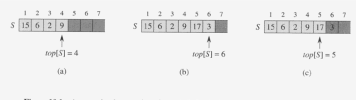
illustrate the result of each operation in the sequence PUSH(S,
4), PUSH(S, 2), POP(), PUSH(S, 3), PUSH(S, 9), POP(), and PUSH(S,
0) on an initially empty stack S stored in array S[1..6].
1 2 3 4 5 6 7 1 2 3 4 5 6 7 15 6 2 9 17 3 S15 6 29 173 top[S] = 4 top[S] = 6 top[S] = 5
Data Structures and Algorithm Analysis
illustrate the result of each operation in the sequence PUSH(S,
4), PUSH(S, 2), POP(), PUSH(S, 3), PUSH(S, 9), POP(), and PUSH(S,
0) on an initially empty stack S stored in array S[1..6].
1 2 3 4 5 6 7 1 2 3 4 5 6 7 15 6 2 9 17 3 S15 6 29 173 top[S] = 4 top[S] = 6 top[S] = 5
 Must be written in C++ Please
Lab 11 Due Date: April 25, 2019 Total Points: 15 points The purpose of this lab is to implement and test a static and dy namic stack Part 1: Static Stack In this part, you are going to design a stack of characters. Assume a simple static array implementation. Complete the code below as specified by the comments below const int MAX- 5 // define an alias for the element type class Stack private:...
Must be written in C++ Please
Lab 11 Due Date: April 25, 2019 Total Points: 15 points The purpose of this lab is to implement and test a static and dy namic stack Part 1: Static Stack In this part, you are going to design a stack of characters. Assume a simple static array implementation. Complete the code below as specified by the comments below const int MAX- 5 // define an alias for the element type class Stack private:...
 Collections (a) What are generic types and what is their importance in ADTs for collections? (b) How are the ADTS of stacks and queues similar? How does their behaviour differ? (c) What is the difference between a static and a dynamic data structure? Why are static structures such as arrays often used in the background for dynamic data structures (e.g., in Java's ArrayList)? What issues does this raise and how are they generally resolved? (d) Suppose the following fragment occurs...
 help finish Queue, don't think
I have the right thing.
# 1. After studying the Stack class and testStack() functions in stack.py # complete the Queue class below (and test it with the testQueue function) # # 2. Afer studying and testing the Circle class in circle.py, # complete the Rectangle class below (and test it with the testRectangle function) # # # 3. SUBMIT THIS ONE FILE, with your updates, TO ICON. # # # NOTE: you may certainly...
help finish Queue, don't think
I have the right thing.
# 1. After studying the Stack class and testStack() functions in stack.py # complete the Queue class below (and test it with the testQueue function) # # 2. Afer studying and testing the Circle class in circle.py, # complete the Rectangle class below (and test it with the testRectangle function) # # # 3. SUBMIT THIS ONE FILE, with your updates, TO ICON. # # # NOTE: you may certainly...
 Data Structures and Algorithm Analysis
illustrate the result of each operation in the sequence PUSH(S,
4), PUSH(S, 2), POP(), PUSH(S, 3), PUSH(S, 9), POP(), and PUSH(S,
0) on an initially empty stack S stored in array S[1..6].
1 2 3 4 5 6 7 1 2 3 4 5 6 7 15 6 2 9 17 3 S15 6 29 173 top[S] = 4 top[S] = 6 top[S] = 5
Data Structures and Algorithm Analysis
illustrate the result of each operation in the sequence PUSH(S,
4), PUSH(S, 2), POP(), PUSH(S, 3), PUSH(S, 9), POP(), and PUSH(S,
0) on an initially empty stack S stored in array S[1..6].
1 2 3 4 5 6 7 1 2 3 4 5 6 7 15 6 2 9 17 3 S15 6 29 173 top[S] = 4 top[S] = 6 top[S] = 5
Most questions answered within 3 hours.
-
Where is the error in this code sequence?
String s1 = "Hello";
String s2 = "ello";...
asked 11 months ago -
Financial data for Joel de Paris, Inc., for last year
follow:
Joel de Paris, Inc.
Balance...
asked 11 months ago -
Consider this reaction:
Al2(SO4)3 (aq)+ BaCl3
(aq) Al2Cl6 (aq)- +
3BaSO4(s) . What is the...
asked 11 months ago -
Suppose that Savneet is considering increasing her
recent random sample from 20 car rentals to 40...
asked 11 months ago -
Trucks arrive at an unloading terminal at an average rate of 120
per hour.
Trucks arrive...
asked 11 months ago -
Why are methanol and ethanol completely soluble in water while
octanol is not very little soluble....
asked 11 months ago -
A facilities manager at a university reads in a research report
that the mean amount of...
asked 11 months ago -
When the CuSO4 is rehydrated by adding water to the anhydrous
compound, is this an endothermic...
asked 11 months ago -
A ray of sunlight is passing from diamond into crown glass; the
angle of incidence is...
asked 11 months ago -
A block of mass 0.249 kg is placed on top of a light, vertical
spring of...
asked 11 months ago -
how do the kidneys compensate in the presences of acidosis
a) trigger hyperventilate
b) reserve acid...
asked 11 months ago -
Question 501 pts
The rental rate of capital to the firm increases. Which of the
following...
asked 11 months ago