What will be printed by the code below What will be printed by the code below...
What will be printed by the code below
What will be printed by the code below
#include <iostream>
using namespace std;
class A {
public:
A() {cout << "+1";}
~A() {cout << "-1";}
};
class B: public A {
public:
B() {cout << "+2";}
~B() {cout << "-2";}
};
class C: public B {
publc:
C() {cout << "+3";}
~C() {cout << "-3";}
};
int main() {
A a1;
B b1;
A *a2 = new A;
B *b2; = new B;
delete a2;
delete b2;
return 0;
}
Homework Answers
#include <iostream>
using namespace std;
class A {
public:
A() {cout << "+1";}
~A() {cout << "-1";}
};
class B: public A {
public:
B() {cout << "+2";}
~B() {cout << "-2";}
};
class C: public B {
public:
C() {cout << "+3";}
~C() {cout << "-3";}
};
int main() {
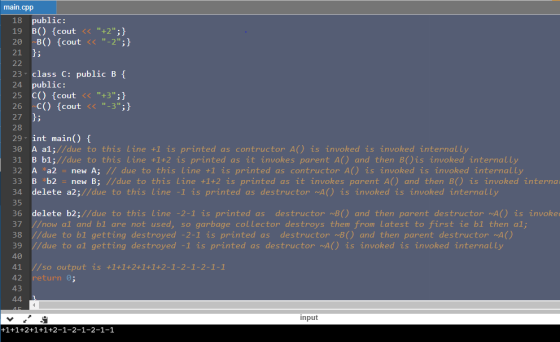
A a1;//due to this line +1 is printed as contructor A() is invoked
is invoked internally
B b1;//due to this line +1+2 is printed as it invokes parent A()
and then B()is invoked internally
A *a2 = new A; // due to this line +1 is printed as contructor A()
is invoked is invoked internally
B *b2 = new B; //due to this line +1+2 is printed as it invokes
parent A() and then B() is invoked internally
delete a2;//due to this line -1 is printed as destructor ~A() is
invoked is invoked internally
delete b2;//due to this line -2-1 is printed as destructor ~B()
and then parent destructor ~A() is invoked internally
//now a1 and b1 are not used, so garbage collector destroys them
from latest to first ie b1 then a1;
//due to b1 getting destroyed -2-1 is printed as destructor ~B()
and then parent destructor ~A()
//due to a1 getting destroyed -1 is printed as destructor ~A() is
invoked is invoked internally
//so output is +1+1+2+1+1+2-1-2-1-2-1-1
return 0;
}
Add Answer to:
What will be printed by the code below
What will be printed by the code below...
What is printed by the following program? (read the code carefully) #include <iostream> using namespace std;...
What is printed by the following program? (read the code carefully) #include <iostream> using namespace std; class A { public: int x; }; int main() { A *a = new A; A *b = new A; a->x=1; b->x=1; if (a == b) { cout << "black"; } else { cout << "white"; } delete a; delete b; return 0; }
Redesign your Array class from lab6 as a class template to work with the application below....
Redesign your Array class from lab6 as a class template to work with the application below. write your overloaded output stream operator as an inline friend method in the class declaration. Include the class template header file in your application as below. #include "Array.h" main() { Array<char> c(3); c.setValue(0,'c'); c.setValue(1,'s'); c.setValue(2,'c'); cout << c; Array<int> i(3); i.setValue(0,1); i.setValue(1,2); i.setValue(2,5); cout << i; Array<int> j(3); j.setValue(0,10); j.setValue(1,20); j.setValue(2,50); cout << j; Array<int> ij; ij = i + j; cout << ij;...
There are many problems with the program below. Describe 5 of these problems in detail. For...
There are many problems with the program below. Describe 5 of these problems in detail. For each, also explain how you could fix or avoid the issue. #include <iostream> using namespace std; class Duck { public: virtual void quack() { cout << "Quack" << endl; } }; class RubberDuck : public Duck { public: RubberDuck() { array = NULL; } RubberDuck(int size) { array = new int[size]; array[0] = 1; array[1] = 2; array[2] = 3; } ~RubberDuck() { delete...
2. What is the value of x alter the following code is executed # include<iostream> using...
 2. What is the value of x alter the following code is executed # include<iostream> using namespace std; int main int t-0, c- 0,x-3; while (c < 4) t=t+x; cout << x return 0; a) 3 b) 21 c) 24 d) 48 3. What is the output of the following code? # include<iostream> using namespace std; int main0 int a- 3; for (int i 5; i >0; i) a a+i cout << a << “ “ return 0; d) 8...
5. What’s wrong with the code below? Feel free to compile and run the program to...
5. What’s wrong with the code below? Feel free to compile and run the program to investigate. [6] #include <iostream> using namespace std; class HW1 { public: char *word; HW1() { } ~HW1() { delete [] word; } }; void foo(HW1 a) { //some operation here } int main() { HW1 a; a.word = new char[80]; strcpy(a.word, "abc"); foo(a); return 0; }
UUS TOP Question 17: What is the output of the code presented below? int y =...
 UUS TOP Question 17: What is the output of the code presented below? int y = 5; int x 7; intx yPtr = &x; *yPtr = 8 + 4 * 6/2 + ( 5 cout<oxyPtr; *yPtr = *yPtr + *yPtr / 2; cout<<xyPtr; 2 ); Question 18: The following is true about the code below. Tine Time: 1 SetMinute(unsigned int ninutes) this.minutes - minutes; return this; Question 19: What is the output of the code presented below? include <iostream using...
what is the output for the following code? explain the steps. /*#include <iostream> using namespace std;...
what is the output for the following code? explain the steps. /*#include <iostream> using namespace std; int f(int &i) { i = 10; return(5 * i); } int main() { int n = 5; f(n); cout << n << "\n"; return 0; } #include <iostream> using namespace std; int sub1(int n) { n--; return n; } int main() { int m = 10; for(int j = 0; j < 10; j++) m -= sub1(j); cout << m << "\n"; return...
47 What is printed out by the code listed below the classes (i.e., below the line)?...
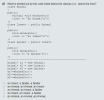 47 What is printed out by the code listed below the classes (i.e., below the line)? class Animal public virtual void whoAreYou () cout << "an Animal\n";h class Insect public Animal public void whoAreYou() cout < "an Insect\n"; class Spider public Insect public void whoAreYou() cout << "a Spider\n"; Animal* a1-new Animal; Animal* a2 = new insect ; Animal* a3 = new spider; al->whoAreYou ); a2->whoAreYou ); ??->whoAreYou ( ) ; an Insect, a Spider, a Spider O an Animal,...
Convert the below code into if else selection: #include <iostream> using namespace std; int main() {...
 Convert the below code into if else selection: #include <iostream> using namespace std; int main() { int num; sin. >> num; switch (num) { case 1: cout << "Casel: Value is: << num << endl; break; case 2: break; case 3: cout << "Case3: Value is: " << num << endl; break; default: cout << "Default: Value is: << num << endl; break; } return; }
C++ Please complete the implementation of the following source code (Question3.cpp). You need to add your...
C++ Please complete the implementation of the following source code (Question3.cpp). You need to add your code in the source code where the comment “// your code” locates. After you finish the implementation, please also provide the output of your program. #include <iostream> using namespace std; class Shape { protected: // your code public: void setWidth (int w) { // your code } void setHeight (int h) { // your code } }; class Rectangle: public Shape { public: int...
 2. What is the value of x alter the following code is executed # include<iostream> using namespace std; int main int t-0, c- 0,x-3; while (c < 4) t=t+x; cout << x return 0; a) 3 b) 21 c) 24 d) 48 3. What is the output of the following code? # include<iostream> using namespace std; int main0 int a- 3; for (int i 5; i >0; i) a a+i cout << a << “ “ return 0; d) 8...
 UUS TOP Question 17: What is the output of the code presented below? int y = 5; int x 7; intx yPtr = &x; *yPtr = 8 + 4 * 6/2 + ( 5 cout<oxyPtr; *yPtr = *yPtr + *yPtr / 2; cout<<xyPtr; 2 ); Question 18: The following is true about the code below. Tine Time: 1 SetMinute(unsigned int ninutes) this.minutes - minutes; return this; Question 19: What is the output of the code presented below? include <iostream using...
 47 What is printed out by the code listed below the classes (i.e., below the line)? class Animal public virtual void whoAreYou () cout << "an Animal\n";h class Insect public Animal public void whoAreYou() cout < "an Insect\n"; class Spider public Insect public void whoAreYou() cout << "a Spider\n"; Animal* a1-new Animal; Animal* a2 = new insect ; Animal* a3 = new spider; al->whoAreYou ); a2->whoAreYou ); ??->whoAreYou ( ) ; an Insect, a Spider, a Spider O an Animal,...
 Convert the below code into if else selection: #include <iostream> using namespace std; int main() { int num; sin. >> num; switch (num) { case 1: cout << "Casel: Value is: << num << endl; break; case 2: break; case 3: cout << "Case3: Value is: " << num << endl; break; default: cout << "Default: Value is: << num << endl; break; } return; }
Most questions answered within 3 hours.
-
Where is the error in this code sequence?
String s1 = "Hello";
String s2 = "ello";...
asked 10 months ago -
Financial data for Joel de Paris, Inc., for last year
follow:
Joel de Paris, Inc.
Balance...
asked 10 months ago -
Consider this reaction:
Al2(SO4)3 (aq)+ BaCl3
(aq) Al2Cl6 (aq)- +
3BaSO4(s) . What is the...
asked 10 months ago -
Suppose that Savneet is considering increasing her
recent random sample from 20 car rentals to 40...
asked 10 months ago -
Trucks arrive at an unloading terminal at an average rate of 120
per hour.
Trucks arrive...
asked 10 months ago -
Why are methanol and ethanol completely soluble in water while
octanol is not very little soluble....
asked 10 months ago -
A facilities manager at a university reads in a research report
that the mean amount of...
asked 10 months ago -
When the CuSO4 is rehydrated by adding water to the anhydrous
compound, is this an endothermic...
asked 10 months ago -
A ray of sunlight is passing from diamond into crown glass; the
angle of incidence is...
asked 10 months ago -
A block of mass 0.249 kg is placed on top of a light, vertical
spring of...
asked 10 months ago -
how do the kidneys compensate in the presences of acidosis
a) trigger hyperventilate
b) reserve acid...
asked 10 months ago -
Question 501 pts
The rental rate of capital to the firm increases. Which of the
following...
asked 10 months ago